Specialist Building & Property Maintenance Services You Can Depend On.


- Home
- About
- Building Services
- Property Maintenance
- Structural Services
- Damp Services
- Fire Safety
- Emergency Repairs
- Trades
- Contact
Penetrating Damp Investigation & Repairs in Flintshire
Penetrating Damp Flintshire
Flintshire sits in one of the wetter corridors of North Wales. The county’s western and south-western exposures face prevailing Atlantic weather patterns, and annual rainfall across the area — particularly at elevation above Mold, through the Halkyn Mountain range, and across the coastal strip from Flint to Greenfield — creates persistent moisture pressure on property envelopes throughout the autumn and winter months.
The county’s housing stock is diverse. Victorian and Edwardian terraced and semi-detached properties dominate the Deeside towns of Connah’s Quay, Shotton, and Flint. Mid-century housing across Buckley, Mynydd Isa, and Queensferry introduces different construction considerations. Older rural properties in the villages around Mold, Northop, and the Halkyn range often feature solid stone or rubble-built construction with lime mortar, requiring a particularly careful diagnostic approach.
At Quirks Property Maintenance, we carry out penetrating damp investigations and remedial works across Flintshire. Our surveys are completed by FOD Certified Surveyors (FODCS) — verified members of the Federation of Damp, with our listing independently confirmed on the FOD specialist directory. For Deeside properties specifically, see our Deeside damp survey service. For broader local damp proofing services, see our Flintshire damp proofing specialists page.
What Is Penetrating Damp?
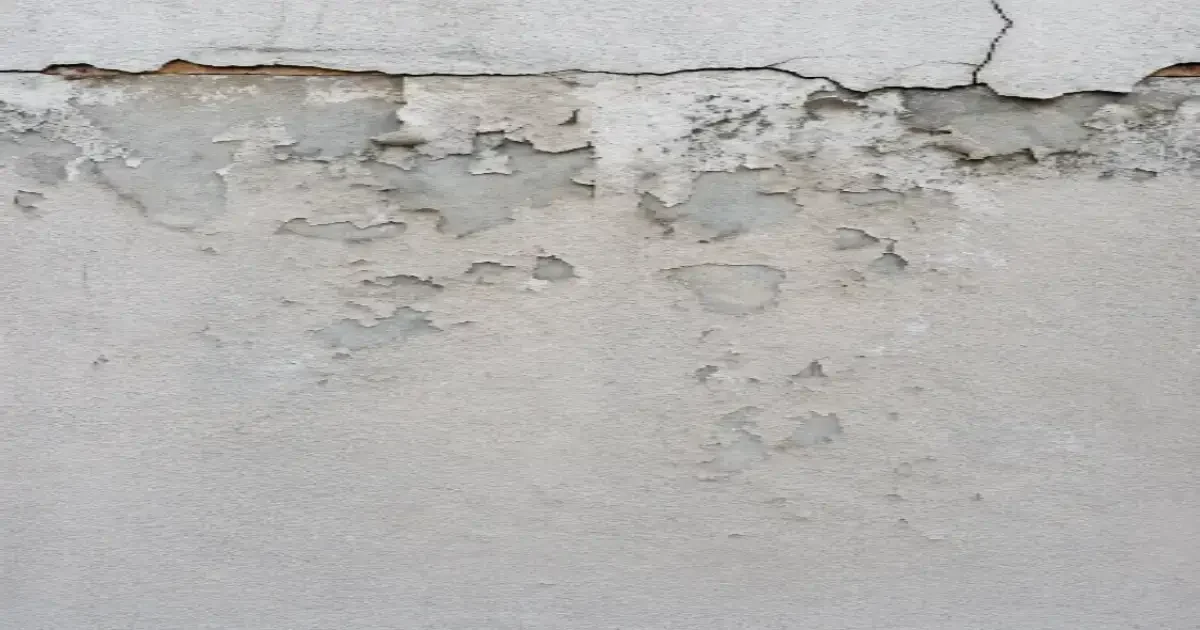
Penetrating damp occurs when water enters the building fabric through a defect in the external envelope — driven laterally through walls, around window and door frames, through rooflines and chimney stacks, or via defective guttering that allows sustained wall saturation. In Flintshire, penetrating damp is often most noticeable after the sustained wet periods typical between October and March.
- Common signs in Flintshire properties include:
• Damp patches appearing or worsening after rainfall — particularly on west or south-west facing elevations
• Staining or tide marks on upper walls or ceilings
• Moisture around chimney breasts where stacks have deteriorated pointing or failing flashings
• Damp patches around window or door reveals, particularly on properties with original timber frames
• Musty odours in rooms on exposed elevations
• Bubbling, stained or peeling internal decoration, or plaster that feels soft or hollow
Unlike condensation damp in Flintshire, penetrating damp typically does not present with widespread black mould growth. Untreated penetrating damp can lead to timber decay and — where moisture reaches structural timbers — wet rot or in persistent cases dry rot. Repeated saturation and drying cycles can also contribute to structural cracking in masonry.
Common Causes We Investigate Across Flintshire
- • Failed or eroded pointing — particularly on solid brick Victorian and Edwardian properties in the Deeside towns
• Defective or lifting lead flashings at chimney stacks and roof abutments — addressed via our Flintshire chimney works service - • Blocked, damaged or overflowing guttering — Flintshire — particularly on older cast-iron systems
• Cracked or detached render on solid-wall properties or gable ends
• Defective window and door frame seals, particularly on properties with original timber frames
• Stone or rubble-wall porosity combined with failed render on rural Flintshire properties
• Bay window junction failures — Flintshire — common on Edwardian semis where the bay roof meets the main wall
• Flat or low-pitch roof sections on extensions are common across mid-century Flintshire properties
How Quirks Resolves Penetrating Damp in Flintshire
Our approach is investigation-led throughout. We identify the specific cause before any remedial work is recommended. Our Flintshire damp surveys are carried out by FOD Certified Surveyors using calibrated moisture meters and thermal imaging where required. For Deeside properties, our Deeside damp survey service provides area-specific expertise. Quirks Property Maintenance is a verified member of the Federation of Damp — view our listing on the FOD specialist directory.
- Depending on survey findings, remedial works may include:
• Repointing using a mortar specification compatible with the existing wall construction
• Roof repairs and flashing replacement
• Emergency gutter repairs — Flintshire
• Render repairs, patching, or full render replacement where appropriate
• Chimney works — Flintshire including flashing replacement, stack repointing, and pot repairs
• Bay window repairs — Flintshire — bay roof lead replacement and junction resealing
• Dry rot treatment — Flintshire — for affected structural timbers where damp has caused fungal decay
• Structural repairs — Flintshire — where damp and structural movement combine
• Leak detection where a plumbing or drainage source cannot be ruled out
Understanding Damp & Moisture Paths
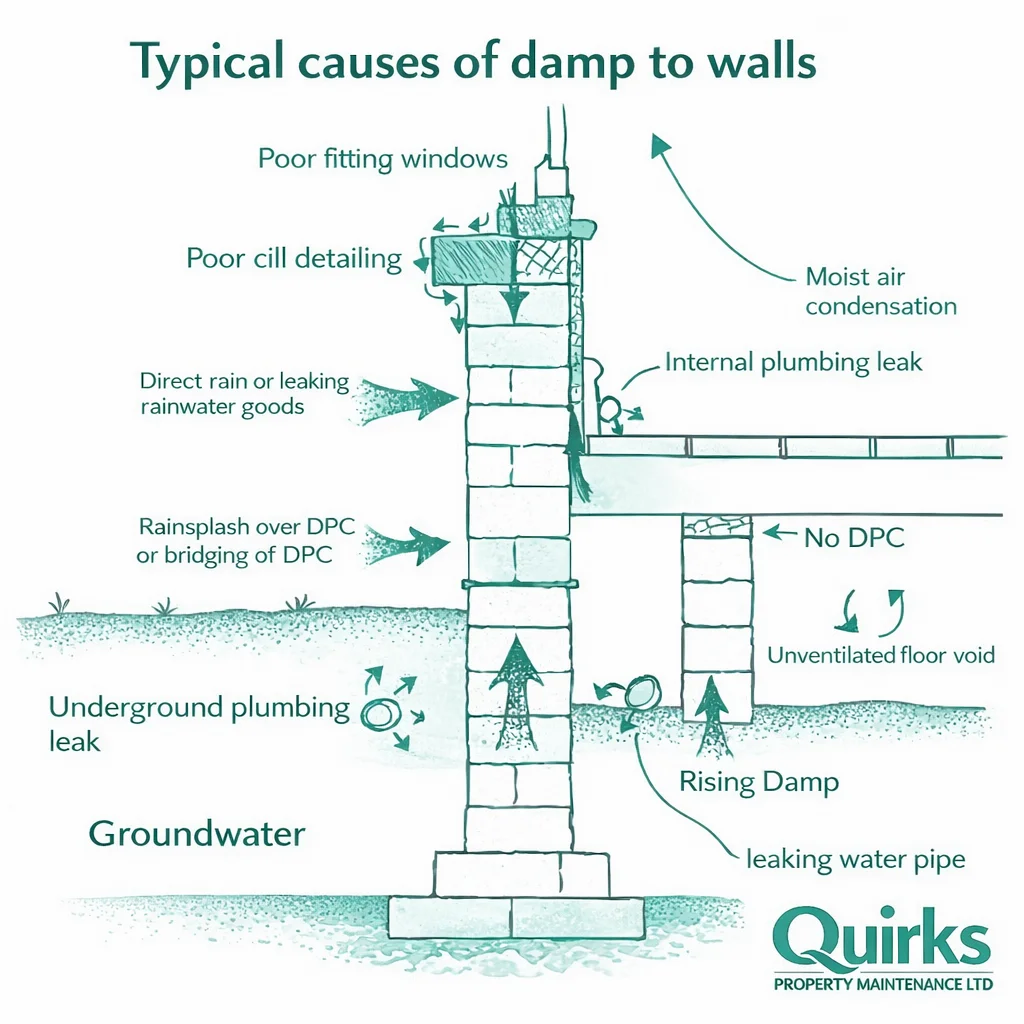
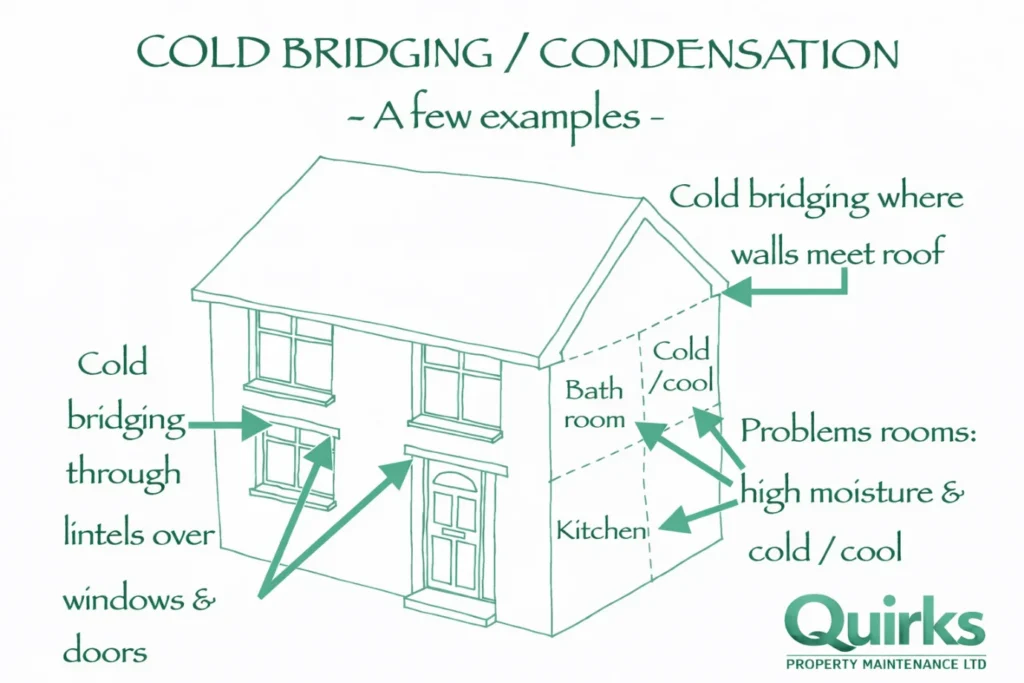
This is particularly important for properties across Flintshire.
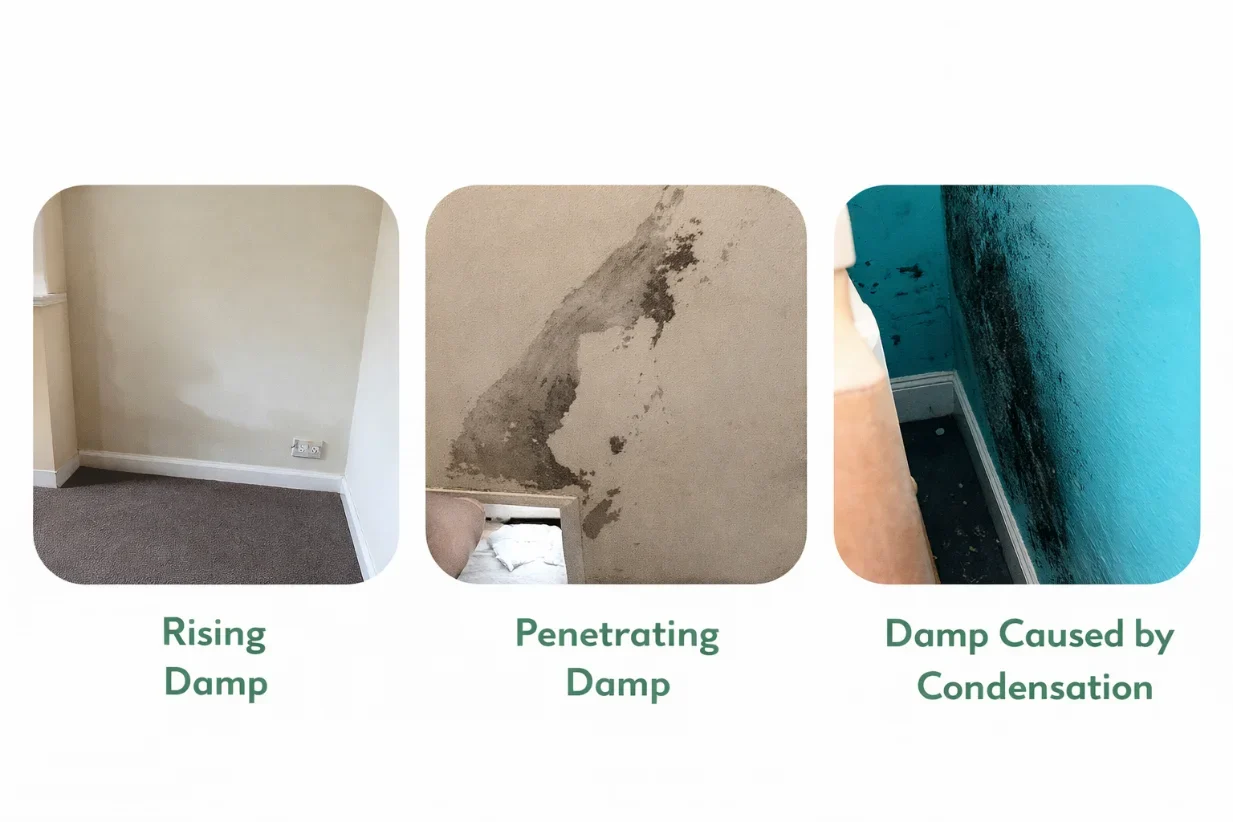
Penetrating Damp vs Rising Damp vs Condensation in Flintshire
Penetrating Damp
Enters through external defects in the building envelope. Can appear at any height. Worsens during or after rainfall. Does not usually cause black mould. Particularly common in Flintshire due to the county’s exposure and high proportion of older solid-wall construction.
Rising Damp
Travels upward from the ground through capillary action when the DPC has failed or is absent. Confined to the lower sections of ground floor walls only — typically up to around one metre. Our Flintshire damp proofing service covers DPC installation and rising damp remedial works.
Condensation Damp
Forms internally due to temperature differences and poor ventilation. Most common in bedrooms, bathrooms and kitchens. Typically associated with widespread black mould. Does not worsen specifically during rainfall. Our condensation damp service in Flintshire covers diagnosis and ventilation improvements.
Why Flintshire Properties Are Particularly Susceptible
Exposure to Driving Rain
Properties on the Deeside coastal plain — from Flint southward through Bagillt, Greenfield, and toward Connah’s Quay — face sustained westerly wind-driven rain across relatively flat, open terrain. Properties on higher ground through Buckley, Mynydd Isa, and Halkyn experience both higher rainfall totals and greater wind exposure, with exposed masonry on western and south-western elevations bearing the brunt.
Solid-Wall Construction in Older Flintshire Properties
The Victorian and Edwardian terraces that characterise Flint, Connah’s Quay, Shotton, and parts of Mold were built with solid brick walls and lime mortar pointing — construction that predates the cavity wall design. These walls have no air gap to interrupt the moisture path. When pointing degrades or brickwork becomes porous, water can penetrate through to the internal face directly. Repointing with a compatible lime mortar mix is typically the correct remedy.
Rural and Stone-Built Properties
The villages around Mold, Northop, Halkyn, Rhosesmor, and the surrounding countryside feature a significant number of older stone-built properties — some constructed with rubble-fill cores and lime render. Stone is naturally porous in many forms, and render failures on rubble-built walls can allow water to enter the wall core and track to the internal face.
Chimney Stacks Across Flintshire
A high proportion of Flintshire’s pre-1960s housing retains chimney stacks, many of which have not been actively maintained since solid fuel heating was replaced. Deteriorated pointing, failed lead flashings, cracked stacks, and open or poorly capped flues are all common causes. Our dedicated Flintshire chimney works service covers investigation and remedial works, and our chimney damp service addresses internal chimney breast moisture specifically.
Bay Window Junction Failures
Bay windows on Edwardian semis throughout Flintshire are a common penetrating damp entry point where the bay roof meets the main wall. Our dedicated bay window repair service in Flintshire covers junction lead replacement and structural re-tying.
Flintshire's Building Heritage and Why It Matters
Flintshire has a rich industrial and agricultural heritage that is directly reflected in its property stock. The Deeside corridor — Connah’s Quay, Shotton, Queensferry, Sandycroft — grew rapidly during the late Victorian and Edwardian periods alongside steel, paper, and manufacturing industries, producing dense rows of terraced workers’ housing that remain the dominant residential fabric today.
Further inland, Mold developed as the county town with a mix of Georgian, Victorian and Edwardian civic and residential buildings. The surrounding villages — Northop, Halkyn, Rhosesmor, Caerwys, Treuddyn — contain older farmhouses and rural properties constructed from local sandstone and limestone with lime render finishes.
Properties built in different eras with different materials require different approaches to damp investigation and treatment. Our surveyors are experienced across the full range of construction types present in Flintshire, and we select remedial specifications compatible with the specific building fabric being treated.
🔗 Related Services in Flintshire
- Damp Surveys — Flintshire
- Damp Surveys — Deeside
- Flintshire Damp Proofing Specialists
- Damp Proofing — Flintshire
- Condensation Damp — Flintshire
- Chimney Damp
- Chimney Works — Flintshire
- Bay Window Repairs — Flintshire
- Repointing & Brick Pointing
- Roofing Services
- Emergency Gutter Repairs — Flintshire
- Dry Rot Treatment — Flintshire
- Wet Rot Treatment
- Structural & Concrete Repairs — Flintshire
- Pre-Purchase Survey
- Leak Detection
Penetrating Damp Services In Chester
Penetrating Damp Services In Wirral
Case Studies — Penetrating Damp in Flintshire
Victorian Terrace, Connah’s Quay — Gutter Overflow and Porous Brickwork
A homeowner in Connah’s Quay reported persistent damp to the front bedroom wall, always worse during wet weather. Two attempts at redecorating had failed to resolve the problem. Our survey identified two contributing factors: a cast-iron gutter joint had failed and was overflowing onto the wall below during moderate rainfall, and the front elevation brickwork had become significantly porous with eroded mortar joints across a large section of the first floor. Remedial works included replacement of the cast-iron gutter section with new uPVC guttering and repointing of the affected front elevation using lime-rich mortar. No moisture issues have been reported since.
Stone Cottage, Near Halkyn — Failed Render and Chimney Ingress
A rural property near Halkyn had suffered from damp patches to two ground floor rooms over several years. A previous contractor had advised rising damp as the cause. Our survey found no evidence of a rising damp pattern. Moisture mapping identified render that had partially detached from the rubble-built external wall, allowing water to enter the wall core. The chimney stack was also found to have significant pointing failure. Remedial works involved full re-render of the affected elevation in breathable lime render, and chimney stack repointing via our Flintshire chimney works service with a new flue cap fitted. The misdiagnosis of rising damp, had it been acted upon, would have been both expensive and entirely ineffective.
- 🏠 Buying a Property in Flintshire? What to Check
Our pre-purchase damp assessment service provides an independent specialist report that tells you exactly what type of damp is present, why, and what remediation is genuinely required — useful for price negotiations before exchange.
When viewing Flintshire properties, pay particular attention to:
- The condition of pointing on all elevations — check for crumbling, absent, or recessed mortar
- Guttering — look for plant growth, overflow staining on walls, or sections pulling away from the fascia
- Chimney stacks — cracked or leaning stacks, absent pots, poor flashings
- Render condition — tap gently for hollow sections, look for cracks or areas of detachment
- Internal walls on exposed elevations — particularly upper floor rooms on west and south-west facing walls
- Fresh decoration in rooms facing prevailing weather — sometimes used to conceal known damp problems
Frequently Asked Questions
Is penetrating damp more common in Flintshire than in other areas?
Flintshire’s combination of relatively high annual rainfall, prevalent westerly wind-driven rain, and a large stock of older solid-wall construction makes penetrating damp a particularly common issue. Well-maintained properties with sound pointing, guttering, and rooflines resist moisture effectively — but regular external maintenance is more important here than in sheltered or lower-rainfall areas.
My house has had new double glazing fitted but I still get penetrating damp — why?
New UPVC windows solve frame-related water ingress, but they are only one possible source among many. If your penetrating damp is caused by eroded pointing, failed guttering, a defective chimney, or cracked render, replacing windows will have no effect on those moisture paths. Investigation to identify the specific source is essential before any remediation is undertaken.
How do I tell if I have condensation rather than penetrating damp in my Flintshire property?
Condensation is typically associated with widespread black mould — particularly in bedrooms, bathrooms, and kitchens — and does not worsen specifically with rainfall. Our condensation damp service in Flintshire covers diagnosis and ventilation improvements for condensation-related issues separately.
How do you tell if damp is penetrating or rising in a Flintshire terrace?
Rising damp affects the lower sections of ground floor walls only — typically up to around one metre — and often shows as a horizontal tide mark with associated salt crystallisation on the plaster. Penetrating damp can appear at any height and worsens clearly after rainfall. Our Flintshire damp survey service uses calibrated equipment to distinguish them accurately.
Do you cover all of Flintshire including rural areas?
Yes — we cover the full county including Mold, Buckley, Flint, Connah’s Quay, Shotton, Hawarden, Ewloe, Queensferry, Holywell, Northop, Mynydd Isa, Saltney, Sealand, Sandycroft, Bagillt, Greenfield, Halkyn, Rhosesmor, and surrounding villages, as well as cross-border areas into Chester and Cheshire and Wirral.
Will breathable masonry treatments fix my penetrating damp?
Breathable water repellent treatments can reduce moisture absorption, but they are an additional measure — not a substitute for addressing the underlying defect. The defect must be corrected first; a repellent treatment can then provide supplementary protection to porous masonry where appropriate.
Get a Penetrating Damp Survey in Flintshire
If you have damp patches, staining, or moisture problems at your Flintshire property — whether in a Deeside terrace, a Mold townhouse, or a rural stone cottage — contact Quirks Property Maintenance Ltd for an honest professional assessment.
Send Photos via WhatsApp for a quick assessment.
Quirks Property Maintenance Ltd — FOD-verified penetrating damp investigation and repair specialists serving Flintshire, Deeside, and surrounding North Wales.
Independently Verified
Quirks Property Maintenance Ltd is a verified member of the Federation of Damp (FOD) — the UK’s specialist damp industry body. Our listing on the FOD specialist directory can be viewed and confirmed independently. All damp surveys are carried out by FOD Certified Surveyors (FODCS) in line with the FOD survey standard.
