Specialist Building & Property Maintenance Services You Can Depend On.


- Home
- About
- Building Services
- Property Maintenance
- Structural Services
- Damp Services
- Fire Safety
- Emergency Repairs
- Trades
- Contact
Penetrating Damp Investigation & Repairs in Chester
Penetrating Damp Chester
Chester’s housing stock is among the most architecturally varied in the North West. From Victorian terraces in Hoole and Blacon to Georgian townhouses in the city centre, Edwardian semis across Upton and Boughton, and older sandstone properties throughout the surrounding Cheshire villages — the area presents a wide range of penetrating damp challenges that require local knowledge and experience to diagnose correctly.
Unlike newer cavity-wall construction, many Chester properties were built with solid masonry walls or lime-based mortars that can degrade over time. When pointing fails, render cracks, or flashings lift, rainwater has a direct path through the wall fabric. Chester also sits in an area of moderate to high annual rainfall, and exposed western or south-western elevations can be particularly vulnerable to driving rain during autumn and winter months.
At Quirks Property Maintenance, we investigate and carry out remedial works on penetrating damp across Chester and the surrounding Cheshire area. Our surveys are completed by FOD Certified Surveyors (FODCS) — verified members of the Federation of Damp, with our listing independently confirmed on the FOD specialist directory. For a broader overview of local damp services in Chester, see our Chester damp proofing specialists page
What Is Penetrating Damp?
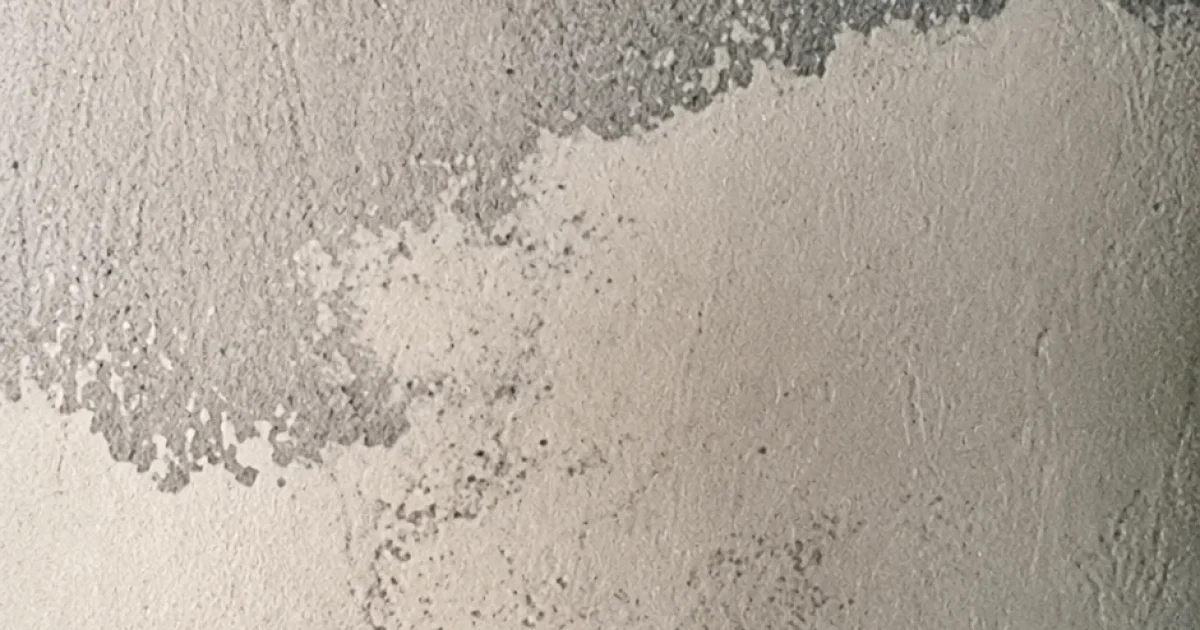
Penetrating damp occurs when water enters the building fabric through a defect in the external structure, rather than rising from the ground or forming through condensation. It is driven laterally — through walls, around window and door frames, via rooflines and parapets, or through defective chimney stacks.
It is often most noticeable after periods of heavy rainfall, when damp patches or tide marks appear on internal walls or ceilings. On some Chester properties — particularly those with older solid brick or sandstone construction — moisture can travel a surprising distance through the wall before becoming visible internally, which can make the entry point harder to identify without proper investigation.
Common symptoms in Chester properties include:
- • Damp patches appearing or worsening after rainfall
• Staining or tide marks on upper walls or ceilings
• Damp patches around chimney breasts — often linked to defective flashing or porous stacks
• Water ingress around the window or door reveals
• Musty odours in rooms on exposed elevations
• Bubbling, peeling or stained internal plaster or decoration
• Patches that do not rise from floor level — distinguishing them from rising damp
Unlike condensation damp in Chester, penetrating damp typically does not present with widespread black mould growth. However, if left untreated, it can lead to timber decay, plaster deterioration, increased heat loss through saturated wall fabric, and in longer-term cases, structural damage.
🔍 Common Causes of Penetrating Damp in Chester
Failed or Eroded Pointing
Particularly common in pre-1919 solid brick properties across Hoole, Newton, and Boughton. Over time, the mortar between bricks weathers, becomes porous, or drops out entirely. Water can then travel directly through the mortar joints into the wall. Our repointing service in Chester addresses this directly using mortar specifications compatible with the original wall construction.
Defective or Missing Flashings
Lead flashings around chimneys, dormers, and roof abutments seal vulnerable junctions against water ingress. On older Chester properties, flashings can lift, crack, or corrode over many decades. Our chimney damp service in Chester covers chimney-related water ingress specifically, and general roof flashing repairs are handled through our roofing services.
Blocked or Defective Guttering and Downpipes
Blocked guttering is one of the most common causes of penetrating damp we encounter. When rainwater overflows at the gutter joint, it saturates the wall below. Gutter repairs and replacement are a frequently overlooked but highly effective remedy. Related issues with fascias and soffits are covered through our fascias, soffits and guttering service.
Bay Window Junction Failures
The junction between the bay window roof and the main wall is a classic water entry point on Edwardian properties across Chester’s suburbs. Our dedicated bay window repair service in Chester specifically covers junction lead replacement and resealing.
Cracked or Spalled Masonry
Frost damage, weathering, and impact can cause brickwork to spall or crack. Once the face of a brick breaks away, the exposed interior absorbs rainfall far more readily. Our brickwork and masonry service in Chester covers the repair and replacement of affected sections.
Chimney Damp
Chimney stacks on period Chester properties are a frequent source of penetrating damp, often resulting in damp patches to the chimney breast walls internally. Causes include deteriorated flashings, porous brickwork on the stack, failed chimney pots, and missing chimney caps on unused flues. Our dedicated chimney damp service in Chester covers investigation and remedial works specific to chimney-related moisture.
🔧 How Quirks Resolves Penetrating Damp in Chester
-
Effective penetrating damp treatment starts with finding the exact source — not guessing, not applying a blanket waterproof coating and hoping for the best. Our approach is investigation-led throughout.
Step 1 — Damp Survey and Investigation
We carry out a thorough damp survey using calibrated moisture meters and thermal imaging where required. We inspect both internally and externally, mapping moisture readings against the property’s construction and the likely water paths. This gives us a clear picture of where water is entering and why — before any remedial recommendation is made. Quirks Property Maintenance is a verified member of the Federation of Damp — you can confirm our listing independently on the FOD specialist directory.
Step 2 — Clear Written Report
Following the survey, we provide a clear report explaining the findings, the likely cause, and a specific scope of remedial works. We do not recommend work that is not necessary. If the issue is straightforward — blocked guttering, for example — we will tell you that directly.
Step 3 — Targeted Remedial Works
Remedial works are carried out to directly address the identified defect. Depending on the survey findings for your Chester property, this may include:
- Repointing in Chester of deteriorated mortar joints using a compatible mortar specification
- Brickwork and masonry repairs in Chester — brick repair and replacement of spalled masonry
- Roof and flashing repairs
- Gutter repairs or replacement
- Bay window repairs in Chester — lead replacement and junction resealing
- Chimney damp investigation and repair in Chester
- Leak detection where a plumbing or drainage source cannot be ruled out
Understanding Damp & Moisture Paths
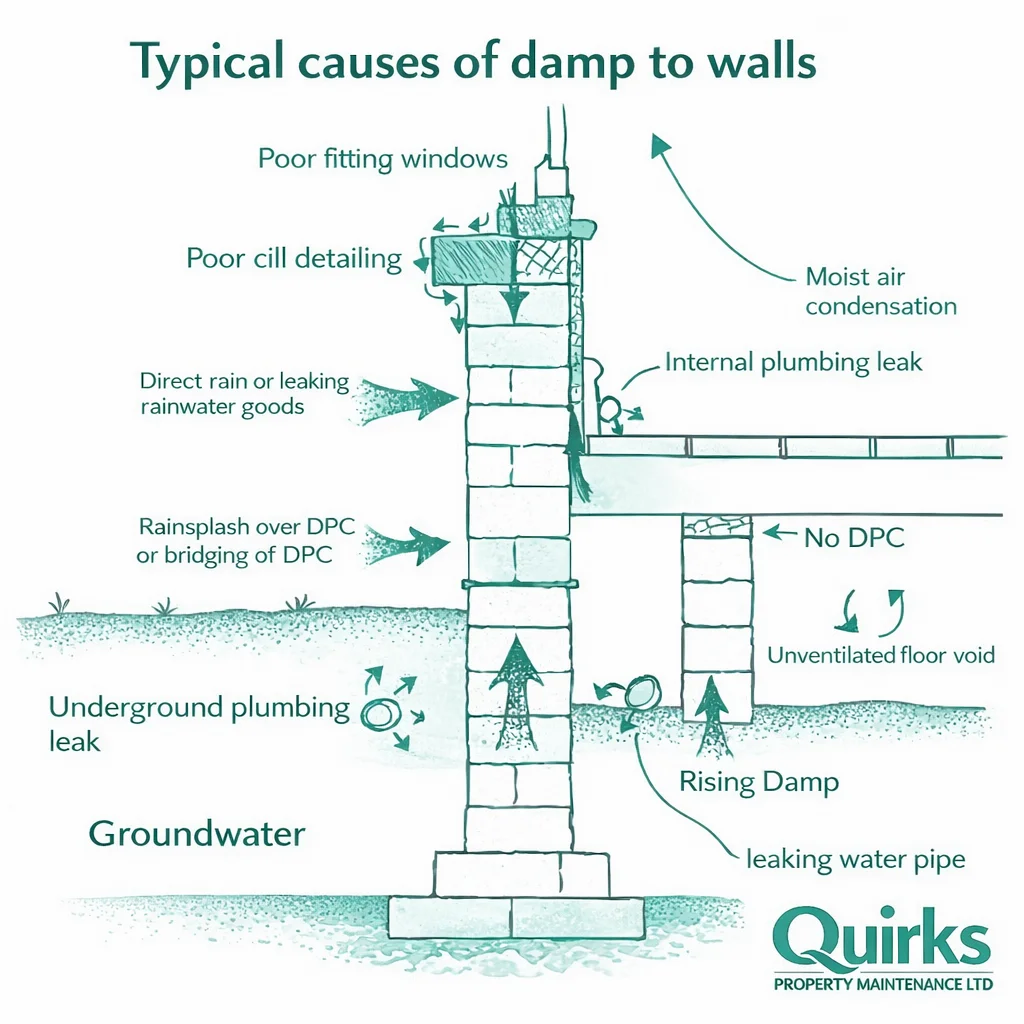
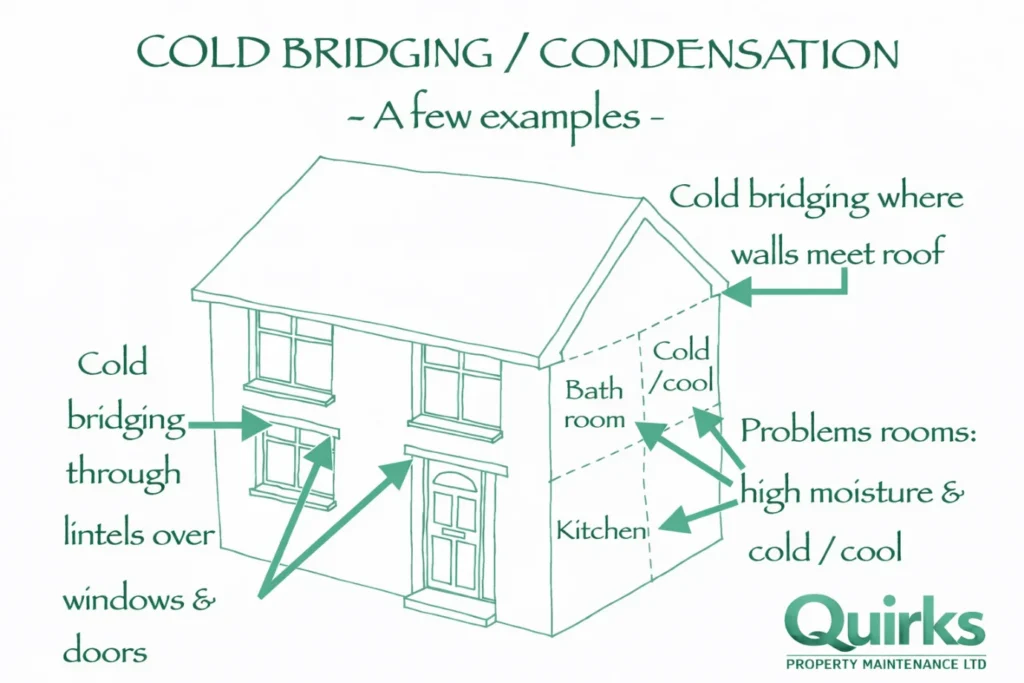
This is particularly important for properties across Chester.
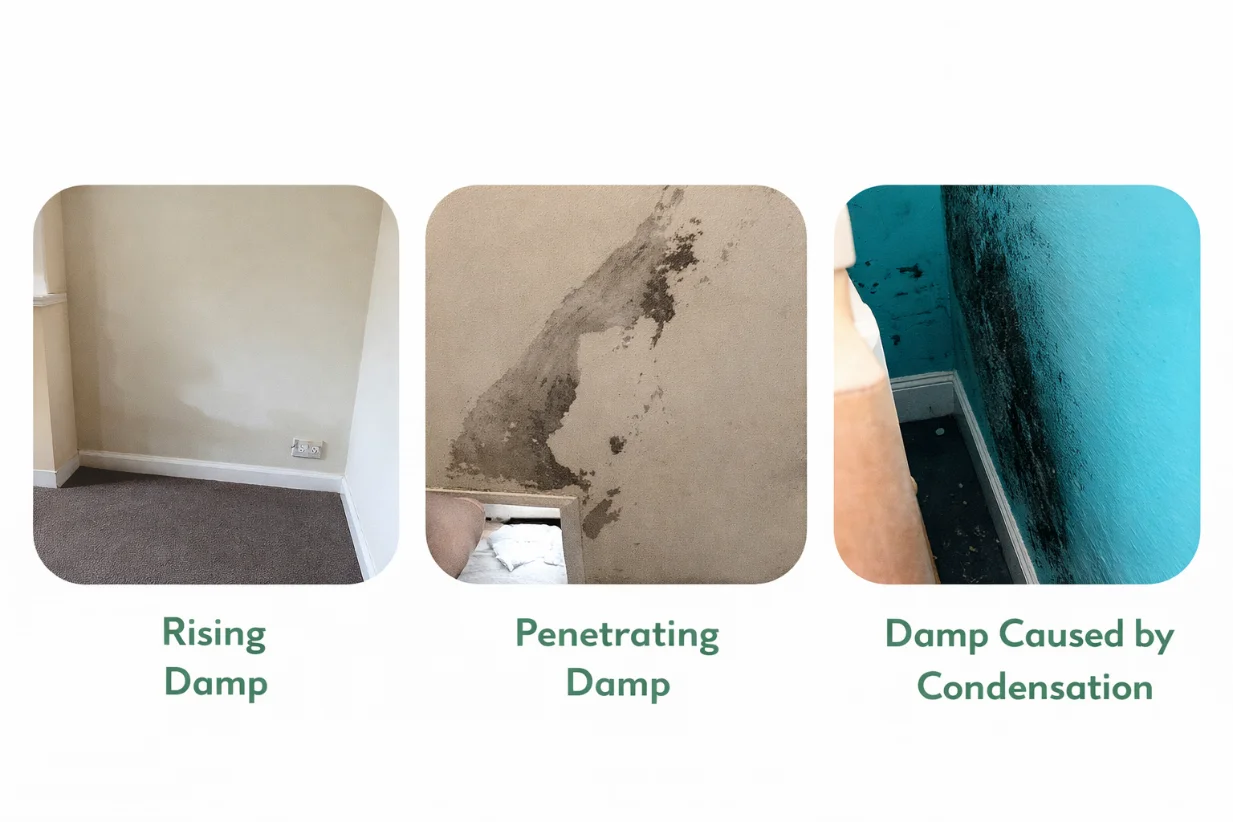
Penetrating Damp vs Rising Damp vs Condensation in Chester
Penetrating Damp
Enters through external defects — can appear at any height — worsens during or after rainfall — does not usually cause black mould. Particularly common in older Chester properties with solid brick walls and deteriorated external maintenance.
Rising Damp
Travels upward from the ground through capillary action when the damp-proof course has failed or is absent. Confined to the lower sections of ground floor walls only, typically up to around one metre. Often shows as a tide mark with associated salt crystallisation. Our Chester damp proofing specialists cover DPC installation and rising damp remedial works.
Condensation Damp
Forms internally when warm moist air meets a cold surface. Most common in bedrooms, bathrooms and poorly ventilated kitchens. Typically associated with widespread black mould. Does not worsen specifically during rainfall. Our condensation damp service in Chester covers diagnosis and ventilation improvements.
If you are unsure which type of damp you have, the safest approach is a professional survey. Misdiagnosis is costly — treating rising damp on a property that actually has a blocked gutter problem achieves nothing and wastes money.
🏘️ Why Chester Properties Are Particularly Susceptible
Chester has one of the highest concentrations of pre-1919 housing in Cheshire West. Much of the city’s residential stock — particularly in Hoole, Newton, Boughton, Garden Lane, and the older parts of Blacon — comprises Victorian and Edwardian terraced and semi-detached properties built with solid brick construction and lime mortar pointing.
Over decades, lime mortar naturally weathers and erodes. In older Chester properties, particularly those on exposed elevations or with north-facing or south-westerly aspects, pointing can become porous or start to crumble — often without being immediately visible at ground level. This is one of the most common causes of penetrating damp we encounter across Chester.
Chester’s famous black-and-white timber-framed buildings and older sandstone properties in the city centre also have their own moisture challenges. Sandstone is naturally porous, and the junction between timber frames and render or infill panels can open up over time, allowing water ingress that can be mistaken for other damp types.
Other local factors that contribute to penetrating damp in Chester properties include:
- • Older clay or cast-iron guttering systems that have become misaligned, corroded, or blocked
- • Chimney stacks on period properties, where lead flashings may have deteriorated over many decades
- • Bay windows on Victorian and Edwardian houses in Chester — where the junction between the bay roof and the main wall is a common point of water entry
- • Flat or low-pitch roofing sections on extensions and outriggers, common on Chester terraced properties
If you are buying a property in Chester and a homebuyer survey has flagged potential damp, our pre-purchase damp survey service can provide an independent assessment before you commit.
🏛️ Chester's Building Heritage and Why It Matters for Damp
Chester is one of the best-preserved Roman, medieval and Georgian cities in England. Much of the city’s residential fabric dates to the Victorian era, when rapid expansion beyond the walls produced the terraced and semi-detached housing that now characterises areas like Hoole, Newton, and parts of Saltney on the Welsh border.
For homeowners in Chester’s older properties, this matters practically: the materials and construction methods used require a damp treatment approach that understands traditional building fabric. Applying inappropriate modern materials — such as rigid cement renders into lime-built walls — can trap moisture and accelerate deterioration rather than solving the problem. Our surveyors are experienced in both traditional and modern construction across Chester and Cheshire.
- 🔗 Related Services in Chester
-
Chester Damp Proofing Specialists
- Condensation Damp — Chester
- Chimney Damp — Chester
- Damp Surveys
- Repointing & Brick Pointing — Chester
- Brickwork & Masonry — Chester
- Bay Window Repairs — Chester
- Roofing Services
- Gutter Repairs
- Fascias, Soffits and Guttering
- Damp Proofing
- Timber Repairs, Wet Rot Treatment, Dry Rot Treatment
- Pre-Purchase Survey
- Structural & Concrete Repairs — Chester
- Penetrating Damp Services In Flintshire
- Penetrating Damp Services In Wirral
Case Studies — Penetrating Damp in Chester
Victorian Terrace, Hoole — Failed Pointing and Chimney Flashing
A homeowner in Hoole contacted us following repeated damp patches on an upper bedroom wall and chimney breast. The patches worsened noticeably during wet weather and had persisted through two attempts at redecoration.
Our survey identified two separate entry points: heavily eroded lime mortar pointing on the front elevation at first floor level, and a failed lead flashing at the chimney stack base. Remedial works included full repointing of the affected elevation using a lime-compatible mortar, and replacement of the chimney flashing with new lead. Following a drying period, the internal walls were replastered and redecorated. No further moisture issues have been reported.
Edwardian Semi, Upton — Blocked Guttering and Bay Window Ingress
A property in Upton presented with damp affecting the main front reception room and the hallway. The homeowner had been advised rising damp was the cause by a previous contractor.
Our survey found no evidence of a failed DPC or rising damp pattern. Moisture mapping identified two separate entry points: a blocked and overflowing gutter joint at first floor level was saturating the wall beneath, and the junction between the bay window roof and the main wall had failed, allowing water entry directly above the window reveal. Works included gutter cleaning and repair, replacement of the bay window lead flashing, and internal plastering reinstatement. The property has remained dry since completion.
- 🏠 Buying a Property in Chester? What to Check
Our pre-purchase damp assessment service provides an independent specialist report that tells you exactly what type of damp is present, why, and what remediation is genuinely required — useful for price negotiations before exchange.
When viewing Chester properties, pay particular attention to:
- Condition of pointing on all elevations — check for crumbling, absent, or recessed mortar
- Guttering — look for plant growth, overflow staining on walls, or sections pulling away from the fascia
- Chimney stacks — cracked or leaning stacks, absent pots, poor flashings
- Bay windows — staining at the bay/wall junction, or soft internal plaster above window reveals
- Internal walls on exposed elevations — particularly upper floor rooms on west and south-west facing walls
Fresh decoration in rooms facing prevailing weather — sometimes used to conceal
Frequently Asked Questions
What are the most common causes of penetrating damp in Chester houses?
In Chester, the most common causes we find are failed or eroded pointing on Victorian and Edwardian solid brick walls, defective lead flashings around chimney stacks, blocked or overflowing guttering, and bay window junction failures on Edwardian semis across Hoole and Upton.
How do I tell if I have penetrating damp or rising damp?
Rising damp affects the lower sections of ground floor walls only — typically up to around one metre — and often shows as a horizontal tide mark with salt crystallisation. Penetrating damp can appear at any height and worsens clearly after rainfall. Our Chester damp proofing specialists carry out a proper survey to diagnose accurately.
How do I tell if I have penetrating damp or condensation in Chester?
Condensation is typically associated with widespread black mould — particularly in bedrooms, bathrooms, and kitchens — and does not worsen specifically with rainfall. Our condensation damp service in Chester covers this separately. If you are unsure which type you have, a professional survey is the safest approach.
Does penetrating damp go away on its own during a dry summer?
No — the underlying defect remains even if symptoms temporarily reduce during dry periods. Ongoing wet-dry cycles often worsen the original defect over time. Frost damage during winter can enlarge cracks and open mortar joints further, making the following wet season worse. The damp will return once autumn rainfall begins.
I've just bought a Chester house and the survey mentioned damp — what should I do?
Book an independent specialist survey before committing to any remediation. Homebuyer surveys flag concerns but rarely provide a precise diagnosis. Our pre-purchase damp survey service provides an accurate assessment of type, cause, and required works.
Which areas of Chester and Cheshire do you cover?
We regularly carry out penetrating damp investigations and remedial works across Chester including Hoole, Upton, Blacon, Boughton, Newton, Christleton, Huntington, Tarvin, Mickle Trafford, Saughall, and Saltney, as well as across Flintshire and Wirral.
Get a Penetrating Damp Survey in Chester
If you have damp patches, staining, or moisture problems at your Chester property, contact Quirks Property Maintenance Ltd for an honest, professional assessment.
Send Photos via WhatsApp for a quick assessment.
Quirks Property Maintenance Ltd — FOD-verified penetrating damp investigation and repair specialists serving Chester, Cheshire West, and surrounding areas.
Independently Verified
Quirks Property Maintenance Ltd is a verified member of the Federation of Damp (FOD) — the UK’s specialist damp industry body. Our listing on the FOD specialist directory can be viewed and confirmed independently. All damp surveys are carried out by FOD Certified Surveyors (FODCS) in line with the FOD survey standard.
