Specialist Building & Property Maintenance Services You Can Depend On.

Structural repairs · Crack stitching · Concrete repair · Lintels

Structural repairs to masonry
and concrete, done properly

Cracked and stepped brickwork stitched with helical bars, spalling concrete cut back to sound material and rebuilt, failed lintels and arches replaced, and the wall or structure made good afterwards — structural repairs across North Wales, Cheshire and Wirral, to an engineer’s specification where one is needed.

Helical bar crack stitching into sound masonry either side
Spalling and corroded concrete cut back and repaired
Rendered, repointed and made good by the same team
 
 
WhatsApp or email gets the quickest reply. We come back to you as soon as we can.
Google5.0★★★★★Based on 150+ Google reviews
Trading since2008
£5 millionpublic liability insurance in place
Workmanship guarantee on completed works
One contractorAll trades under one roof

In short: A crack is a symptom. We repair the masonry or concrete so it is sound again, and where the cause needs investigating we say so before any repair is priced. Send photographs of the crack, from close up and from across the room or street, and we will tell you which it is.

One contractor

One contractor for the repair and the making good

A structural repair rarely ends at the crack. We do what comes after it too.

  • Crack stitching

    Stainless steel helical bars bedded in resin across cracked masonry, run into sound wall either side, so the two halves act as one again.

  • Concrete repair

    Spalled, cracked or corroded concrete cut back to sound material, the reinforcement treated, and the section rebuilt with a repair mortar.

  • Lintels and arches

    Failed steel, concrete and timber lintels replaced, and cracked brick arches rebuilt; see lintel repair and replacement.

  • Making good

    Render, pointing, plaster and decoration-ready finishes after the repair, so the wall looks like a wall again.

What we repair

  • Cracked and stepped brickwork and blockwork, internal and external
  • Cracks through render, including below parapets and copings
  • Spalling concrete to lintels, sills, steps, balconies and canopies where the reinforcement has corroded
  • Cracked and delaminating concrete floors and plinths
  • Failed steel, concrete and timber lintels and cracked brick arches
  • Masonry damaged by impact, vehicle strike or a removed fixing
  • Bowed or bulging walls tied back — see lateral restraint and wall ties

How the repair works

How crack stitching works

Slots are cut into the horizontal mortar joints across the line of the crack, at intervals up its height, and cleaned out. Stainless steel helical bars are bedded into the slots in a resin grout and run well past the crack into sound masonry on both sides, so each bar ties the two halves of the wall together across the fracture. The joints are then pointed up and the wall made good; from the outside there is nothing to see.

It works because the bars take the tension across the crack that the mortar can no longer carry. It does not work if the crack is still moving for a reason nobody has looked at, which is why a wide, stepped or recurring crack is looked at first. Where the cause is not obvious we say so and suggest a structural engineer’s assessment before pricing the repair; where it is, we quote from your photographs.

Concrete repair

Concrete fails from the inside out. Water reaches the steel reinforcement, the steel rusts and expands, and the concrete over it cracks and falls away: the brown-stained, blown patches on a lintel, sill or balcony edge. The repair is to cut the damaged concrete back to sound material, clean and treat the exposed steel, and rebuild the section with a cementitious repair mortar that bonds to the old and protects the steel. Where the reinforcement has lost too much section the engineer specifies how it is replaced.
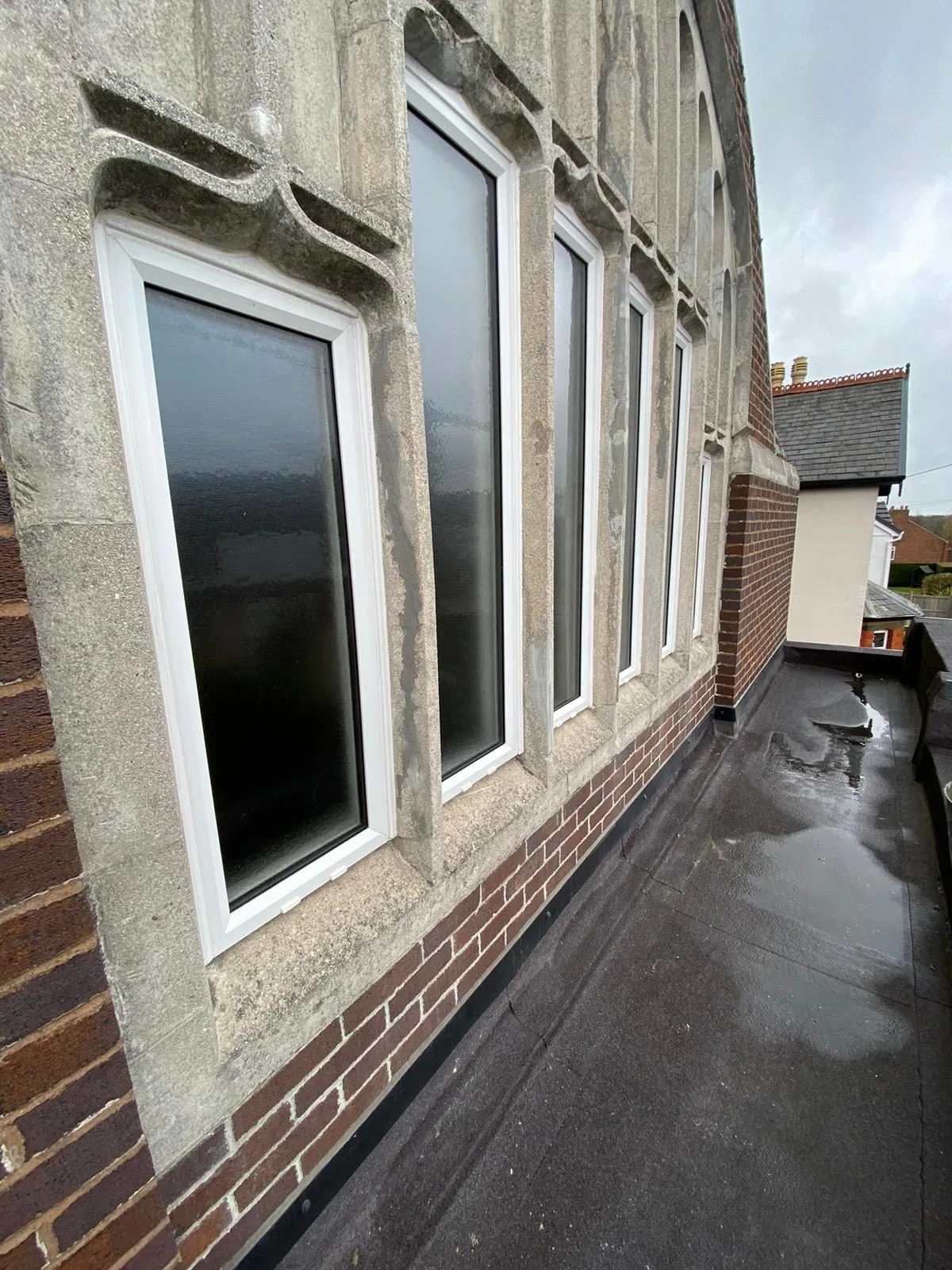
Repaired cast concrete window surrounds on a brick building, seen from the flat roof alongside

Chester — block of flats, rendered elevation

CHESTER — BLOCK OF FLATS, RENDERED ELEVATION

Recent crack stitching project in Chester

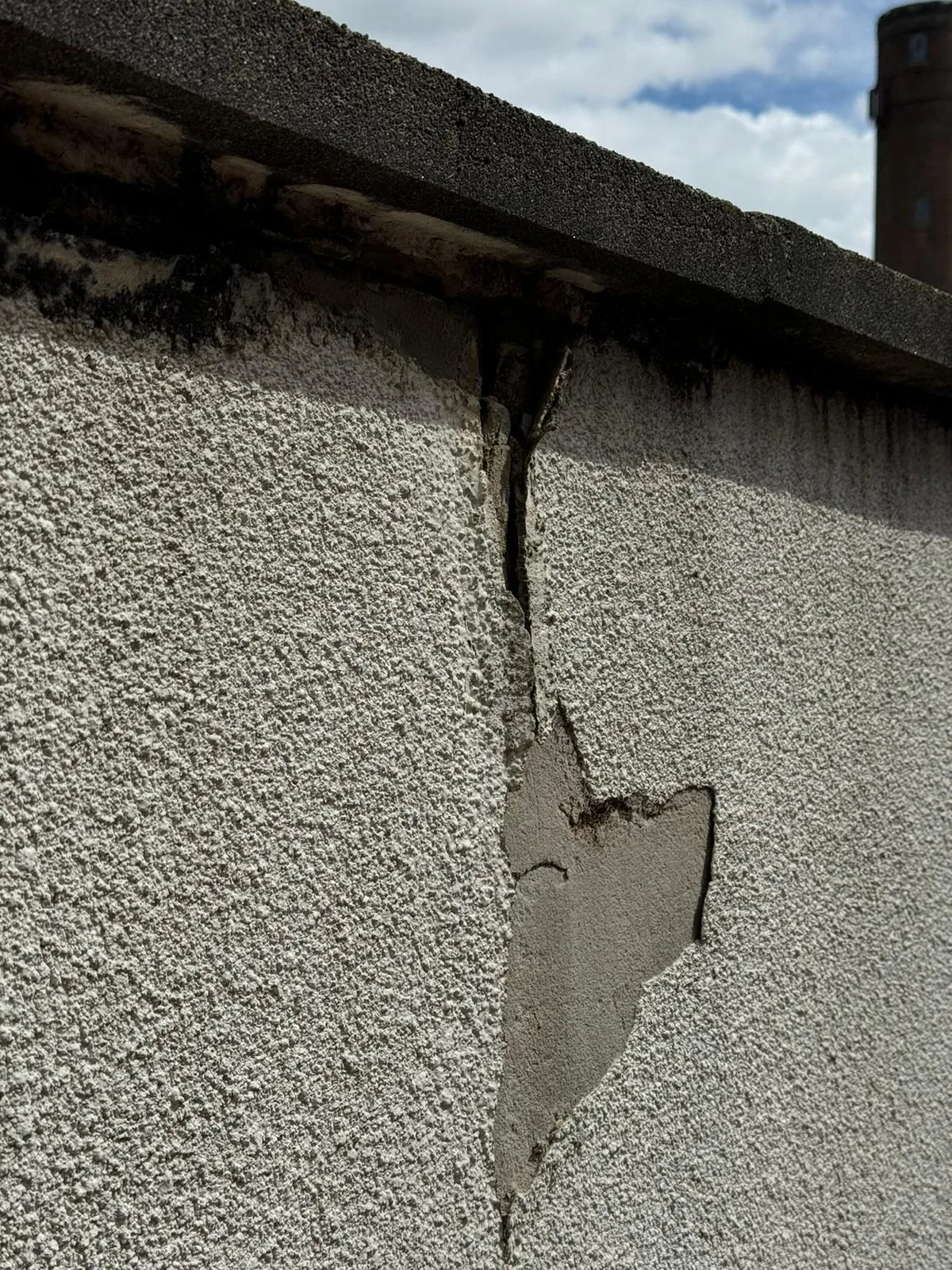
A vertical crack had opened through the render on the side elevation of a two-storey block of flats in Chester, running down from under the concrete coping on the parapet. Around it the render had blown away from the wall behind. The crack was stitched with helical bars, the loose render cut out and the patch re-rendered, from a scaffold on the pavement. The cause of the crack was not investigated as part of this job and is not stated here.

BEFORE

A crack from the coping, and render that had let go

The crack ran straight down from the underside of the parapet coping, where the render meets the top of the wall, and had opened the render along its length. Below it a patch of render had blown and fallen away, leaving the bare wall showing through. That is the point at which a cosmetic crack becomes a weather problem: once the render is off, water gets behind the rest.

Because the crack was at high level on a street elevation, the first job was the scaffold. The block sits on the pavement with parking alongside, so the scaffold was put up with the pavement edge coned and a barrier at the road, and left clear for people to pass.

DURING

Stitching across the crack

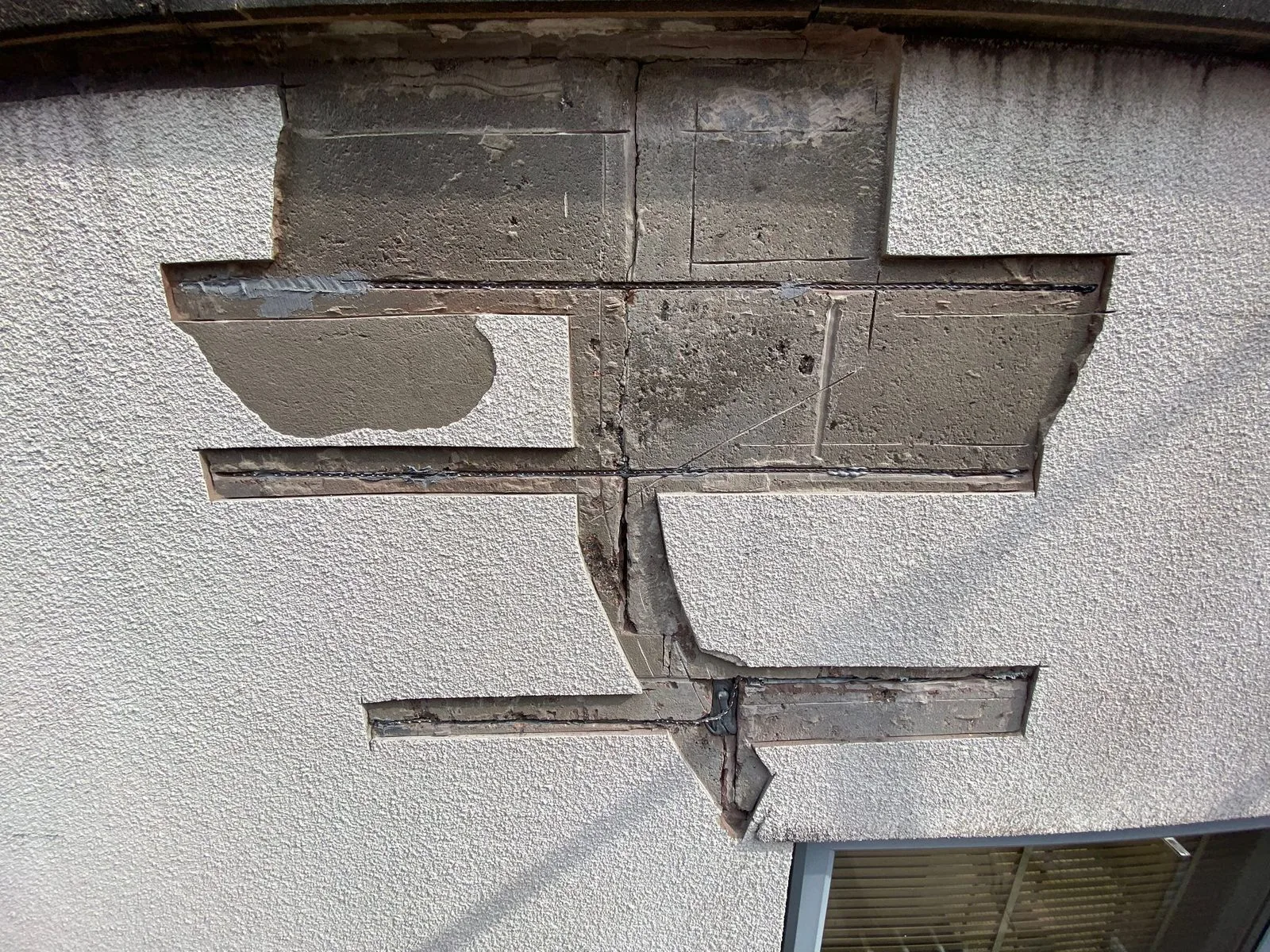
With the scaffold up, the render was cut back in a stepped pattern around the crack, far enough to get to sound render on all sides, and the masonry behind it exposed. Slots were then cut into the horizontal joints across the line of the crack and cleaned out, and stainless steel helical bars bedded into them in resin, run past the crack into sound wall on both sides so each bar ties the two halves together.

The third photograph shows that stage: the render removed in a stepped outline, the bars set in their slots across the crack, and the crack itself still visible between them before the patch was built back up.

AFTER

Re-rendered, ready for decoration

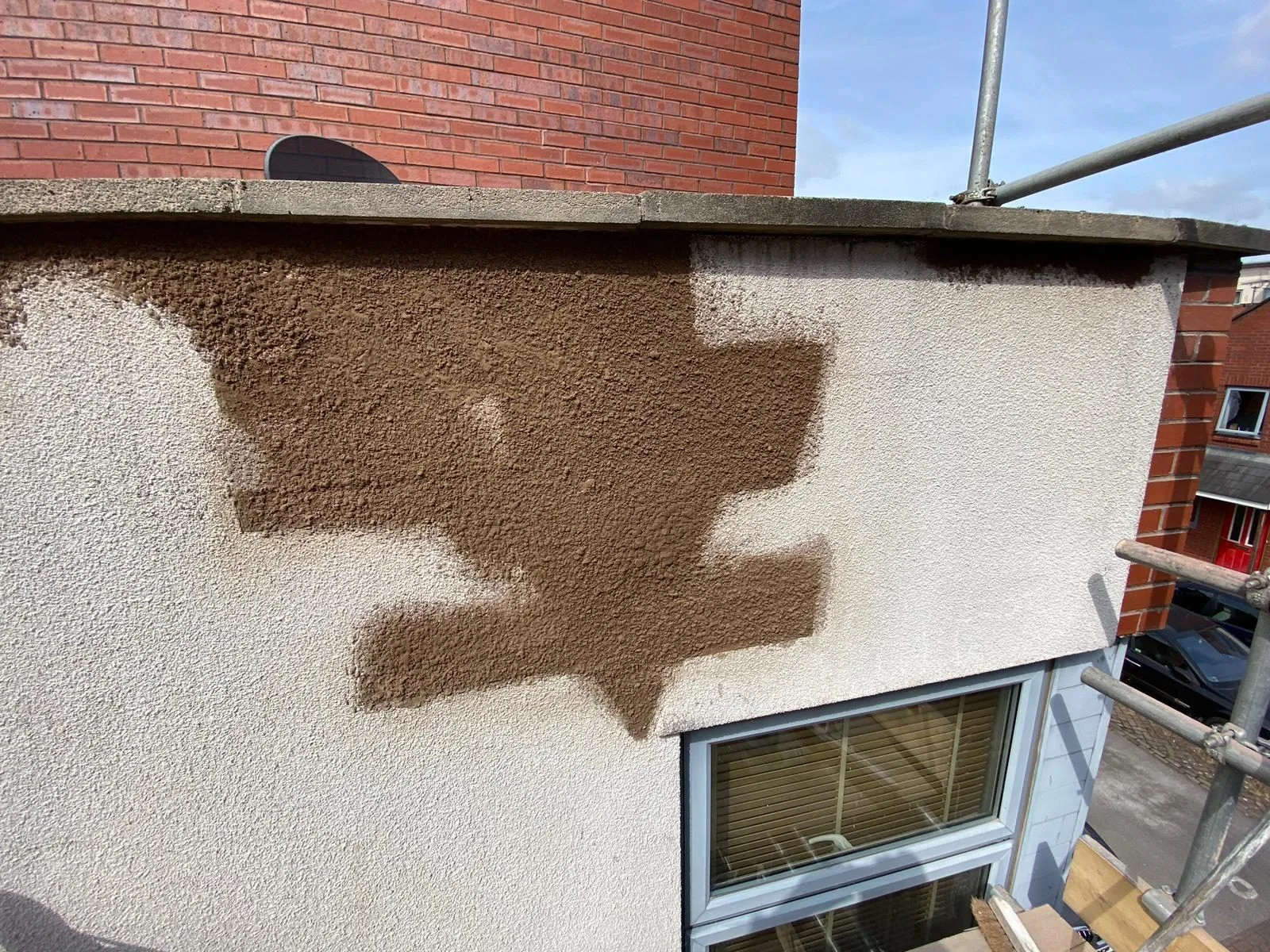
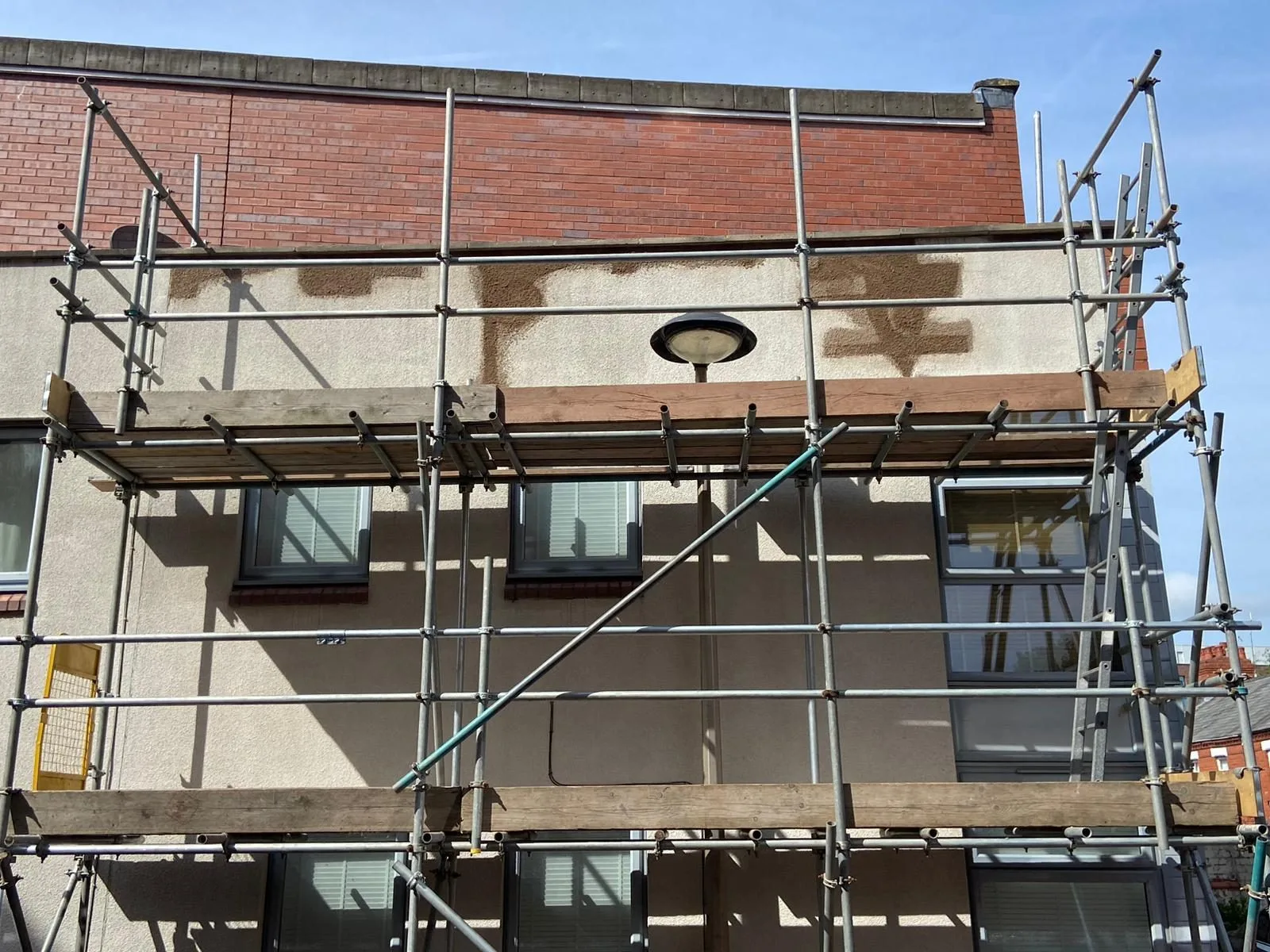
The patch was built back up in a sand and cement render, keyed to the existing and finished to match the surrounding texture, so it will take the same paint as the rest of the elevation. The fourth photograph shows it from the scaffold, still unpainted; the fifth is the elevation from the street with both repaired areas visible on the upper wall.

Decoration of the repaired areas was left to the customer.
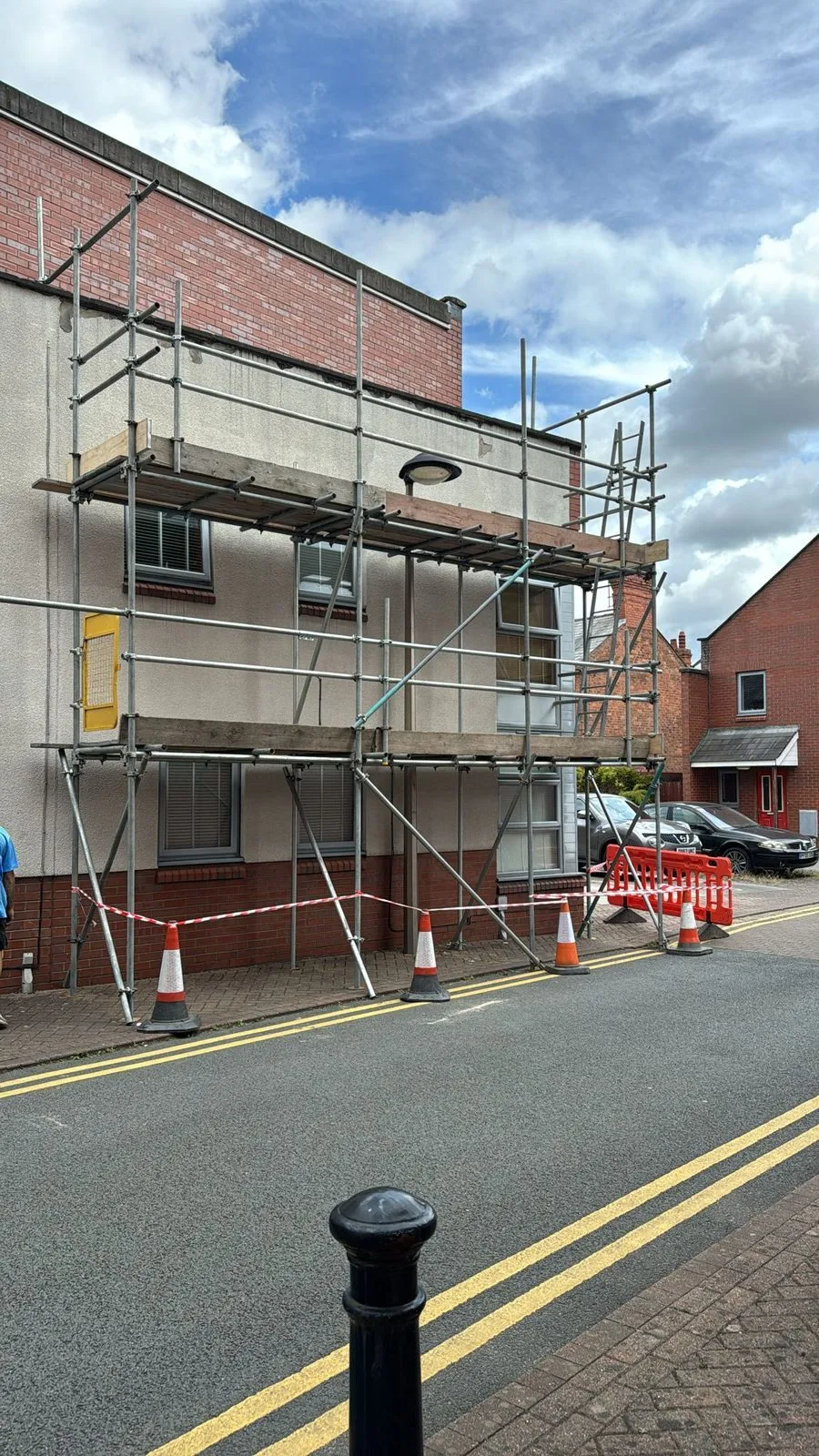
Scaffold on the pavement against a rendered two-storey building with brick above, traffic cones along the kerb
Scaffold up on the street elevation, the pavement coned and a barrier to the road.
Vertical crack in textured render running down from under a concrete coping, with a patch of render missing beside it
The crack from the underside of the coping, and the render that had blown away beside it.
Render cut away in a stepped outline exposing the wall, with helical bars set in horizontal slots across a vertical crack
The render cut back and the helical bars bedded across the crack into sound wall either side.
Fresh sand and cement render patch in a stepped shape on a textured rendered wall below a coping, unpainted
The patch re-rendered and textured to match, left unpainted for the customer to decorate.
Rendered elevation seen from the scaffold with two fresh render patches on the upper wall below the brick
The elevation with both repaired areas visible before decoration.

This study covers the scaffold, the crack stitching and the render repair. The cause of the crack was not investigated as part of the work and no engineer was involved; where a crack is wide, stepped or recurring, we would advise a structural engineer’s assessment before any repair is priced. Decoration was for the customer.

Scope — what was done

  • Scaffold to the side elevation, pavement coned and a barrier to the road
  • Blown render cut out in a stepped outline to sound render
  • Slots cut into the joints across the crack and cleaned out
  • Stainless steel helical bars bedded in resin across the line of the crack
  • Patch re-rendered in sand and cement, keyed and finished to match
  • Scaffold struck; site cleared
LocationChester
PropertyTwo-storey block of flats, rendered with brick above
IssueVertical crack through the render below the parapet coping; render blown around it
CauseNot investigated as part of this job
WorkHelical bar crack stitching and render repair, from scaffold
DecorationLeft to the customer
Crack stitchingHelical barsRender repairChester

Where we work

We carry out structural repairs across North Wales, Cheshire and Wirral, and we also cover mid-Cheshire. The work varies with the building stock: in Chester and Wrexham it is mostly cracked solid-brick Victorian and Edwardian walls and the render over them; along the Wirral and North Wales coast it is salt-driven corrosion of the steel in concrete sills, lintels and balconies; across Deeside and Flintshire it is the inter-war concrete lintels and sills now reaching the end of their life, and the odd render crack below a parapet.

Areas we cover

  • Flintshire and Deeside — Connah’s Quay, Shotton, Queensferry, Hawarden, Flint, Mold, BuckleyCH5 to CH8
  • Chester and Ellesmere Port — Hoole, Handbridge, Upton, Blacon, Lache, Ellesmere PortCH1 to CH4, CH65 and CH66
  • Wirral — Birkenhead, Wallasey, Hoylake, West Kirby, Heswall, Bebington, BromboroughCH41 to CH49, CH60 to CH64
  • Wrexham and Denbighshire — Wrexham, Gresford, Llay, Ruabon, Rhyl, PrestatynLL11 to LL18
  • Mid-Cheshire — Northwich, Winsford, Tarporley, KnutsfordCW6 to CW9 and WA16
North WalesNORTH WALESFLINTSHIREWrexhamWREXHAMChesterCHESTERWirralWIRRALEllesmere PortELLESMERE PORTConwyCONWYDenbighshireDENBIGHSHIRECheshireCHESHIREA55M53M56A483A494Boundaries © OpenStreetMap contributors

We cover North Wales, Cheshire and Wirral from the Deeside and Chester districts out to mid-Cheshire.

What customers say

★★★★★ 5.0 · 150+ Google reviews

  • ★★★★★

    “Really pleased with the work Quirks Property Maintenance did for me. They replaced two lintels above my windows following a recommendation from my surveyor, stitched the brickwork and repointed everything beautifully. They did a great job and left everything really tidy afterwards. They were also very helpful and kind throughout, and were always happy to explain what they were doing and answer my questions, which I really appreciated. The finished work looks great and I’d definitely recommend them.”

    Mrs S

  • ★★★★★

    “Effective, efficient and friendly service. Quirks carried out installation of a new steel lintel and step crack repair above my front door. They were methodical, explained the process to me at different stages and liaised with building control. They did a really great job!”

    S C

  • ★★★★★

    “Mike and his team repaired my house after I had an issue with subsidence. They turned up when they said they would, there work is excellent and they were the best priced for the work I wanted doing. Will be using them again in the future. Thank you Mike”

    Andrew Peters

Read all our reviews on Google

More from us

Related services

Your questions

Frequently asked questions

Is the crack in my wall serious?

Hairline cracks through plaster or render usually are not. Cracks that step through the brickwork, that are wider at one end than the other, that you can fit a coin into, or that keep coming back after filling, need looking at before they are repaired. Send us photographs from close up and from across the room or street, with something for scale, and we will tell you which kind yours is.

Do I need a structural engineer before crack stitching?

For a crack with an obvious local cause — a removed fixing, impact damage, a failed lintel you can see — usually not; we quote the repair from your photographs. For cracks that suggest movement, or that have recurred, yes: the engineer establishes why before we repair the result, and the repair is designed around the cause. We tell you which when we see the photographs, and we do not stitch a crack that is still moving.

Will the crack come back?

If the cause has been dealt with, the stitched masonry is tied together across the crack and the repair is designed not to open again. If the cause has not been found and is still active, any repair can crack again, which is why we are careful about which cracks we stitch without an engineer’s input.

What is spalling concrete?

Concrete that has blown off the surface, usually over a rusting steel bar, leaving a hollow or a brown-stained patch. It is common on inter-war and post-war concrete lintels, sills, balconies and canopies, and it gets worse each winter as water gets to more of the steel. The repair is to cut back, treat the steel and rebuild the section.

Can you repair a cracked concrete lintel rather than replace it?

Sometimes, where the lintel is sound and only the surface has spalled. Where the lintel has cracked through, or the reinforcement has corroded badly, it is replaced. We tell you which from the photographs; replacements are covered on our lintel repair page.

Does the work need Building Control?

Crack stitching and concrete surface repairs on their own usually do not. Replacing a lintel, or any repair that changes how a wall carries its load, is notified to Building Control, under the Regulations in England for Chester, Cheshire and Wirral and as applied in Wales for Flintshire, Wrexham and the rest of North Wales. We tell you which applies when we quote; the application is yours and we arrange the inspections where they are needed.

How much do structural repairs cost?

It depends on the length and number of cracks, whether the wall is rendered or exposed brick, whether an engineer’s design is needed, how much concrete has to be cut back, whether scaffold or access equipment is needed, and how much making good follows. Most jobs we can price from photographs — send yours on WhatsApp or by email and we’ll come back with a written quotation.

Written and reviewed by Michael Quirk, Director.

How it works

Send us a photo, we’ll take it from there

You don’t need to describe the problem down the phone. A photo tells us most of what we need.

  1. 1WhatsApp or email us photos. A couple of pictures of the problem and your postcode.
  2. 2We reply with what it looks like and what happens next. Where the photos show enough, that’s a price. If not, we’ll tell you what else we need.
  3. 3You get a written quotation. A clear scope of works, so you know what is included.
  4. 4We do the work and leave it clean.
  5. 5Workmanship guarantee on completed works. In writing on your quote.
Send Photos on WhatsApp
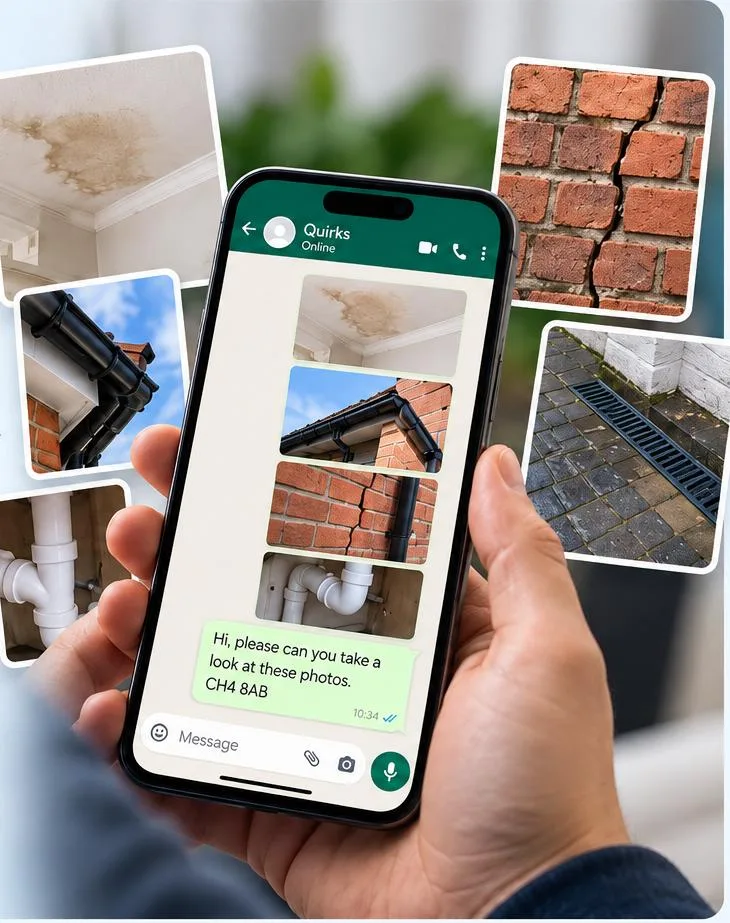
Customer sending Quirks photos of damp, gutters, cracked brickwork and a leaking pipe on WhatsApp

Request a written quotation

Attach photographs of the crack or damage from close up and from a distance, with something for scale, and any engineer’s or surveyor’s report if you have one.

    So we can confirm we cover your area.


    JPG, PNG, HEIC, WEBP or PDF. One photograph per box.

    We use your details and photographs to deal with your enquiry — our privacy policy explains how.

    Prefer to send photos? Message us on WhatsApp

    STRUCTURAL REPAIRS — SEND US PHOTOGRAPHS

    Worried about a crack? Send us a photo.

    Scan the code
    Powered by Joinchat