House Survey Repair Quotes Before You Buy
In short: we provide written, itemised quotations for the repairs flagged in your house survey — damp, roofing, structural and more — across Chester, Flintshire, Wrexham, Wirral, Cheshire and North Wales. Buyers use our figures to negotiate the price, plan their budget, and decide with confidence before exchange.
Buying a property is one of the biggest financial decisions you will make, and a survey that flags damp, roofing problems or structural movement leaves you with one urgent question: what will it actually cost to put right?
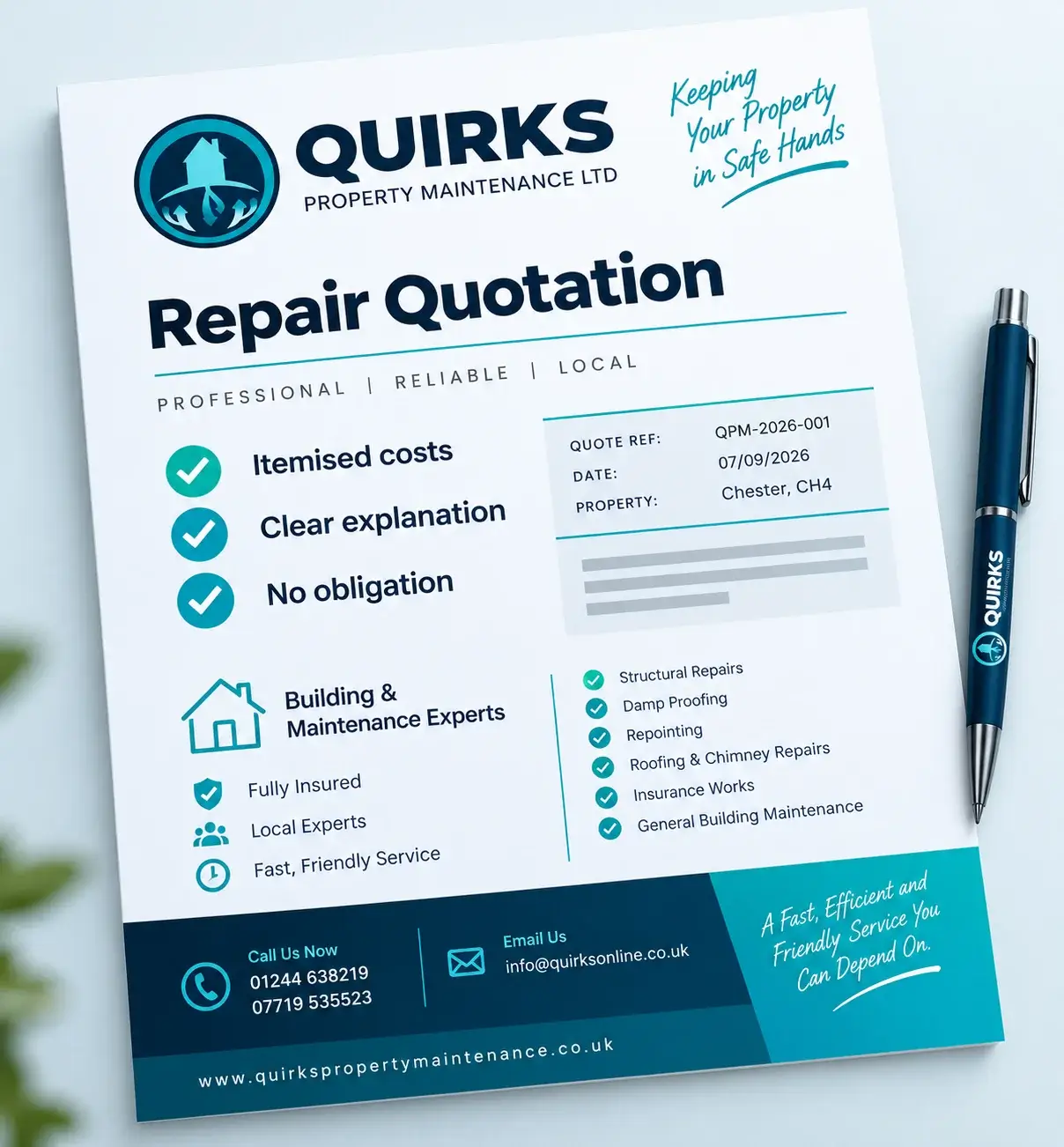
Quirks Property Maintenance Ltd provides a professional written quotation for the repairs, remedial works and improvements highlighted in your Home Buyers Report or building survey — and for related structural and building improvements you plan once you move in. Accurate, practical costs you can take back to the negotiating table.
And because Quirks is a multi-trade contractor, one inspection prices the whole report. A survey rarely flags just one thing — it flags damp AND roof wear AND cracked pointing. Single-trade specialists can each quote for their slice; we put an itemised figure against every defect within our trade scope, in one document, from one contractor.
We are equally clear about what sits outside that scope. Electrical and gas installations, asbestos testing, drainage and CCTV surveys, and structural engineering assessments all need the relevant specialist, and we tell you openly when an item on your survey needs one — rather than pricing something we should not be pricing.
Repair quotes for Level 2 and Level 3 survey findings
Whichever survey you have had, the report tells you what is wrong with the property. It does not tell you what the repairs will cost. That is the gap we fill. We do not carry out the house survey itself; we work from the report you already have — a Level 2 Home Survey, a Level 3 Building Survey or another surveyor’s report — inspect the defects it has flagged, and provide a written quotation for the repairs within our trade scope.
Level 2 Home Survey
The RICS Level 2 Home Survey, which many buyers still know as the HomeBuyer Report, is the survey most often commissioned on conventional houses and flats in reasonable condition. It grades each element of the property with a condition rating and describes the defects the surveyor found, but it does not include repair costs. We take the items a Level 2 report has flagged, inspect them, and put an itemised figure against each one that falls within our trades.
- We inspect the defects highlighted in your report
- Provide a written, itemised quotation
- Honest, practical advice on what needs doing
- Help you plan and budget before you buy
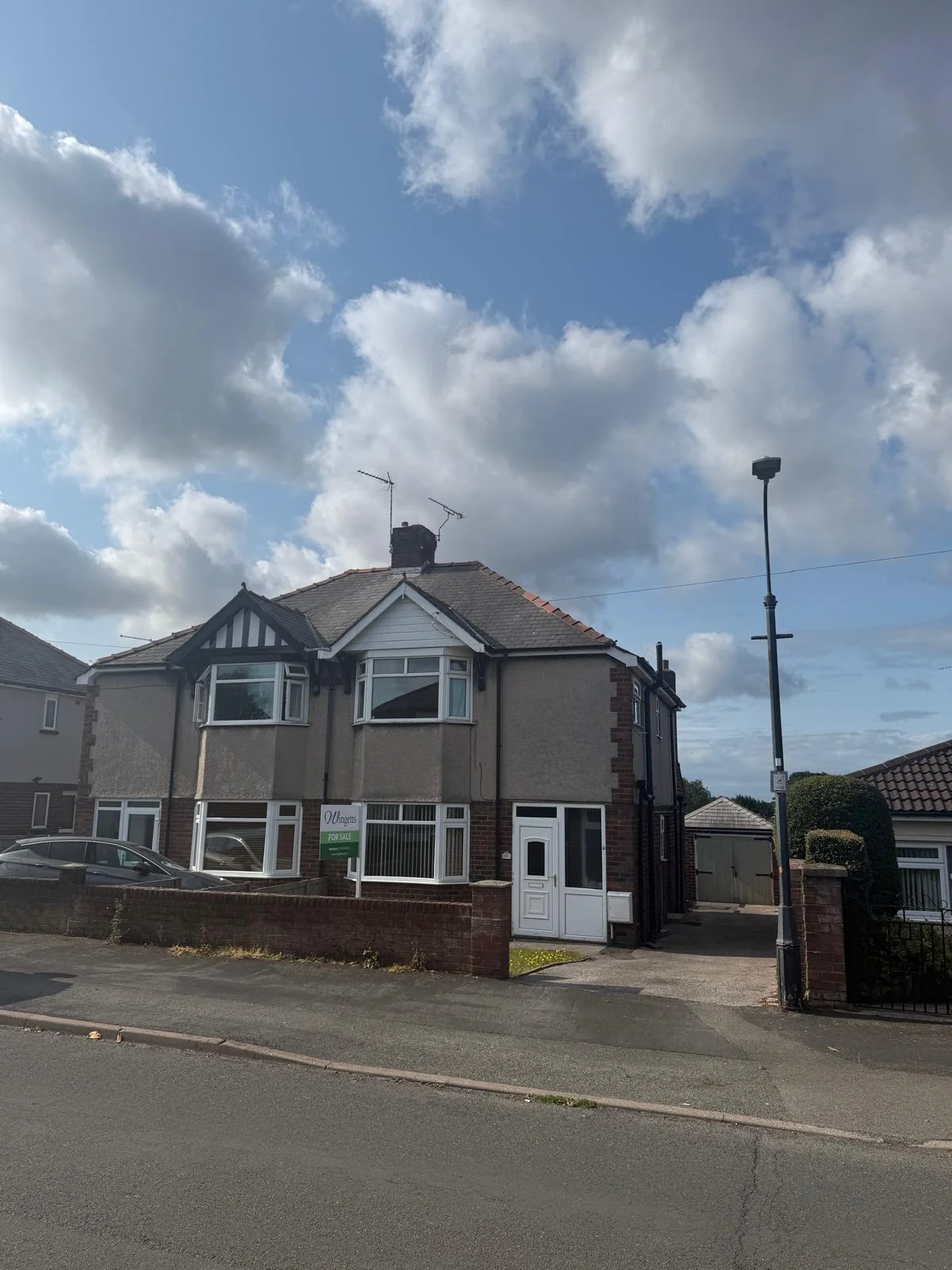
Most common for standard homes
Level 3 Building Survey
A Level 3 Building Survey, formerly known as a full structural survey, is the most detailed of the RICS home surveys. It is usually chosen for older, larger, altered or unusual properties. The report is longer, the list of defects is often longer, and it will frequently recommend further investigation of particular items before you commit. We work through a Level 3 report section by section, price every defect within our trade scope, and say plainly where an item needs specialist investigation — a structural engineer’s report, a drainage CCTV survey, an asbestos test — before a repair can be quoted for.
- We inspect the defects in your report that fall within our trade scope
- Provide a detailed written quotation
- Flag where a specialist investigation is needed
- Help you understand the full scope of works
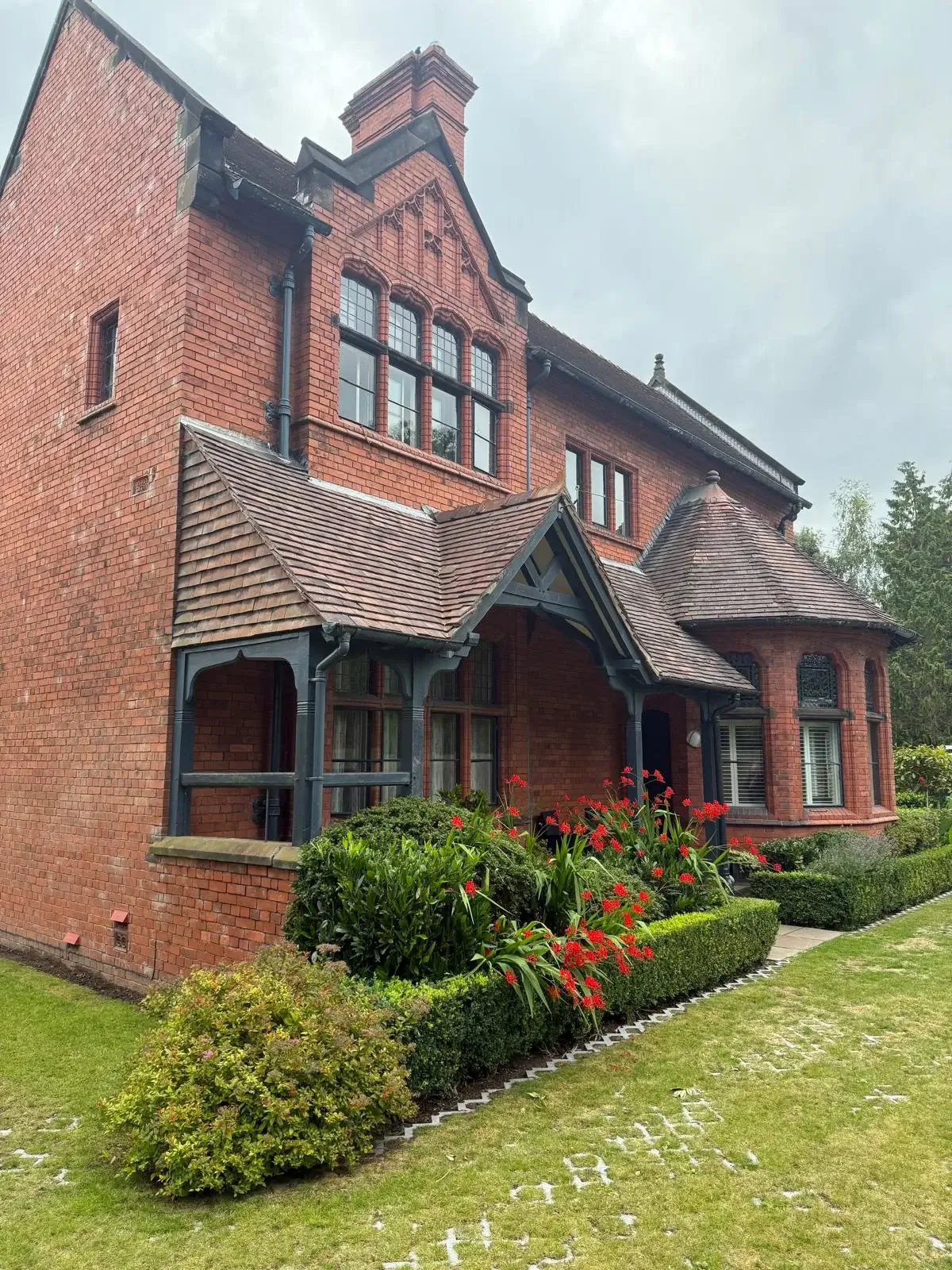
Ideal for older, larger or unusual properties
Condition Rating 3 Defects
Serious defects that need attention
Under the RICS Home Survey Standard the surveyor gives each element of the property a condition rating. Rating 1 means no repair is currently needed. Rating 2 means a defect that needs attention but is not considered serious or urgent. Rating 3 means a defect that is serious, needs urgent repair or replacement, or needs further investigation. Other survey formats use a similar grading.
Condition Rating 3 defects are the items that most often hold up a purchase, because they are the ones a buyer cannot sensibly leave unanswered. A rating 3 does not automatically mean the property is a poor buy: a worn roof covering, a failed chimney stack or a damp problem is a rating 3 in the report and, in most cases, a definable job with a definable cost. Our quotation deals with each rating 3 item within our trade scope on its own line, so you can see what it involves and what it costs. If you would like the fuller picture, we can price rating 2 items as well.
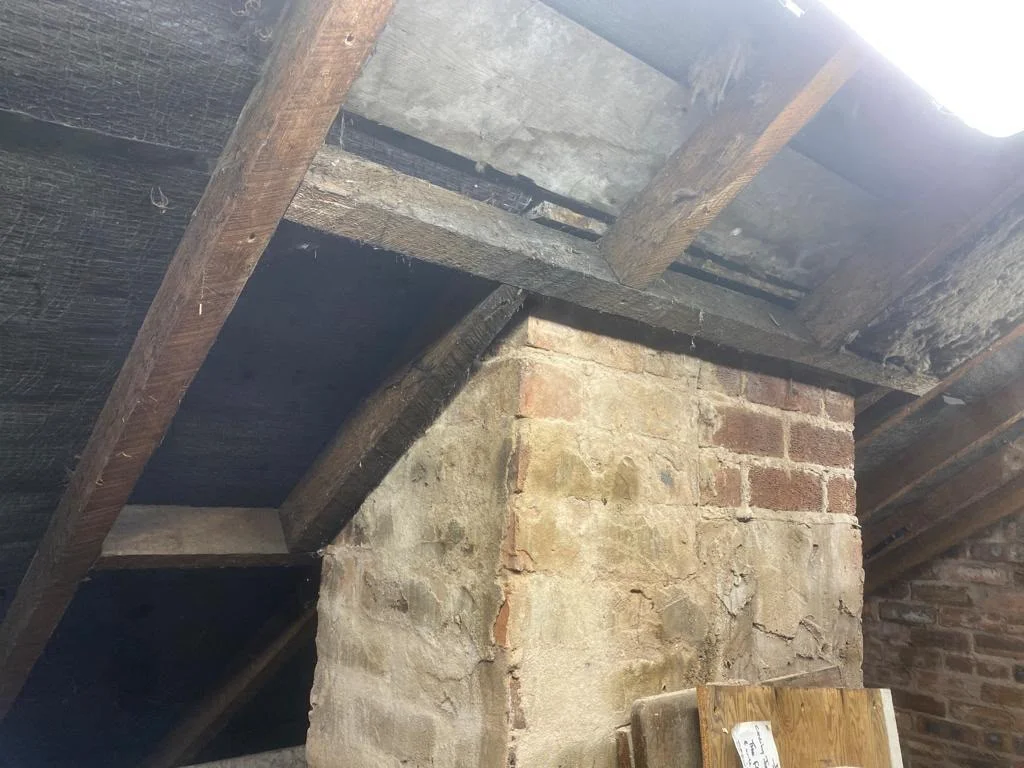
Common examples include:
- Cracks and movement
- Roofing defects
- Chimney problems
- Damp and moisture issues
- Timber and structural concerns
Repairs recommended by your surveyor
Where a survey identifies a defect, the surveyor’s role ends with a recommendation: repair, replace, investigate further, or obtain quotations from suitably qualified contractors before you commit to the purchase. The surveyor does not carry out the work and does not price it. Our quotation picks up where the report leaves off. We follow the surveyor’s recommendations item by item and keep the report’s own section references against our figures, so every cost can be traced back to the defect it relates to. If our inspection finds something the report did not, we say so separately, so you know what came from the survey and what came from us.
Builder quotations and repair costs before exchange
Surveyors recommend builder quotations following a house survey for a reason. A figure worked out from the report alone, or a number given over the phone without a visit, is not a sound basis for a decision of this size. A proper builder’s quotation follows an inspection, is in writing, is itemised, and states what it includes and what it does not.
Timing matters as much as the figure. Once contracts have been exchanged you are committed to the purchase, and from that point the cost of putting the defects right is yours to carry. The time to establish repair costs is between receiving the survey and exchanging, while the figures can still inform your decision. Our quotation is written for exactly that window.
Already have your Level 2 or Level 3 survey?
Simply email or WhatsApp your survey report and we’ll take care of the rest.
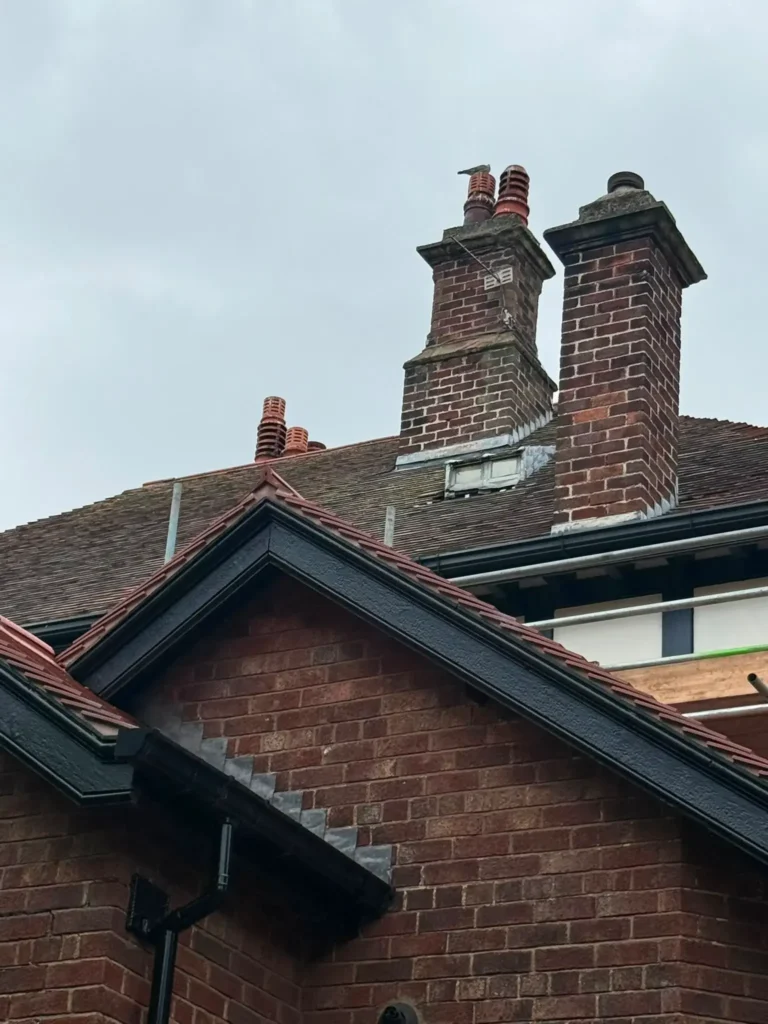
Chimney stack and tiled roof inspection for water ingress at Wirral property
The survey found damp. Now what?
Damp is one of the most common issues flagged in house surveys — and one of the most common reasons buyers panic or walk away from an otherwise sound property. The survey tells you damp is present; it rarely tells you what kind, what caused it, or what it costs to fix. The difference matters enormously: similar signs of damp can have completely different causes — from condensation and penetrating moisture to genuine rising damp — and the correct repair, and its cost, depend on identifying the cause properly.
Quirks is a Federation of Damp (FOD) member with FOD Certified Surveyors. We diagnose the actual cause — rising damp, penetrating damp or condensation — and give you a written, itemised cost to put it right, before you exchange. If the survey has flagged damp, you can also combine this service with a full damp survey, including moisture testing, cause diagnosis and salt contamination assessment.
Period properties deserve a special mention: much of the housing stock in Chester,
Wrexham and North Wales predates modern damp proofing, and older buildings bring timber
problems with them — woodworm, wet rot and dry rot in floors, beams and roof timbers. We
price damp and timber remedial works together, so a survey full of period-property caveats
becomes one itemised list of real costs.
The survey flagged roof problems
Roof defects are the other big survey red flag — and survey wording like “roof approaching end of economic life” or “further investigation recommended” rarely tells you what the work actually costs. The price of the same defect can vary enormously with access, scaffold requirements, roof height and materials, which is why generic cost guides are little help in a negotiation.
Quirks carries out roof repairs, chimney works and fascia, soffit and guttering work across the region. We inspect the specific defects your survey has flagged, explain whether they are routine maintenance, urgent repair or replacement planning, and put a written, itemised figure against each — including access and scaffold where required, so the number you negotiate with is the number the job actually costs.
What we quote for
Damp and moisture
Rising damp, penetrating damp, condensation, salt-contaminated plaster and replastering, timber rot and woodworm treatments, full damp investigations with moisture readings.
Roofing and chimneys
Roof repairs and replacements, chimney repointing, rebuilding and ventilation, flat and pitched roof defects, fascias, soffits and guttering.
Structural and building defects
Cracked brickwork and repointing, lintel replacements and RSJ installations, wall removals and structural alterations, movement and settlement issues.
The survey flagged cracks or movement
Nothing in a survey scares a buyer like the words “evidence of movement” — but that wording covers everything from historic settlement that stopped decades ago to active subsidence, and the required response can range from straightforward masonry repairs to further investigation by a structural engineer. The signs a survey picks up — diagonal cracking, cracks wider than a few millimetres, doors and windows that have started to stick — have many possible causes, from clay-soil shrinkage and tree roots to historic mining settlement in parts of the region. The survey flags the symptom; what you need before exchange is to know what fixing it actually costs.
Quirks carries out crack stitching, repointing, lintel replacements, RSJ installations and structural alterations, and we put written, itemised figures against the structural defects your survey has flagged. And we are honest about limits: where cracking suggests active movement that needs a structural engineer’s assessment first, we tell you so — and price the repair once the engineer has reported.
What you receive
• Written itemised quotation with a clear scope of works
• Repair cost breakdown by trade
• Photographic evidence of defects
• Practical repair recommendations
• Optional quotations for related structural and building improvements within our trade scope
• Documentation suitable for purchase negotiations, budgeting, and supporting mortgage or funding discussions where applicable
Why our assessment is chargeable
A free contractor quote costs nothing because it exists to win the work that follows, which is exactly why surveyors warn buyers to treat free quotes with caution. Our pre-purchase assessment is chargeable because it is a piece of professional documentation in its own right: an itemised, written quotation you can compare like-for-like with any other contractor, put in front of a vendor, or hand to your solicitor or lender — whether or not you ever instruct us for the works. We are not RICS surveyors. We provide repair cost assessments only. Where your budget allows, we recommend a full survey alongside our quotation: the survey tells you what is wrong, and our quotation tells you what it costs to put right.
A surveyor
• Identifies and reports defects
• No repair pricing provided
• Advises that contractor quotations are obtained
Quirks
• Itemised repair costs against each flagged defect
• Negotiation-ready written documentation
• Full works available from one contractor
How it works
01 — Arrange access
Vacant or occupied — access arranged via the agent, vendor or tenant.
02 — Property inspection
We inspect the specific defects your survey has flagged.
03 — Detailed written quotation
One itemised document covering every defect within our trade scope.
04 — Negotiate, budget or plan
Use the figures with the vendor, your solicitor or your lender.
Real outcomes for real buyers
• £7,500 price reduction negotiated by a buyer in Chester using our itemised repair quotation
• Structural repair funding secured by a buyer in Wrexham on the strength of our documentation
• Investment purchase planned with confidence in Mold using our cost assessment
Need a repair quote before exchange?
Most buyers who contact us are working to a date. The survey has come back, the solicitor is raising enquiries and the estate agent wants to know when you will be ready to exchange. Conveyancing and exchange deadlines do not wait for repair costs, yet repair costs are often the last piece of information a buyer needs before those deadlines can be met with confidence.
You do not need everything in place to make a start. Send us the relevant extracts from your survey first — the sections that describe the defects you want priced — together with the property address and the dates you are working to. Reviewing the extracts before we visit lets us confirm which items sit within our trade scope, tell you at the outset if anything needs specialist investigation before it can be priced, and plan the inspection around what actually needs looking at.
Access is arranged through the estate agent, the vendor or, where the property is let, the tenant. Tell us who holds the keys and we will make the arrangements. We then inspect the relevant defects and provide a written, itemised quotation for the items within our trade scope.
If your timescale is tight, say so when you get in touch. We will be straight with you about what can be done in the time available, rather than leave you waiting on a figure you were counting on.
Can you renegotiate a house price after a survey?
It is a fair question, and a common one. Buyers do go back to vendors after a survey, and a report that flags serious defects often reopens the conversation about price. Some vendors agree a reduction that reflects the cost of the repairs; some agree to have particular works carried out before exchange; some hold firm. The outcome depends on the property, the market and how the case is put, and no contractor can tell you in advance which way it will go.
Where our quotation helps is in turning a survey’s findings into something both sides can work with. A survey can say that a roof covering is at the end of its serviceable life or that damp to a wall needs investigation and repair, but it puts no figure on either. A written, itemised repair quotation from an established local contractor does. It sets out each defect, the scope of the work and the cost against it, in a document that can be shared with the vendor, the estate agent or your solicitor and set alongside any other quotation they choose to obtain. Buyers use it to support a request for a price reduction, to agree exactly which works the vendor will complete before exchange, or to satisfy themselves that the agreed price still holds up once the repair costs are taken into account.
What our quotation is, and what it is not
Quirks provides repair cost quotations only. We are a building and property maintenance contractor, and our quotation tells you what the repairs within our trade scope would cost. It is not legal advice or conveyancing advice, it is not valuation advice, and it is not advice on the price you should offer or accept. Those are matters for you, with your solicitor, your surveyor or valuer and, where relevant, your lender or mortgage adviser. Our part is to make sure that the repair figures you take into those conversations are accurate, itemised and in writing.
Works after purchase
If you go ahead with the purchase, the same contractor that priced the survey findings can carry them out — one contractor from inspection through to completion, including damp proofing and, where structural alterations require it, work set out under building regulations. Guarantees provided where applicable.
• Damp proofing and remedial treatments
• Timber treatment, wet rot and dry rot works
• Roofing, chimney and leadwork repairs
• Repointing and masonry repairs
• Crack stitching and structural repairs
• Lintel replacements, RSJs and structural alterations
Areas we cover
Serving Chester, Flintshire, Wrexham, the Wirral, Cheshire and North Wales.
• Chester — CH1–CH4
• Flintshire — CH5–CH8
• Wirral — CH41–CH49 and CH60–CH63
• Wrexham — LL11–LL14
What does it cost?
Our service is chargeable due to the time and expertise required to produce a professional, accurate quotation rather than a rough estimate. If you go on to instruct Quirks for the works, our assessment fee is deducted in full from the cost of the job. Contact us to discuss your property and timescales.
Why choose Quirks Property Maintenance Ltd?
We combine technical expertise with excellent service to deliver trusted results and complete peace of mind.
20+ Years’
Experience
Extensive experience in building repairs, structural works and property maintenance.
One Multi-Trade Contractor
We can assess damp, roofing, masonry, structural and general building defects under one roof.
Detailed Itemised Quotations
Clear written costs against the defects highlighted within the Home Buyers Report or building survey.
Negotiation-Ready Documentation
Our quotation can be used to help negotiate with the vendor, plan the repair budget and understand the likely cost of works before exchange.
Repairs After Purchase
If the customer proceeds with the property, Quirks can also carry out the quoted remedial works from inspection through to completion.
★★★★★
Based on 100+ Google reviews
Super fast response and excellent advice given. Recommended” — Dawn, Chester
Accredited & approved
Memberships and certifications

DEESIDE, FLINTSHIRE — PRE-PURCHASE SURVEY
Pricing a Level 2 Home Survey Report for a Buyer in Deeside, Flintshire
A buyer had a Level 2 home survey carried out on a house in Deeside before completing the purchase. The report came back with several elements rated as significant defects requiring further investigation, and the surveyor advised the purchaser to budget accordingly. What the report did not do — and is not intended to do — is tell the buyer what any of it would cost to put right. He came to Quirks Property Maintenance Ltd for that.
What the survey flagged
Three sections of the report drove the cost question.
The chimney stacks were described as brick stacks with metal flues and clay pots in lime parging, in fair to poor condition. The flaunching and detailing were defective and needed making good in sulphate-resistant mortar, the pointing had eroded locally, and there were spalled bricks that needed cutting out. One flue was open to the elements with no protective cowl, and the surveyor recorded the chimney breast as damp internally at first-floor level, recommending a cowl and air vents to the breasts. Because the chimney stacks are shared with the neighbouring property, party-wall requirements and agreement with the adjoining owner may need to be considered before works proceed.
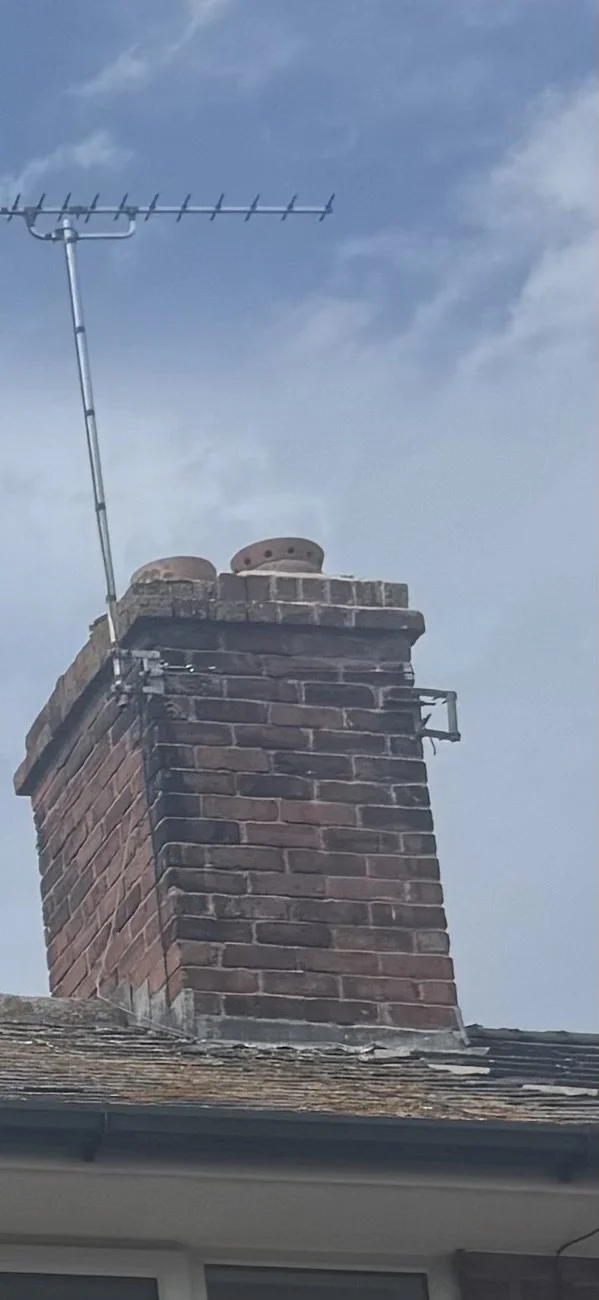
The roof covering was thin slate with concrete ridge tiles, again fair to poor. The mortar fillets had dropped out of the ridge, there were loose, slipped and cracked slates, and a number of slates were being held in place with tingles — metal strips fitted where a slate has slipped before. There was no underfelt. The surveyor’s view was that the fixings were beginning to fail, further slippage was likely, and ongoing repair would be needed until the covering was replaced. Separately, the report noted there was no junction detail at all between this roof and the adjoining property’s, and recommended one be formed to prevent ingress, with the cost shared with the adjoining owner.
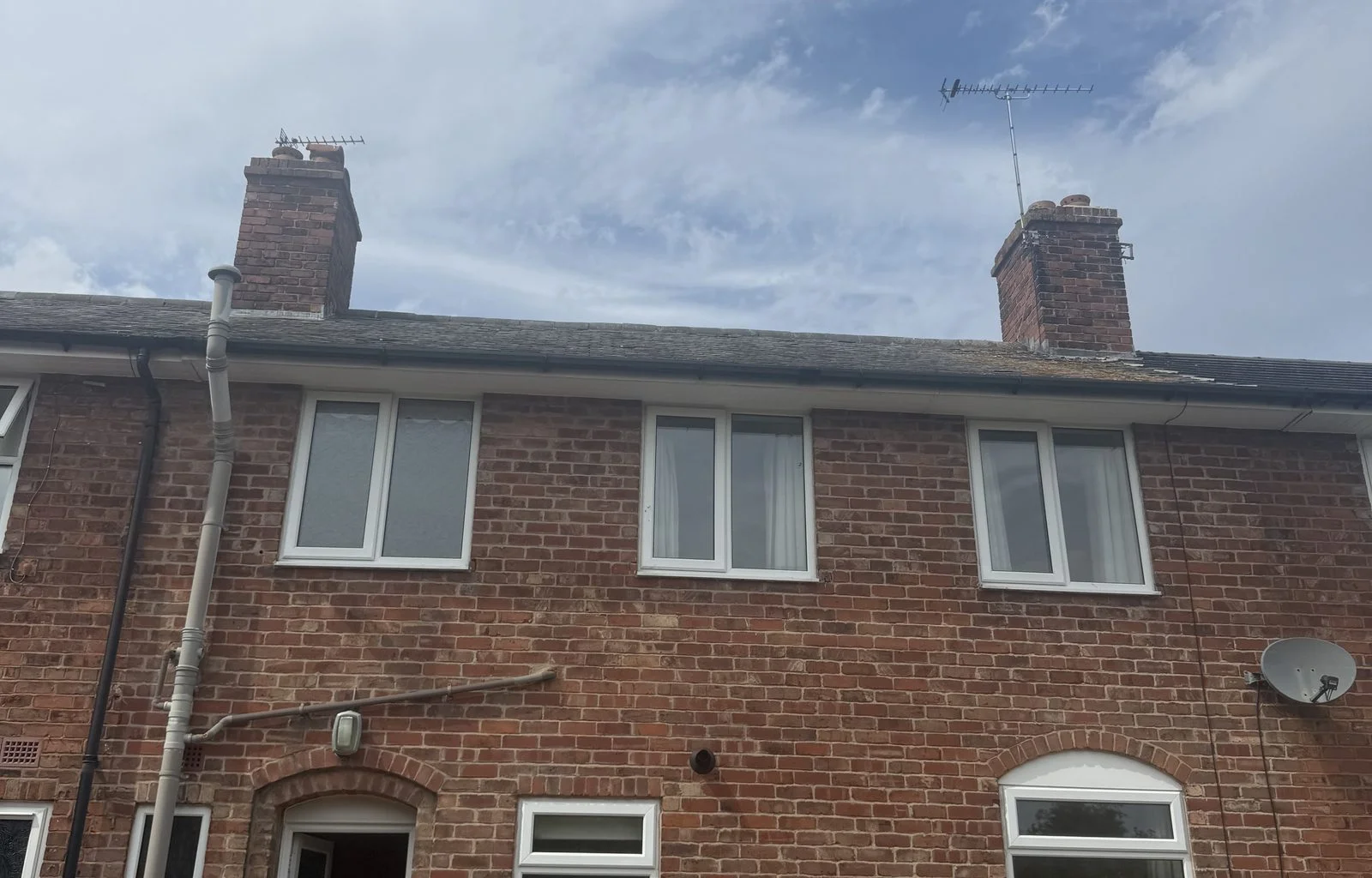
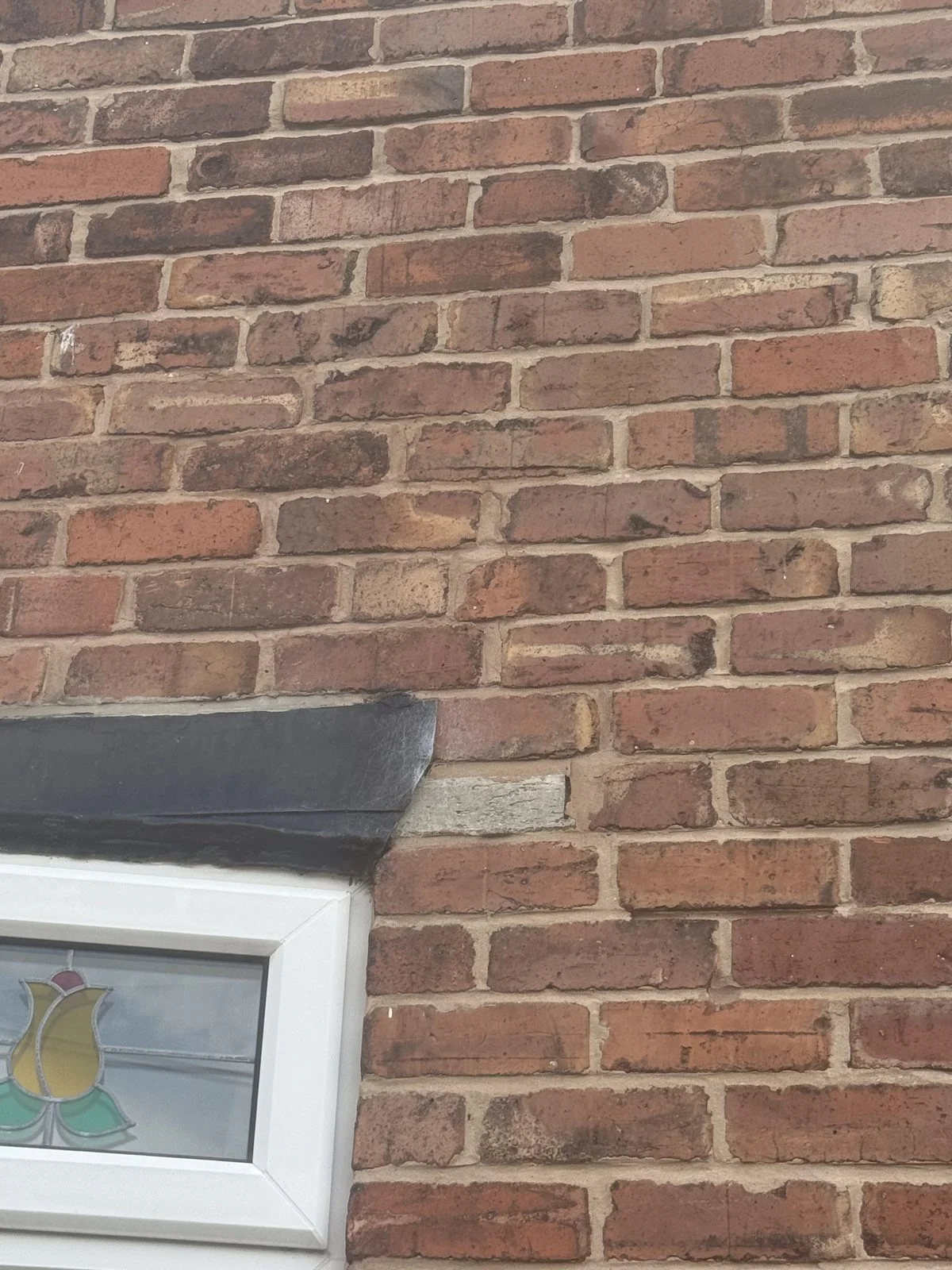
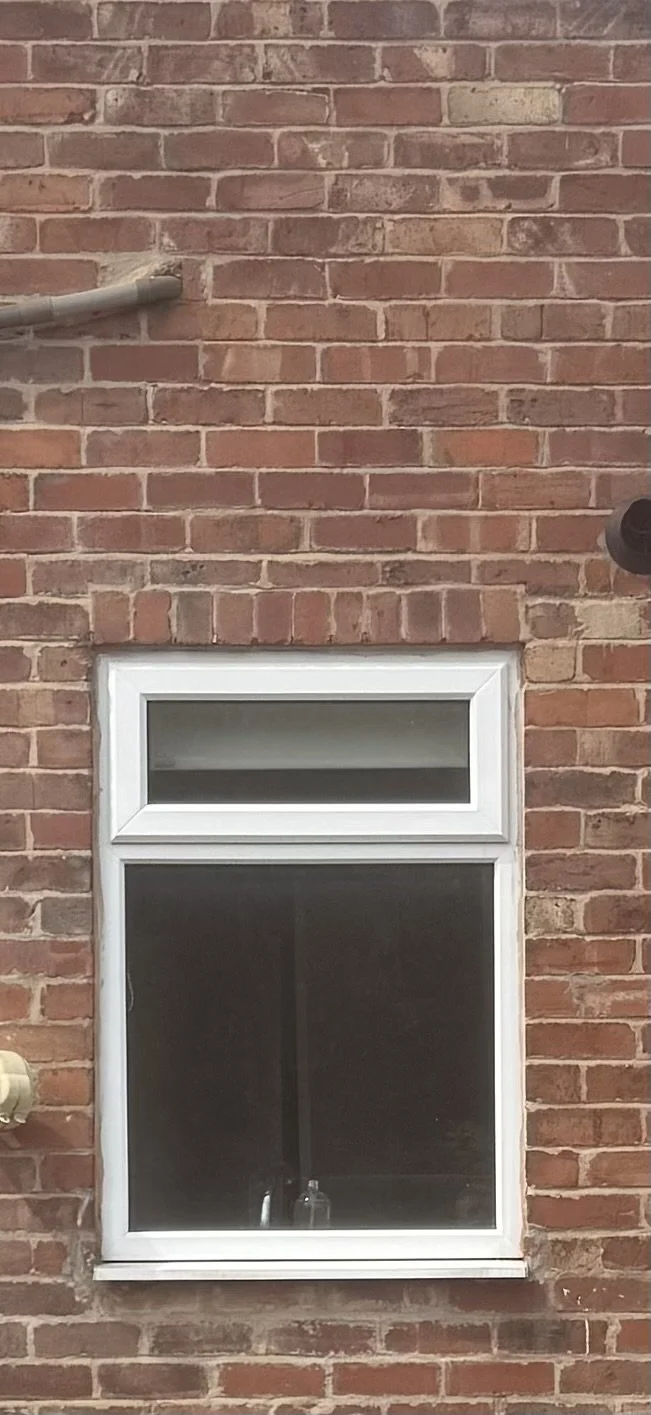
The window openings produced the section that most buyers find hardest to price. The survey identified an indication of failure to the front living room window lintel, evidenced by step cracking running upwards from it — a concrete boot lintel approaching the end of its serviceable life. It also noted several windows where a brick soldier course was doing the job of a lintel and was not adequate, with the masonry visibly bowing above one of them. The recommendation was to review the lintel defects with a competent builder or a structural engineer.
What we priced, and what we did not
We prepared a single quotation covering three of the survey’s sections, priced by section so the buyer could read our quotation alongside his report line for line: chimney repointing, crown repairs and flashing maintenance in sulphate-resistant mortars as the survey specified; a complete re-roof including scaffolding, timber treatment, breathable membrane, new battens, slate reinstatement with an allowance of up to 300 replacement slates, a mechanically fixed dry-ridge system and associated leadwork; and replacement of the lintels above the front bay-style window and the smaller rear ground-floor window, with helical crack stitching to the agreed cracked area above the front window.
Just as importantly, we set out what we had not priced, and listed each excluded survey item explicitly rather than leaving it to be discovered later: the spalled chimney bricks, the cowl and the air vents to the chimney breasts, lintel or helical work to window openings beyond the two named, and the window re-sealing, trickle vents and jamb insulation. Each was offered as a separate quotation on request. The shared junction detail at the party boundary was priced separately as well, because the detail itself and any contribution from the adjoining owner had to be agreed first.
That distinction matters when a quotation is being used in a negotiation. A buyer needs to be able to say what a figure does and does not cover, and a vendor’s agent will find the gap if there is one.
The parts a buyer has to deal with themselves
The property is in Flintshire, so the Welsh Building Regulations system applies and any notifications run through Flintshire County Council Building Control. We set out in the quotation that a complete roof covering replacement may require approval on thermal performance, ventilation, weather resistance and structural safety grounds, and that replacing lintels supporting masonry above window openings may require approval as well — with the Building Notice, application fees and inspection charges the client’s responsibility.
We also made clear what we were not providing. Structural engineer’s drawings, calculations and design services were not included. Party wall notices, any agreement with the adjoining owner over the shared stacks and the boundary junction, and any party wall surveyor’s fees were the client’s to arrange. Where Building Control required engineered lintel designs or a detailed crack-stitching specification, that too sat with the client.
None of that is what a buyer wants to hear, but it is what they need to know before they commit. We would rather set it out in the quotation than have it appear as an extra once the works are underway.
Outcome
The buyer used the quotation as part of his negotiation on the purchase, and the price he paid for the property was reduced.
He proceeded with the purchase, instructed us for the works, and the quoted works have since been completed. The shared junction detail at the party boundary remained a matter for agreement with the adjoining owner and was priced separately, as set out in the quotation.
| Client position | Buyer, pre-completion, holding a Level 2 home survey report |
| Service | Pre-purchase repair costings — priced quotation against the survey report |
| Survey sections priced | Chimney stacks; roof coverings; window supports and surrounds |
| Findings priced | Defective chimney flaunching, crowns and eroded pointing; failing slate covering with no underfelt and slipped slates; failed concrete boot lintel with step cracking, and inadequate brick soldier-course lintels |
| Recommendation / Scope | Chimney repointing and crown repairs in sulphate-resistant mortar; complete re-roof with dry-ridge system and leadwork; two replacement lintels with helical crack stitching to the agreed area |
| Left with the client | Building Notice and Building Control fees; party wall notices and any adjoining-owner agreement; structural engineer’s design fees where required |
| Location | Deeside, Flintshire |
| Outcome | Purchase price reduced; buyer proceeded and instructed Quirks; works completed. Twelve-month workmanship guarantee. |
Frequently Asked Questions
The survey has flagged damp — how much will it cost to put right?
It depends entirely on the cause, which is why we inspect before quoting. Similar signs of damp can come from condensation, penetrating moisture or genuine rising damp, and each has a different correct repair and a different cost. A condensation problem, a defective gutter soaking a wall, and a failed damp proof course are three different jobs. We identify the actual cause, then give you a written, itemised figure for putting it right — so you go into the negotiation with a real number rather than a guess from an online cost guide.
The survey mentions movement or cracking — should I still buy?
That is your decision, and a great many properties with historic movement are perfectly sound purchases. The phrase covers a wide range: settlement that stopped decades ago and needs nothing more than masonry repair, through to active movement that needs a structural engineer’s assessment before anyone can sensibly price a repair. Our role is to inspect what the survey has flagged, tell you honestly which category we believe it falls into, and put an itemised figure against the repairs within our trade scope. Where an engineer needs to report first, we say so — and price the repair once they have.
Can your quotation help me renegotiate the purchase price?
That is what most of our buyers use it for. A vendor can dismiss a survey that says “repairs required”; it is much harder to dismiss a written, itemised quotation from an established contractor showing what those repairs cost. Buyers have used our documentation to negotiate reductions, to ask for works to be completed before exchange, or to budget with confidence and proceed at the agreed price. We provide the figures — how you use them is between you, your agent and your solicitor.
Is this the same as a structural survey?
No. We do not provide RICS building surveys — for a full structural or building survey of the property you need a chartered surveyor. Our service is the cost side of it: a surveyor identifies and reports defects, and we price the repair of defects that have already been identified. We do carry out damp surveys, which are a specialist inspection of a specific problem rather than a survey of the whole property. The two are complementary, and where your budget allows we recommend having both: the survey tells you what is wrong, our quotation tells you what it costs to put right.
Do I need a Home Buyers Report before you visit?
It helps a great deal, because it tells us exactly which defects to inspect and price, but it is not essential. If you have a survey, send us the relevant extract or the wording it uses. If you do not, tell us what concerns you about the property and we will inspect and price on that basis, within our trade scope.
How detailed is the quotation?
It is a full written quotation, not an estimate. Each defect within our trade scope is listed with its scope of works and its own cost, broken down by trade, with photographic evidence of what we found and practical recommendations on what is urgent and what can wait. It is written to be read by a vendor, an agent or a solicitor as well as by you, and to stand comparison with any other contractor’s quotation on a like-for-like basis.
Can you inspect vacant or tenanted properties?
Yes, both. Most pre-purchase inspections are arranged through the estate agent, and we are used to working to agent access windows. Where a property is occupied by the vendor or by a tenant, access is arranged in the same way — give us the contact for access and we will arrange it directly, so you do not have to coordinate it yourself.
Do you work with estate agents and solicitors?
Regularly. Our documentation is written to be used in a transaction — agents pass it to vendors, solicitors use it in negotiations, and buyers use it for budgeting. If you are an agent or a solicitor with a purchase held up by survey findings, contact us directly and we will deal with your client from there.
If I buy the property, can you do the works?
Yes. If you go ahead with the purchase, we can also carry out the works we have quoted for. It means one contractor from inspection through to completion — the firm that priced the defects is the firm that puts them right, so nothing is lost in translation between the quote and the job. Guarantees are provided where applicable. There is no obligation: the quotation is yours to use however you choose, including with another contractor.
How much does the service cost?
The fee depends on the property, the number of defects to be priced and the travel involved, so we discuss it with you before booking rather than publishing a figure that would not fit your property. The service is chargeable because it produces a piece of professional documentation, not a sales visit. If you go on to instruct us for the works, the assessment fee is deducted in full from the cost of the job.
What areas do you cover?
Chester (CH1–CH4), Flintshire (CH5–CH8), the Wirral (CH41–CH49 and CH60–CH63) and Wrexham (LL11–LL14), along with wider Cheshire and North Wales. If your property sits just outside those districts, call us — we will tell you honestly whether we can cover it.
Get your survey repair quote
Send us the survey extract or the wording it uses, the property address, the agent’s contact for access, and your timescales. We will arrange the inspection and your written, itemised quotation will follow. ☎ 01244 638219 or ✉ info@quirksonline.co.uk.
Send Photos via WhatsApp for a quick assessment.