Specialist Building & Property Maintenance Services You Can Depend On.

FIRE DOOR INSPECTIONS — NORTH WALES, CHESHIRE AND WIRRAL

Fire door inspections
Every door checked, graded and reported

A fire door inspection checks whether each door would do its job in a fire: that the leaf, frame, hinges, closer, seals, glass, lock and gaps are what a fire door needs, and that it closes and latches on its own. Inspections are carried out by an inspector who holds the FireQual Level 3 Award in Fundamentals of Fire Door Inspection. Every door is checked against the same ten points, graded, photographed and written up on its own page, so you know what passed, what failed and what to do about it.

Because Quirks is one contractor with all trades under one roof, the same company that inspects can carry out the remedial work or supply and fit certificated replacement doorsets — you are not left holding a report and looking for someone to act on it. We inspect across North Wales, Cheshire and Wirral.

FireQual Level 3 qualified inspector
One report page per door, with photograph and outcome
Remedials and replacements by the same contractor
 
 
WhatsApp or email gets the quickest reply. We come back to you as soon as we can.
Google5.0★★★★★Based on 150+ Google reviews
Trading since2008
£5 millionpublic liability insurance in place
Workmanship guarantee on completed works
One contractorAll trades under one roof

In short: A visual, non-destructive inspection of every fire door by a FireQual Level 3 qualified inspector, against ten checks; each door graded and reported on its own page with a photograph; remedial work and certificated replacement doorsets quoted and carried out by the same contractor. Across North Wales, Cheshire and Wirral.

Who it is for

Who needs their fire doors inspected

If you are responsible for non-domestic premises — a shop, office, pub, school or care home — or for the shared parts of a building containing flats, fire safety law in England and Wales expects you to keep its fire doors in working order and to be able to show that you check them. It does not reach inside an individual private home. That falls on the landlord or managing agent of a block of flats, the landlord of an HMO, the employer or occupier of a shop, office or pub, and the operator of a care home or school. A fire risk assessment will usually say the doors need inspecting; this is the inspection it means.

  • Blocks of flats

    Flat entrance doors and communal doors for landlords, freeholders and managing agents — the doors a resident walks through every day and never thinks about.

  • HMOs and rented houses

    Bedroom and kitchen doors in shared houses, for landlords and letting agents who need a record that the doors have been checked.

  • Shops, offices and pubs

    Doors onto escape routes, stairwells and plant rooms in commercial premises, for employers, tenants and property managers.

  • Care homes and schools

    Buildings where people sleep or cannot easily get themselves out, where the doors and the paperwork are looked at hardest.

The rules

How often fire doors need checking

Across England and Wales the Fire Safety Order covers non-domestic premises and the shared parts of buildings containing flats, and puts the duty on the responsible person to keep fire doors maintained and to have them checked by someone competent, as often as the fire risk assessment calls for. In England, blocks of flats whose top floor is more than 11 metres above the ground also have fixed routine checks since January 2023: communal fire doors every three months, and flat entrance doors once a year on a best-endeavours basis — the responsible person has to make a genuine effort to get access, and record where they could not. Every building in England containing two or more flats, whatever its height, must also tell residents what their fire doors are for. Those fixed frequencies apply in England only; in Wales the duty to maintain and inspect still applies, and how often comes from your fire risk assessment.

Two different things are easy to confuse. The routine checks the law asks the responsible person to carry out — is the door closing, is the closer working, is the seal in place, has anything been damaged — can be done by a competent member of staff and recorded. The inspection Quirks offers is the detailed one: every door graded, every check made against evidence, gaps measured and a report page per door, which is what a fire risk assessor or an enforcing authority will ask to see and what tells you what to spend money on. We will tell you which rules apply to your building, in plain English, before any inspection starts. Nothing in an inspection report is a legal opinion; it records what each door is, what evidence it carries and what it needs.

The inspection

What we check on every door

The inspection is visual and non-destructive: locks and hinges are not removed and the leaf is not cut into. Each door is checked against the same ten points and the findings go on its own report page.

  • 1The door itself — graded by what can be seen. A door with a label or plug is checked against it. A door with no identifying marks cannot have its fire resistance proven by looking at it: the report records it as a nominal fire door where its construction is consistent with one and the leaf is at least 44 mm thick, says plainly that its rating is unverified, and lists what evidence is missing separately from any defect found.
  • 2Frame — material and visible condition. The inspection does not open up the frame or check the fire-stopping behind it.
  • 3Hinges — fire-rated and CE-marked, the right grade for the door, every screw in place.
  • 4Lock — working, and with evidence it is suitable for a fire door: the manufacturer’s test or certification evidence for that lock in that type of door, and the intumescent protection the door’s certification calls for, fitted as it requires. A CE mark on its own is not that evidence, and an intumescent pack on its own does not make an unsuitable lock suitable. Where the evidence is missing the report says so, as missing evidence rather than a demonstrated defect.
  • 5Glass — fire-rated glazing with an intumescent glazing seal and the correct beading.
  • 6Seals — intumescent strips, and smoke seals where the door needs them, the right size and type for the door’s grade and undamaged.
  • 7Closer — present and working, so the door closes and latches from any position on its own.
  • 8Door structure — splits, holes, damage, things fixed to the leaf that should not be.
  • 9Signage — the right sign for the type of door, in place and legible.
  • 10Gaps — measured at the top, both sides and the threshold and compared with the tolerances for that door: the figures in its certification or the manufacturer’s evidence where they exist, and otherwise the commonly used guidance figures for existing doors, which the report names. A new-build tolerance is not applied to an old door as if it were a defect in itself; a gap outside the figure that applies to that door is.

Flat entrance doors in a block are assessed against what the building’s fire risk assessment expects of them and what the door was originally provided to do — commonly thirty minutes’ fire resistance with smoke seals, self-closing, in a frame that forms part of the doorset. Missing certification, intumescent strips or smoke seals does not by itself make an existing door unfit; government guidance says the original provision, the door’s condition and the fire risk assessment decide that, and the report is written that way. It keeps two things apart on every door: evidence that is missing (no label, no plug, no certificate for the lock) and defects that were seen (a closer that does not shut the door, a damaged seal, a gap outside tolerance). Missing evidence is recorded as unverified, not as a failure in itself; the report says what each door needs to put either right.

Coverage

Where we inspect

Quirks Property Maintenance Ltd inspects fire doors across North Wales, Cheshire and Wirral — for landlords, managing agents, HMO owners, businesses, and the people responsible for schools, care homes and public buildings.

  • Fire door inspections in Chester — the city centre, Hoole, Handbridge, Boughton, Blacon and Upton, and Ellesmere Port (CH1–CH4, CH65–CH66).
  • Fire door inspections on the Wirral — Birkenhead, Wallasey, Bebington, Heswall, West Kirby and Hoylake (CH41–CH49, CH60–CH63).
  • Flintshire and Deeside — Connah’s Quay, Shotton, Queensferry, Ewloe, Hawarden, Buckley, Mold, Flint and Holywell (CH5–CH8).
  • Wrexham, Denbighshire and Conwy — Wrexham town, the industrial estate and the villages (LL11–LL14), and the North Wales coast.

Send us the number of doors, the building type and a photograph of a typical door and frame on WhatsApp or by email, with your postcode, and we will come back with a written quotation.

What customers say

★★★★★ 5.0 · 150+ Google reviews

  • ★★★★★

    “Very pleased our fire doors were completed fast and professional from start to finish , measuring was straightforward and were helpful explaining payments and paperwork. The work was carried out with a clean work environment would recommend . Craig y don hotel”

    robert pellingtona year ago

  • ★★★★★

    “Quirk’s Property Management recently fitted a fire door at my property. The workmanship was excellent and completed as arranged. Professional throughout the process, highly recommended.”

    Carl Howard3 years ago

  • ★★★★★

    “Recently had a new fire door and frame fitted by Quirks Nice job no mess, would definitely recommend”

    william clothier3 years ago

  • ★★★★★

    “Great service, good workmanship and very tidy. Fitting of fire door”

    Gareth Hughes2 years ago

Read all our reviews on Google

The deliverable

The report you get

One page per door. Each page carries the door’s location, a photograph of the door, every check with its result, the measured gaps, an outcome — pass or fail — and a one-line action: adjust, repair, replace, or no action. An overall cover page summarises how many doors were inspected, how many passed and failed, and any door that could not be accessed on the day. A door we could not get to is recorded as not inspected, its condition unverified, with the access limitation stated and a follow-up visit required; no inspection outcome is assigned until the door has been assessed, and nothing is assumed from the doors around it. Every inspected door always has its own page; there is no summary-only version.

It is written so a landlord, agent or employer can hand it to their fire risk assessor, insurer or managing committee as it is. Where a door needs replacing rather than repairing, the report says so and a separate written quotation follows.
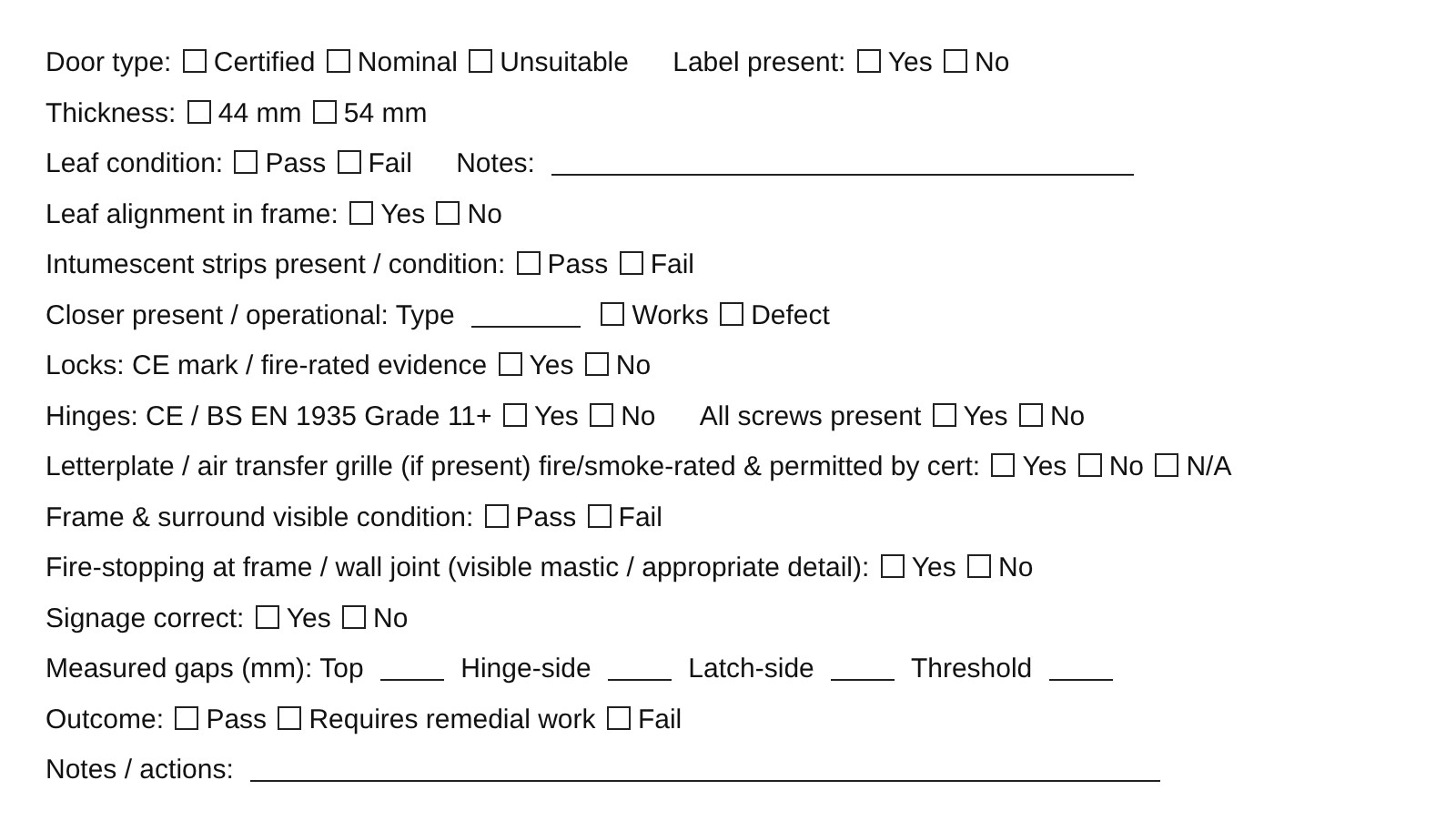
Blank Quirks fire door inspection checklist: the checks made on every door, the measured gaps and the outcome

One contractor

Inspect and repair — one contractor

The inspection report stands on its own. You can ask Quirks to quote for the remedial work, or give the report to another contractor if you prefer — there is no obligation either way.

An inspection report is only useful if something happens next. Because Quirks is one contractor with all trades under one roof, the remedial work the report identifies — closers adjusted or replaced, intumescent and smoke seals fitted, hinges and locks changed for fire-rated ironmongery, gaps corrected, signage fitted — can be quoted and carried out by the same company, by FireQual and BWF fire door trained operatives. Where a door is beyond economical repair, we supply and fit certificated replacement doorsets and hand over the door data and certification on completion.

Our fire door maintenance page covers the remedial work in detail, and our fire door supply and installation page the replacement doorsets.

Nearby

Related services

One contractor

The fire door services around the inspection
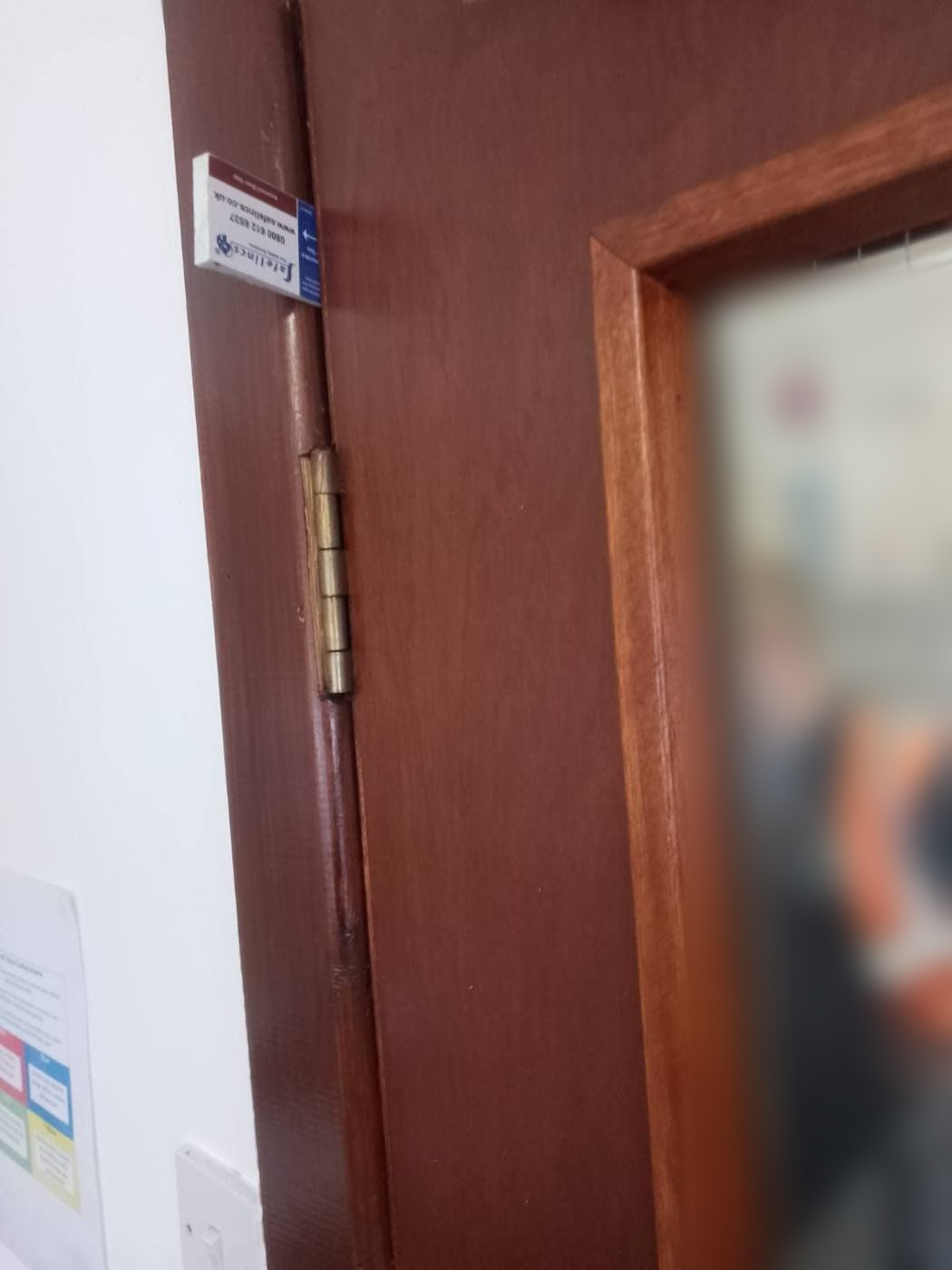
  • Gap gauge card in the hinge-side gap of a fire door with a wired-glass vision panel

    Fire door inspections

    Every door checked against ten points by a FireQual Level 3 qualified inspector; graded, photographed and reported on its own page.

  • Pair of cream six-panel fire doors with keep-shut signs and a pull handle in a carpeted corridor

    Fire door supply and installation

    Certificated FD30 and FD30S doorsets supplied and fitted by FireQual and BWF trained operatives, with door data and certification handed over.
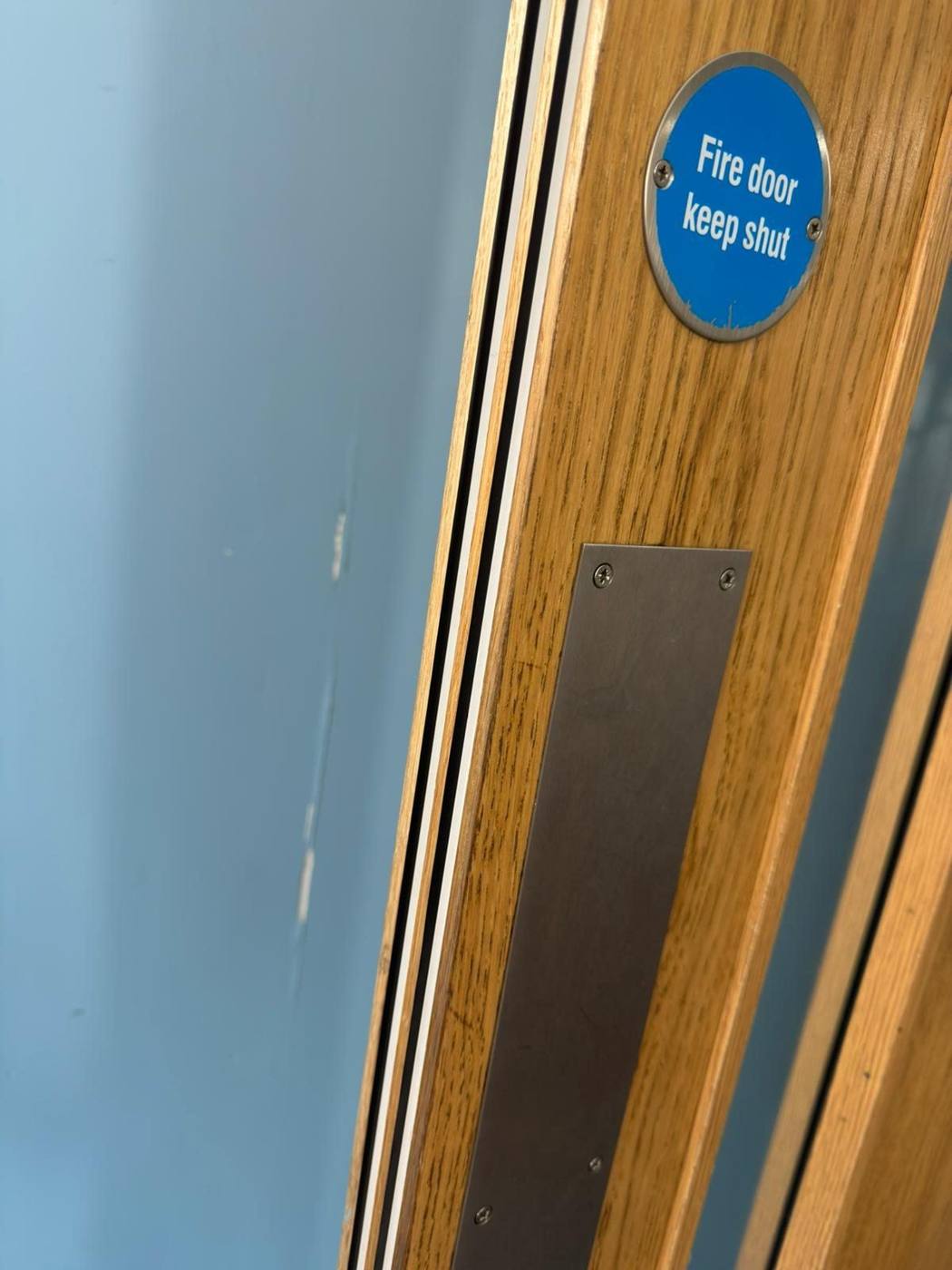
  • Fire door keep shut sign and steel push plate on an oak fire door, the seal visible in the edge

    Fire door maintenance and remedials

    Closers, seals, hinges, locks, signage and gaps put right to the inspection report, with each item checked and recorded on completion.
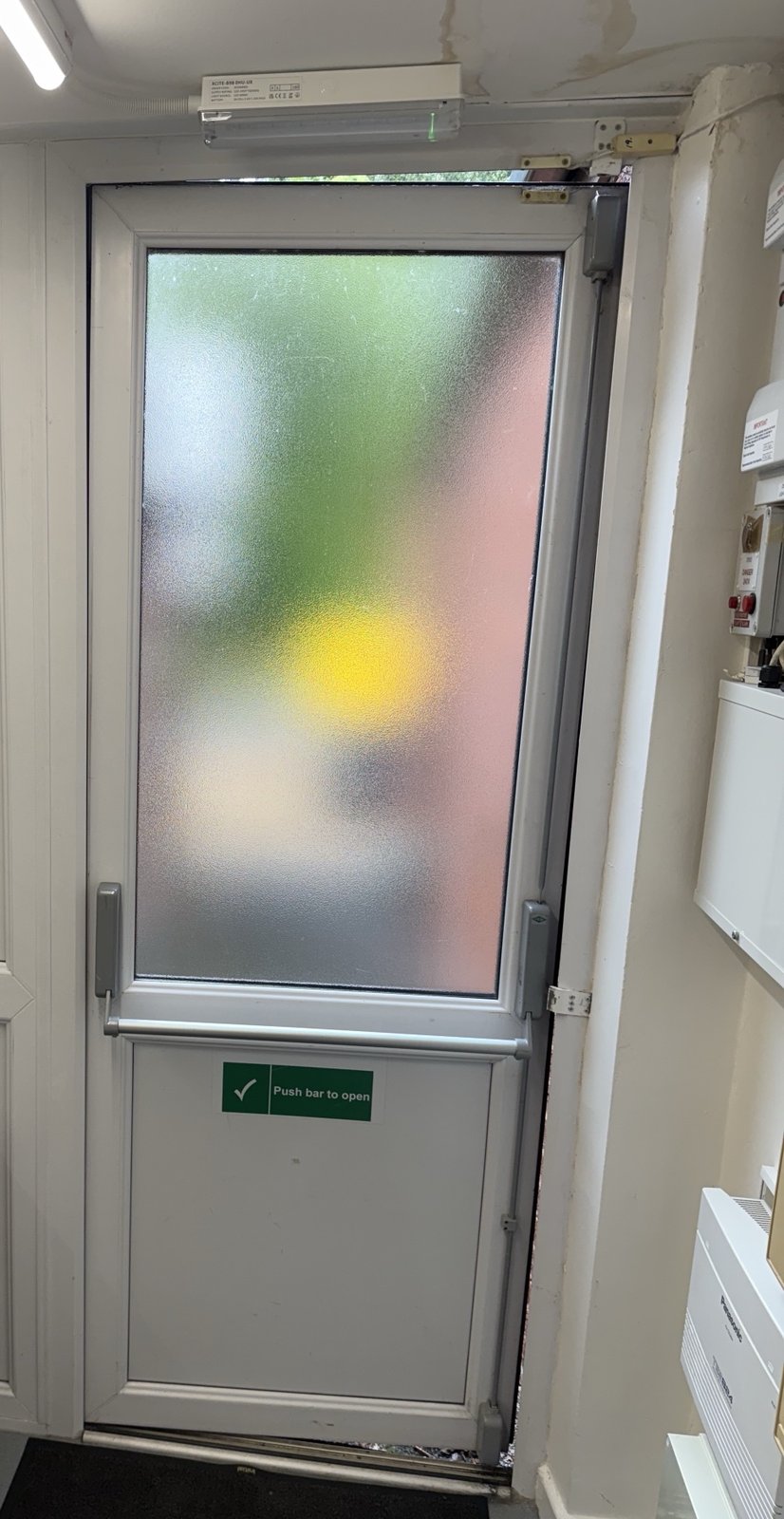
  • Fire exit door with push bar and keep-clear signage, seen from inside

    Fire exit doors

    Escape doors with push bars and exit hardware inspected, repaired or replaced as certificated doorsets.
Your questions

Questions people ask about fire door inspections

What is a fire door inspection?

A check of every fire door in a building against the things that make it work in a fire: the leaf, frame, hinges, closer, seals, glass, lock, signage and the gaps around it, carried out by someone trained to do it, with the findings written down door by door. It is what a fire risk assessment means when it says the doors need inspecting.

Who carries out your inspections?

Inspections are carried out by an inspector who holds the FireQual Level 3 Award in Fundamentals of Fire Door Inspection. The remedial work that follows is carried out by FireQual and BWF fire door trained operatives.

How often should fire doors be inspected?

Routine checks: as often as your fire risk assessment says, and in England, in blocks whose top floor is over 11 metres, communal doors every three months and flat entrance doors every year on a best-endeavours basis; those fixed checks do not apply in Wales. A detailed inspection like ours is what you book when the risk assessment calls for one, when you take on a building, when the routine checks are turning up problems, or when you need a door-by-door record. We will tell you which applies to your building.

Why do older flat entrance doors so often come back with problems?

Two different reasons, and the report keeps them apart. Missing evidence: no label or plug, no certificate for the lock, nothing to show what the door was made to — that makes the door’s rating unverified, not automatically a failure. Demonstrated defects: seals painted over or stripped out during redecoration, closers removed or disconnected, gaps outside the tolerance that applies to that door, letterboxes and fittings cut in. A door can look sound and still carry several of the second kind, and the report says which are which and what each needs.

What does “nominal fire door” mean on a report?

A door with no label, plug or other identifying marks, whose construction is consistent with a fire door and whose leaf measures at least 44 mm thick, but whose fire resistance cannot be proven by looking at it. The report calls it nominal, says its rating is unverified, assesses it against the standard it would be expected to meet, and separates the evidence that is missing from any defect that was seen. Where a door’s construction is plainly not that of a fire door, the report says that too.

Do you inspect fire doors in HMOs?

Yes. Bedroom and kitchen doors in a shared house are checked in the same way as doors in a block, and the report is written for the landlord or letting agent who needs to show the doors have been checked.

Do you repair or replace the doors that fail, or just report?

Both. The report tells you what each door needs; Quirks then quotes and carries out the remedial work, or supplies and fits certificated replacement doorsets, as one contractor. You can also take the report to another contractor — it is written to stand on its own.

Is the inspection destructive? Will my doors be damaged?

No. It is a visual, non-destructive inspection. Nothing is removed or cut; gaps are measured with a gauge and the door is photographed. Where there is no label or plug, the door is graded on what can be seen and the report says that certification could not be checked at source.

How much does a fire door inspection cost?

It is priced by the job, not a flat fee, and the things that move it are the number of doors, the type of building and how spread out the doors are, access — occupied flats need appointments, an empty office does not — and whether remedial work is to be quoted at the same time. Every inspected door gets its own report page whatever the size of the job. Most inspections we can price from the number of doors and a photograph of a typical door and frame — send them on WhatsApp or by email and we’ll come back with a written quotation.

Do you cover my area?

Yes, if you are in North Wales, Cheshire or the Wirral. We inspect across Chester and Ellesmere Port, the Wirral, Flintshire and Deeside, Wrexham, Denbighshire and Conwy. If you are just outside those areas, send us the postcode and the door count and we will tell you whether we can help.

Written and reviewed by Michael Quirk, Director.

Request a quotation

Tell us how many doors, what the building is, and attach a photograph of a typical door and frame. We will come back with a written quotation for the inspection.

    So we can confirm we cover your area.


    JPG, PNG, HEIC, WEBP or PDF, 4MB each. One photograph per box.

    We use your details and photographs to deal with your enquiry — our privacy policy explains how.

    How it works

    Send us a photo, we’ll take it from there

    You don’t need to describe the problem down the phone. A photo tells us most of what we need.

    1. 1WhatsApp or email us the number of doors, the type of building and a photo of a typical door and its frame.
    2. 2We reply with what the inspection will cover and a written quotation.
    3. 3We attend and inspect every door, at a time that suits the building and its occupants.
    4. 4You get the report: one page per inspected door, with the overall cover page.
    Send Photos on WhatsApp
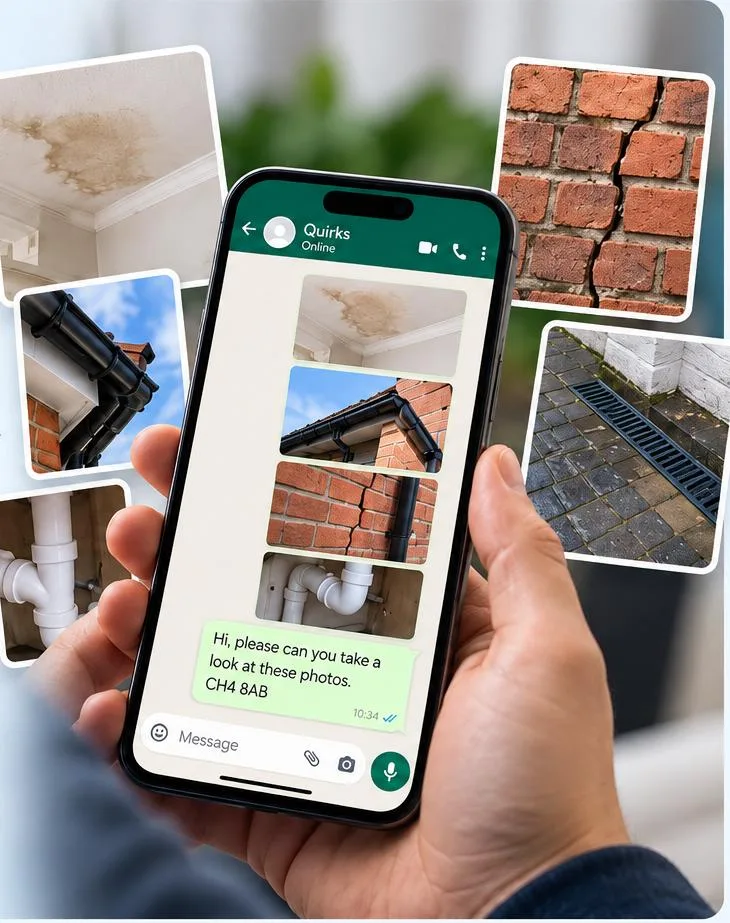
    Customer sending Quirks photos of damp, gutters, cracked brickwork and a leaking pipe on WhatsApp

    FIRE DOOR INSPECTIONS — SEND US PHOTOGRAPHS

    Concerned about your fire doors? Send us some photographs.

    Send us photographs via WhatsApp or email, and our team will review your enquiry and respond as soon as possible.

    All inspection and remedial work is quoted in writing, with the scope and costs clearly explained before you proceed.

    Photographs help us assess your enquiry initially. An on-site inspection may be required to establish the condition and compliance of your fire doors.

    Scan the code
    Powered by Joinchat