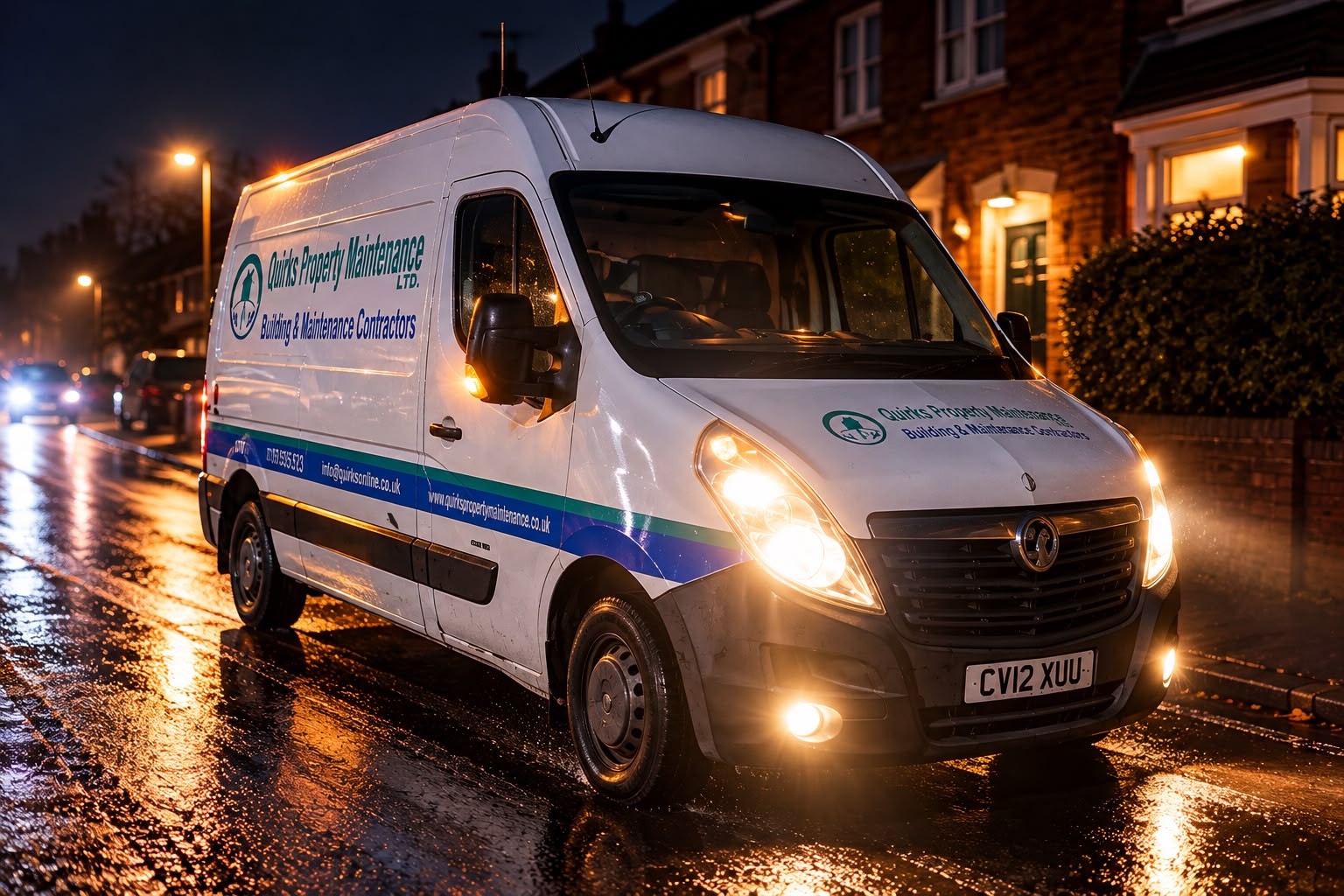
Emergency Builder
Emergency Builder — 24-Hour Call-Out Across Cheshire, the Wirral & North Wales
In short: When a building emergency strikes — a storm-stripped roof, a wall starting to move, water pouring through a ceiling, a smashed shopfront — the priority is making it safe, then repairing it properly. Where it is the roof that has been damaged, see our emergency roof repairs service. Quirks Property Maintenance Ltd provides a 24-hour emergency call-out service across Flintshire, Chester, Cheshire, the Wirral, Wrexham, Ellesmere Port and North Wales. One call. One team. Make-safe first. Permanent repair after.
Immediate danger. If there is an immediate risk to life, fire, suspected gas escape, live electrical danger, collapse or another serious emergency, leave the affected area and contact the appropriate emergency service first. Do not enter an unsafe area, stand beneath a damaged ceiling, climb onto a damaged roof or attempt to prop an unstable structure yourself.
At Quirks Property Maintenance Ltd, we respond to building emergencies for homeowners, landlords and businesses across our region — from the Victorian terraces of Chester and Birkenhead to the hillside villages of Flintshire and the exposed coastal homes of the Wirral. With an experienced, fully insured team across all building trades, we are the firm to call when something goes wrong with your building at any hour.
Quirks Property Maintenance Ltd is rated 5 stars on Google from over 100 customer reviews. We invite you to read our reviews on our Google Business Profile and compare our workmanship, communication and reliability with confidence.
Quirks Property Maintenance Ltd provides a 24-hour emergency call-out service, subject to availability. Attendance is prioritised according to the immediate risk, location, weather conditions, access and team availability. We will provide an honest estimated attendance time when you contact us. Our first job is always to make the affected area as safe as reasonably possible and to stop the damage spreading. The permanent repair follows, carried out properly with the right materials and the right trade, all under one roof.
📞 Call 01244 638219 now — lines open 24 hours, 7 days a year. Or message us on WhatsApp: WhatsApp 07719 535523.
What Counts as a Building Emergency?
If you’re not sure whether your situation is an emergency, it is worth a call. Leaving a building problem overnight can make the damage worse and the repair more expensive. We treat these as urgent:
• Storm damage — roof tiles or slates stripped, a chimney dislodged, lead flashing torn away, a tree through a roof
• Structural movement or partial collapse — sudden new cracks, a wall visibly bowing, a ceiling dropping, a lintel failing above an opening
• Water ingress and burst-related damage — water through a ceiling or down a wall, a ceiling sagging under water weight
• Flood damage — water inside the property after heavy rain, a burst pipe or a failed drain
• Fire and smoke aftermath — making the building safe and weathertight after a fire
• Break-in and accidental damage — a smashed door or shopfront, a vehicle impact leaving the building unsecured
Slow-build damp or gradual cracking is usually not an emergency — we quote for those normally. If unsure, call and we’ll tell you honestly.
Emergency or Not? A Quick Check
| The situation | What to do |
|---|---|
| Water actively coming through a ceiling, or a ceiling sagging under weight | Call now — this worsens by the hour |
| New or suddenly widening cracks, a wall or lintel visibly moving | Call now — keep people out of the room |
| Roof covering stripped or chimney dislodged in a storm | Call now — the next rain does the real damage |
| Property insecure after a break-in, impact or fire | Call now — securing it cannot wait |
| A damp patch that has grown slowly over weeks or months | Book a normal survey — see our penetrating damp pages |
| Hairline cracking that has not changed in months | Book a normal quote — usually monitoring, not emergency |
How an Emergency Call-Out Works
Knowing what happens next takes some of the panic out of the situation, so here is how a Quirks emergency call-out runs from the moment you ring:
• You call, we triage. We ask what has happened, whether anyone is at risk, whether water, gas or electricity is involved, and what you can safely see. This takes a couple of minutes and tells us who and what to send.
• You get an honest time. We tell you our realistic estimated attendance based on risk, location, weather, access and team availability — not a number we can’t stand behind.
• We make it safe. On arrival, we assess the damage, set up any exclusion needed, and carry out the make-safe: propping, sheeting, boarding, isolating services — whatever the situation calls for.
• We record everything. The damage is photographed before and after make-safe, which protects you and supports any insurance claim.
• You get a plain-English explanation. Before we leave you know what we found, what we did, what remains at risk and what must happen next.
• The permanent repair is quoted separately. Once the property is stable we assess the lasting repair, agree the scope with you (and your insurer where relevant), and book it in.
What to Tell Us When You Call
You don’t need technical knowledge — but a few details help us respond faster: what happened and when; whether anyone is hurt or at risk; which part of the building is affected; whether water, gas or electricity is involved; the property type and rough age; the address and any access issues; and whether an insurance claim is likely. If it is safe to do so, photos sent to our WhatsApp on 07719 535523 before we set off help us bring the right materials first time.
What We Do First — Make Safe
Make-safe work is intended to reduce the immediate risk, prevent further deterioration where reasonably possible and secure or isolate the affected area. Depending on the damage, part or all of the property may need to remain unoccupied until further assessment or permanent repairs are completed. Prompt make-safe action may also help reduce further damage and support an insurance claim.
Depending on the situation, make-safe work may include:
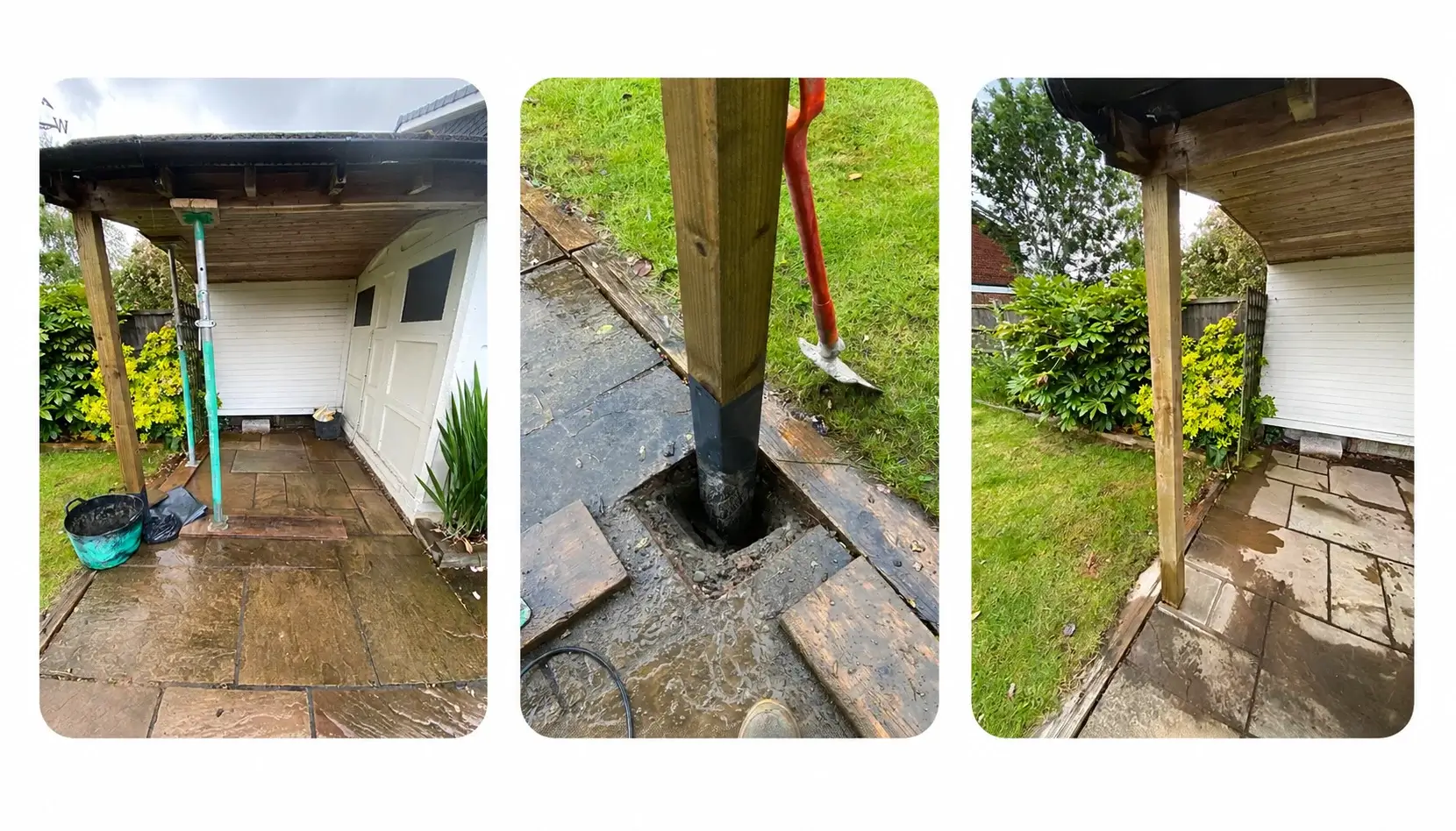
• Temporary propping of unstable elements
• Exclusion zones around hazardous areas
• Temporary weatherproofing — sheeting, tarpaulin or temporary roof covering
• Boarding up insecure windows, doors and shopfronts
• Isolation of affected services, such as water or, where safe and appropriate, electricity
• Removal of immediately dangerous loose material
• Temporary access restrictions
• Photographic records of the damage before any clearing begins
• Referral to a structural engineer or Building Control where appropriate
Temporary work reduces risk; it does not remove every risk. We will tell you clearly what remains outstanding and what the next step is.
Temporary Works — What Emergency Make-Safe Can Involve
Most emergency-building websites never explain this, so briefly: where a structure has lost support, we may install temporary propping (adjustable steel props carrying a load that has lost its support), needling (supporting a section of wall from above while work happens below it), or shoring (supporting an external wall at risk of movement). Complex needling or shoring is never improvised — it is planned and supervised with suitable equipment and, where needed, structural-engineering input, in line with current safe-working guidance. For the full explanation of how these methods work and when each is used, see our dedicated Emergency Structural Stabilisation page.
Our Full Range of Emergency Services
Because Quirks carries all the building trades in-house, one call covers the whole emergency rather than three separate contractors who each fix a third of it.
Structural emergencies. Sudden cracking, a bowing wall, a dropped ceiling or a failed lintel needs assessing and supporting fast — our structural team handles propping, needling and shoring, partial collapse and active movement, working with structural engineers where the situation demands it.
Storm and weather damage. Stripped roofs, torn flashings, dislodged chimney stacks and failed guttering — we make the roofline safe and weathertight, then repair it properly. That includes emergency gutter repairs where a failed or blocked run is pouring water down the wall face.
Water and flood damage. Our flood damage restoration team handles pump-outs, controlled drying and reinstatement after floods, while our plumbing side covers burst pipe response, leak detection service tracing hidden leaks, emergency water main repairs, blocked toilets and drains, leaking radiators and heating pipework, and overflowing tanks and cisterns.
Fire, smoke and security. After a fire, a break-in or an impact, we secure the building — boarding, temporary glazing, emergency door repairs — and make it weathertight, photographing everything for the insurer as we go.
Why Choose Quirks
• 24-hour emergency call-out, subject to availability
• Make-safe done correctly, with permanent repairs to follow
• All trades under one roof — building, roofing, plumbing, joinery, glazing
• Fully insured
• Based in Flintshire and genuinely local to the areas we serve
• Honest advice on what is urgent and what can wait
• Insurance-claim documentation support
• Rated 5 stars on Google from over 100 customer reviews
Local Knowledge — Property Types by Area
• Chester & Cheshire — period, listed and conservation property; solid-wall Victorian terraces in Hoole and Handbridge; timber-framed historic buildings needing careful first-response
• Flintshire & Deeside — exposed hillsides and estuary edge; storm-stripped roofs and chimney damage; solid-wall terraces that saturate fast. We are based in Flintshire, so we can often reach local emergencies promptly, subject to availability. Permanent works in Wales are considered under the Welsh Building Regulations system
• The Wirral — coastal salt accelerates corrosion of steel components; exposed elevations at West Kirby, Hoylake and New Brighton take Irish-Sea storms; large pre-war solid-wall stock in Birkenhead and Tranmere
• Wrexham & North Wales — stone-and-slate and modern stock; stone needs lime-compatible temporary repair; the Welsh regulatory system applies
Areas We Cover
One team covers the whole region, with dedicated local pages for our three core areas:
• Emergency Builder in Chester — the city and surrounding villages, including the listed and conservation stock the city is known for
• Emergency Builder in Flintshire — our home county, from Mold and Buckley to Flint, Holywell and the Deeside towns
• Emergency Builder in Wirral — the whole peninsula, from Birkenhead to West Kirby and Heswall
We also attend emergencies across wider Cheshire including Ellesmere Port and Neston, and throughout Wrexham, Denbighshire and North Wales. Our regular coverage spans the CH postcode areas from Chester (CH1–CH4) and Deeside (CH5–CH8) across the Wirral, plus the LL11–LL14 districts around Wrexham.
Related 24-Hour Emergency Services
Building and property emergencies: structural stabilisation and make-safe · emergency roof repairs · boarding up · emergency window repair · door repairs · flood restoration · fire, smoke and storm restoration · water damage repair · gutter repairs
Plumbing, water and drainage emergencies: 24-hour emergency plumber · emergency drainage · water main repairs · leak detection · burst pipe repair · overflowing tank and cistern repair · blocked toilet and drain clearance · radiator and heating leaks
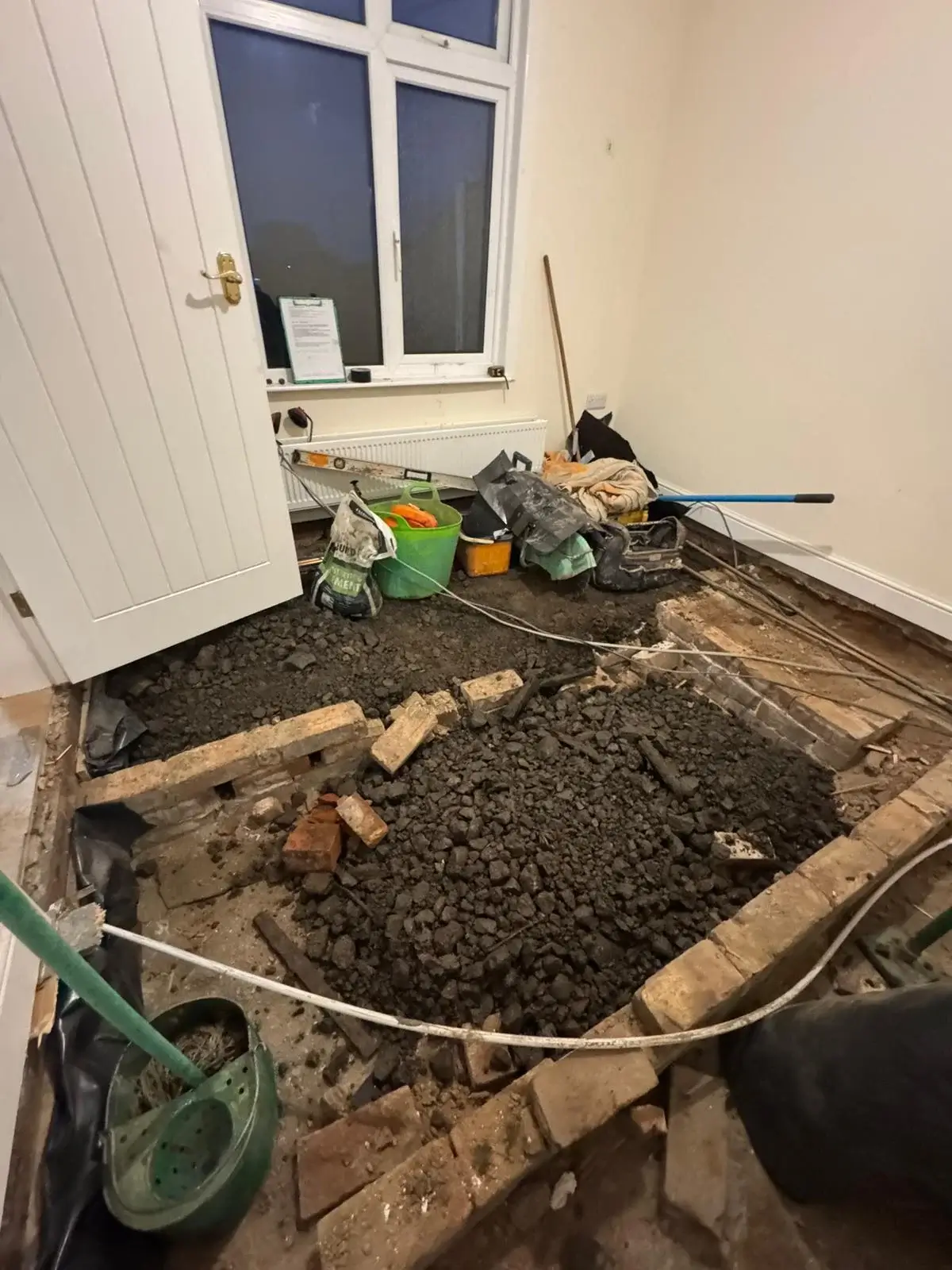
Before, During and After – Emergency Collapsed Floor Repair in Aston, Flintshire
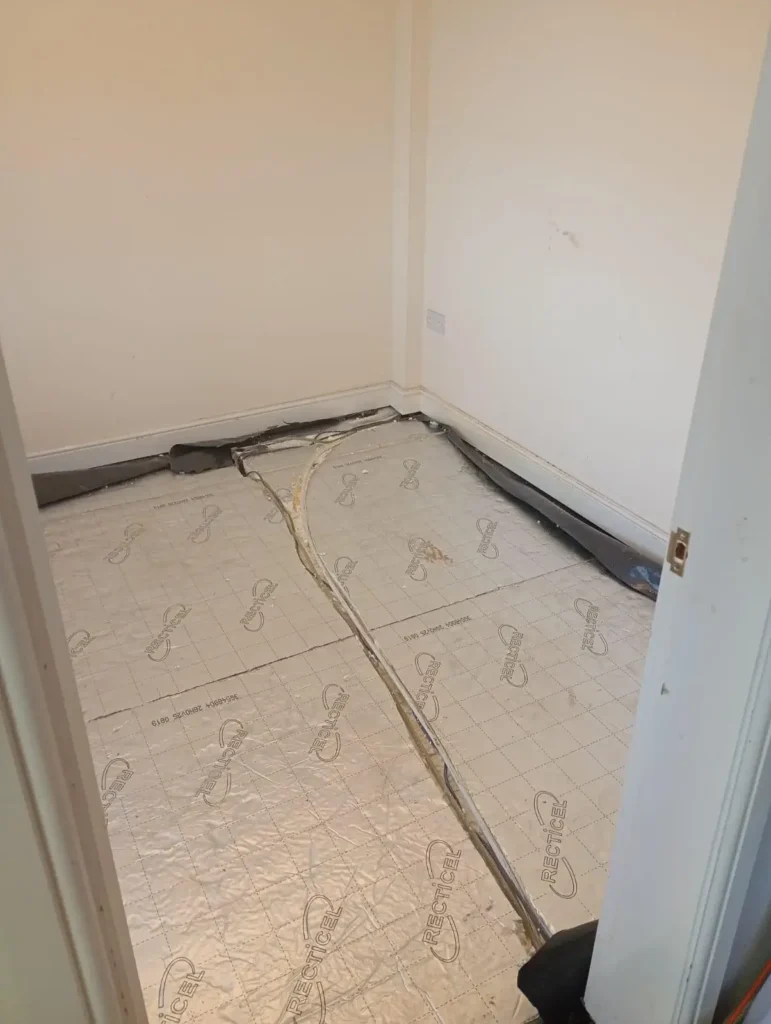
These photographs show a genuine emergency builder project completed in Aston, Flintshire, where prolonged moisture beneath the property had caused a suspended timber floor to deteriorate and collapse. Our emergency builders carried out a full strip-out of the failed floor, installed a new damp proof course (DPC), upgraded the floor insulation and constructed a new structural floor using 18mm moisture-resistant tongue and groove chipboard. As the works involved structural floor replacement, all work was completed in accordance with current Building Regulations, restoring the property to a safe, warm and structurally sound condition.
Before – Emergency Structural Assessment
The homeowner contacted Quirks Property Maintenance after sections of the floor had become unstable and begun to collapse. Following our inspection, we found that prolonged moisture beneath the floor had caused the existing suspended timber structure to deteriorate beyond repair, and that complete replacement was required. Identifying moisture as the cause mattered: replacing the floor without addressing what had destroyed it would simply have started the same process again. The affected room was made safe before the damaged floor was carefully removed, exposing the underlying floor construction for further inspection.
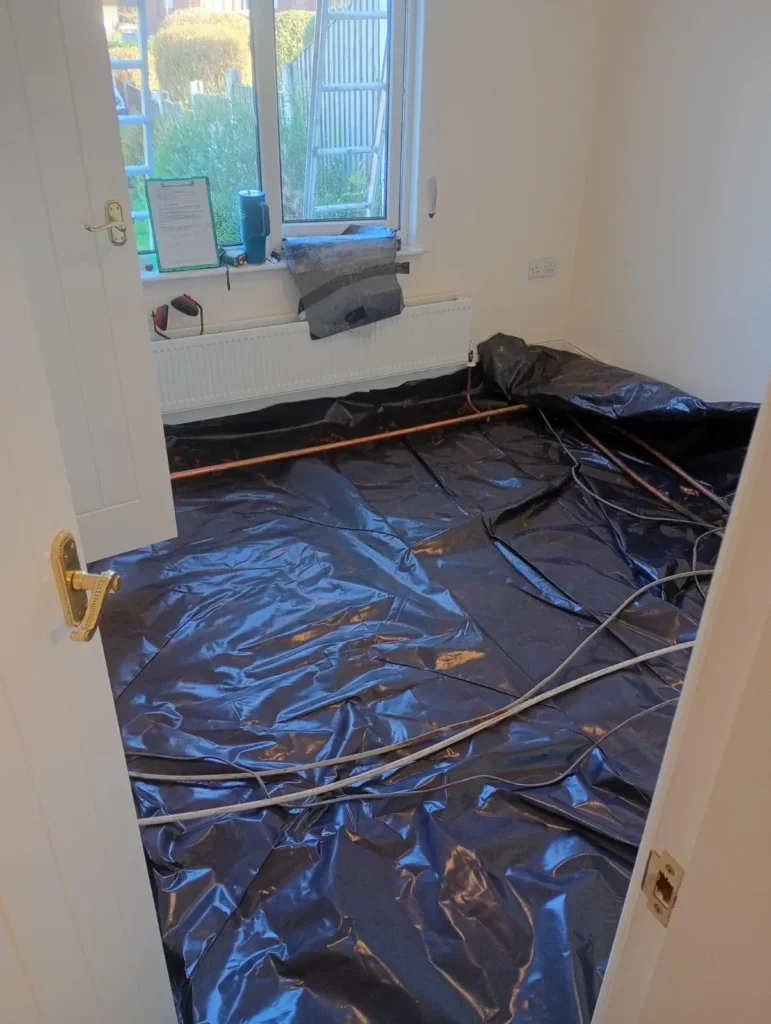
During – Structural Floor Reconstruction
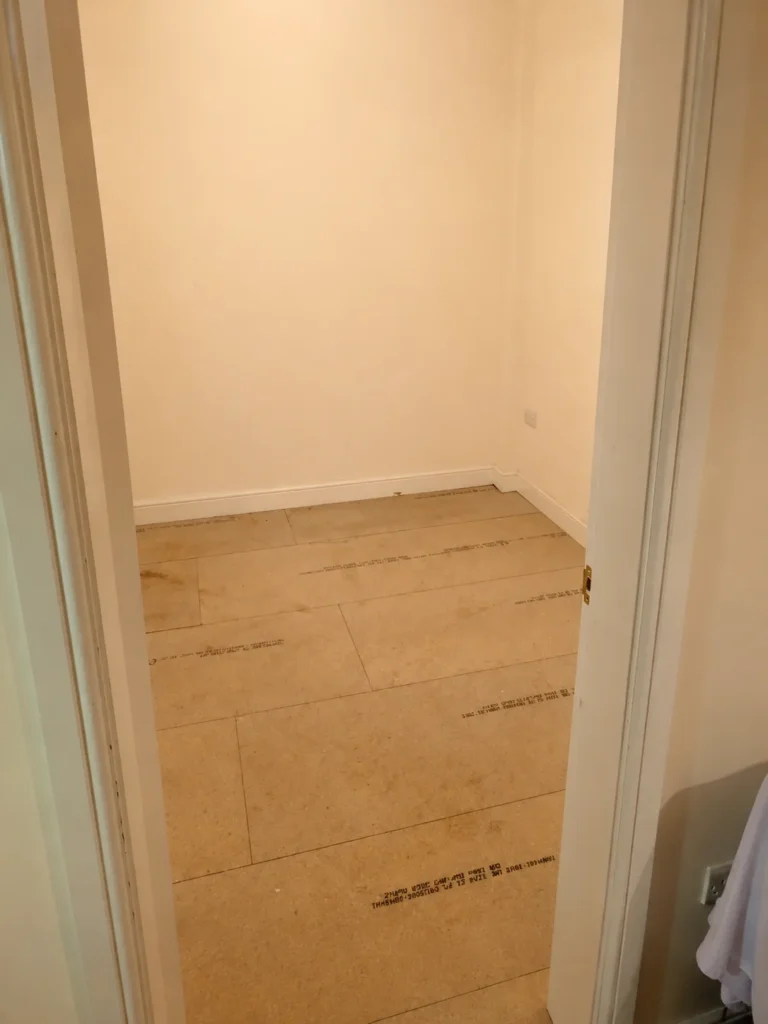
The failed floor structure was completely removed to allow the subfloor to be inspected and prepared. A new damp proof course (DPC) was installed to protect the new construction from moisture, and the underfloor ventilation was put right — the airbricks serving the void were cleared and additional ventilation provided so that air can move beneath the new floor as it should. New floor insulation was then fitted to improve the thermal performance of the property. Once the preparation works had been completed, a new structural floor was installed using 18mm moisture-resistant tongue and groove chipboard, providing a strong, level and durable base ready for the customer’s final floor finish. All works were completed in accordance with current Building Regulations.
After – Building Regulations Compliant Reinstatement
Following completion of the structural floor replacement, the room was left clean, level and ready for decoration and the installation of the customer’s chosen floor covering. The new floor now provides long-term structural stability, improved insulation and effective protection against the moisture ingress that caused the original failure.
The works were notified to Flintshire County Council Building Control under the Welsh Building Regulations system, and the property was restored to a safe, secure and structurally sound condition.
Works Carried Out
• Emergency inspection of the collapsed floor.
• Made the affected area safe.
• Removed the failed suspended timber floor.
• Inspected the existing floor construction.
• Installed a new damp proof course (DPC).
• Cleared and improved the underfloor ventilation serving the void.
• Installed new floor insulation.
• Supplied and fitted a new structural floor using 18mm moisture-resistant tongue and groove
chipboard.
• Ensured the floor was level and structurally sound.
• Completed all works in accordance with current Building Regulations.
• Final quality inspection and site clean.
Project Information
| Field | Detail |
|---|---|
| Location | Aston, Flintshire |
| Property type | Residential property |
| Issue | Collapsed suspended timber floor. |
| Service | Emergency Builder and Structural Floor Replacement. |
| Works completed | Removal of the failed floor, installation of a new damp proof course (DPC), clearance and improvement of the underfloor ventilation, installation of floor insulation, construction of a new structural floor using 18mm moisture-resistant tongue and groove chipboard and reinstatement in accordance with current Building Regulations. |
| Building Control | Notified to Flintshire County Council under the Welsh Building Regulations system. Completion certificate pending. |
| Outcome | The collapsed floor was safely replaced, moisture protection and insulation were upgraded, and the property was restored to a safe, structurally sound and energy-efficient condition. |
Emergency Call-Out Costs
Every emergency is different, so the honest answer on cost is that it depends on what has happened, when we attend and what is needed to make the property safe. The cost of an emergency job may include some or all of the following: the initial emergency assessment or call-out; out-of-hours attendance; labour; materials; boarding materials; temporary sheeting; access equipment; props and temporary-support equipment; plant hire; waste removal; return visits; monitoring; the permanent repairs; and VAT.
The emergency make-safe visit and the permanent repair may be separate scopes and may be priced separately. We will explain what each stage involves and give you a clear price for the permanent works once the damage has been assessed. Tell us as much as you can when you call and we will be straight with you about the likely costs.
Insurance Claims — How We Help
Quirks can photograph the damage, record the initial condition, provide an itemised scope and retain relevant job information to help support an insurance claim. Whether a cost is covered remains subject to the customer’s policy, insurer and loss adjuster. Prompt action may help reduce further damage.
Tell us it’s a claim when you call and we will document the works accordingly, and we can attend alongside the loss adjuster where helpful.
Frequently Asked Questions
How quickly can you get to me?
We operate a 24-hour emergency call-out service, subject to availability. Attendance is prioritised by immediate risk, location, weather, access and team availability — we will give you an honest estimated attendance time when you call. We are based in Flintshire, so we can often reach emergencies in our home county promptly, subject to those same factors.
What does emergency work cost?
It depends on the damage, the time of attendance and what is needed to make the property safe — see Emergency Call-Out Costs above for what a job can include. The make-safe visit and the permanent repair may be priced separately, and we will give you a clear price for the permanent works once the damage has been assessed.
Will my property be safe to occupy after the make-safe visit?
Often, but not always. Make-safe reduces the immediate risk and secures or isolates the affected area; depending on the damage, part or all of the property may need to remain unoccupied until further assessment or permanent repairs are completed. We will tell you honestly where things stand before we leave.
Do you notify Building Control for emergency work?
Building Regulations, listed-building consent, planning permission or other approvals may apply depending on the location, building status and scope of the permanent repair. Immediate danger may require urgent action first, but the consent and notification position for the permanent works still has to be considered — in Wales under the Welsh system and in England under the English system. We will advise on this when we assess the repair.
What's the difference between make-safe and permanent repair?
Make-safe reduces the immediate risk and secures or isolates the affected area. The permanent repair fixes the underlying problem. Separate scopes, separately quoted — make-safe first, repair once stable.
Can you help with an insurance claim?
Yes — we can photograph the damage, record the initial condition, provide an itemised scope and retain relevant job information to help support your claim, and attend with the loss adjuster where helpful. Whether a cost is covered remains subject to your policy, insurer and loss adjuster. Tell us it’s a claim when you call.
My property is listed — can you still attend?
Yes. Reducing immediate danger takes priority regardless of listing; we use reversible, material-appropriate methods and flag consent considerations for the permanent repair early.
I'm a tenant — should I call you or my landlord?
For a building emergency in a rented property, your landlord or letting agent is normally responsible for arranging and paying for the repair, so report it to them straight away. If there is immediate danger, put safety first and follow the guidance at the top of this page before anything else. Landlords and agents can instruct us directly on 01244 638219, 24 hours a day, and we work with letting agents and portfolio landlords across the region — tenants are welcome to
pass them our number.
Do you cover commercial properties?
Yes — retail, commercial, industrial and public sector, including standing arrangements for managing agents and portfolio landlords.
Get in Touch
Building emergency in Cheshire, the Wirral or North Wales? ☎ 01244 638219 ✉ info@quirksonline.co.uk — 24 hours a day, subject to availability. If there is immediate danger, contact the appropriate emergency service first.
Send Photos via WhatsApp for a quick assessment.
Our Commitment
Long-lasting, professional solutions using proven industry methods

Emergency Builder
- Emergency Builder Services In Flintshire
- Emergency Builder Services In Chester
- Emergency Builder Services In Wirral
- Emergency Builder Services In Ellesmere Port
- Emergency Builder Services In Conwy
- emergency builder in Cheshire
- emergency building work in Denbighshire
- emergency builder across North Wales
- emergency building services in Wrexham
- Emergency Builder Services In Flintshire
- Emergency Builder Services In Chester
- Emergency Builder Services In Wirral
- Emergency Builder Services In Ellesmere Port
- Emergency Builder Services In Conwy
- emergency builder in Cheshire
- emergency building work in Denbighshire
- emergency builder across North Wales
- emergency building services in Wrexham