Specialist Building & Property Maintenance Services You Can Depend On.

Load-bearing wall removal · Steel beams · RSJ installation

Load-bearing wall removal,
the steel in and the room plastered

Knocking two rooms into one, opening the kitchen into the dining room, or taking out the back wall for a run of glazed doors — we take the wall out, put the steel beam in to the structural engineer’s design, and plaster, floor and finish the room afterwards, across North Wales, Cheshire and Wirral.

Steel beams and RSJs to the engineer’s calculations
Propped and needled before a brick comes out
Boxed, plastered and made good by the same team
 
 
WhatsApp or email gets the quickest reply. We come back to you as soon as we can.
Google5.0★★★★★Based on 150+ Google reviews
Trading since2008
£5 millionpublic liability insurance in place
Workmanship guarantee on completed works
One contractorAll trades under one roof

In short: Removing a load-bearing wall is one job with three parts: the engineer’s design, the structural work under temporary support, and the making good. We do all three under one written quotation, notified to Building Control.

One contractor

One contractor for the wall, the steel and the finish

The structural work is the middle of the job. We do the parts either side of it too.

  • Engineer’s design

    We work with your structural engineer or arrange one; the beam, bearings and temporary works are specified before anything is priced.

  • Temporary works

    Props and needles carry the floor and the wall above while the old wall comes out, so the house is supported throughout.

  • The steel in

    Beam lifted in, set on its padstones, packed and bolted as the design says; Building Control inspect before it is covered.

  • Making good

    Beam boxed and plastered, the opening lined, floors re-laid, doors re-hung; see structural alterations for the rest of what we do.

What we do

What we do

  • Load-bearing walls removed between rooms, and between house and extension or conservatory
  • Rear and side walls opened up for bi-fold and sliding doors
  • Doorways and openings widened in load-bearing walls
  • Steel beams, RSJs and box frames installed to the engineer’s design, with padstones and bearings formed
  • Walls between house and garage removed as part of a garage conversion
  • Beams boxed, openings lined and plastered, floors and finishes reinstated

Beams and bearings

How the beam is supported, and where it goes

The beam sits on padstones: dense concrete or engineering-brick pads built into the wall at each end that spread the load into the masonry below. Where the wall either side is not sound enough, or the opening is the full width of the room, the engineer may specify a goalpost frame: steel posts at each end as well as the beam across the top.

Where the beam sits is the other decision. A downstand beam hangs below the ceiling line and is boxed and plastered as a shallow step; a flush beam is set up inside the floor depth so the ceiling runs through unbroken, which means opening the floor above and is more work. The engineer’s design and the floor construction decide which is possible; we talk you through both when we quote.

Flintshire — house, rear wall opened up

FLINTSHIRE — HOUSE, REAR WALL OPENED UP

Recent load-bearing wall removal project

The owners of this Flintshire house wanted the back of the ground floor opened up into one space, with a wide glazed opening out to the garden. That meant taking out most of the rear wall, which carried the floor and roof above it, and putting a steel beam in to do the wall’s job. A structural engineer designed the beam. Nothing here had failed; this is a wall that was taken out on purpose.

BEFORE

A sound wall, propped before anything came out

The rear wall ran the full width of the room and was holding up everything above it. Before a brick came out, the floor and the wall above were supported on a line of adjustable steel props and needles, so the load had somewhere to go the whole time the wall was being taken down.

With the props in, the masonry was cut out in sections to the engineer’s line, and the bearings were prepared at each end to take the new beam. The first photograph shows the room at that stage: the old wall gone, the steel in across the top of the opening, and the props still carrying the floor above while the beam was bedded and packed.

DURING

The steel in, the new wall built

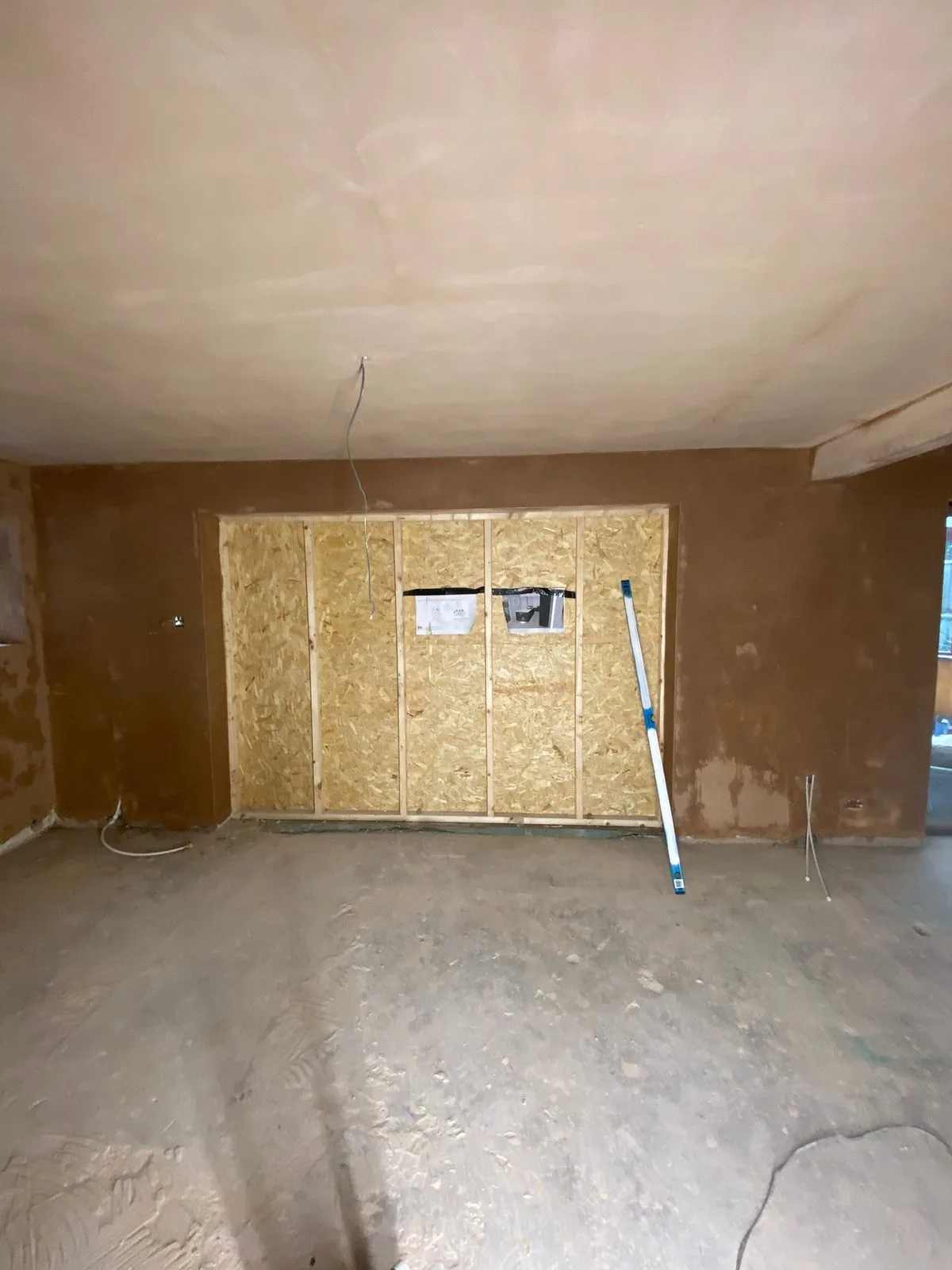
The beam was lifted in, bedded on its padstones and packed tight to the masonry above, so the structure was back on its permanent support before the props came out. The second photograph shows it from the garden end: the steel across the opening, the props still in, and the start of the new timber stud wall being built across the back of the room.

That stud wall is what turned a hole in the back of the house into a room ready to decorate. It was framed in timber, boarded, and the opening for the doors formed in it. The rest of the ground floor was then replastered, including the beam, which was boxed in and skimmed so it reads as a clean downstand rather than a steel.

AFTER

Plastered through, ready for the doors

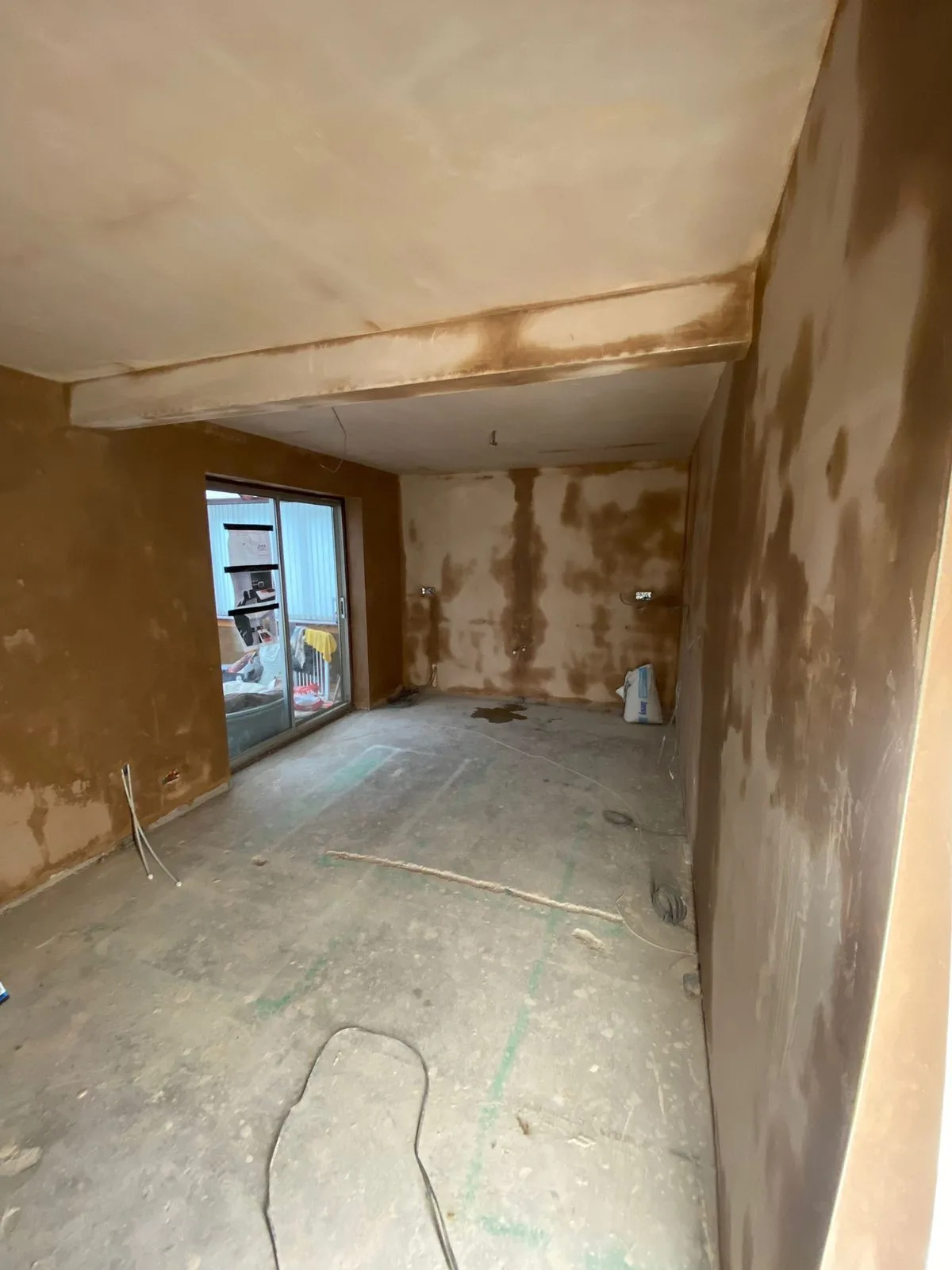
The fourth photograph shows the finished beam line from inside: plastered, square, with the new wall below it skimmed and the whole room ready for decoration. There is nothing on show to say a wall ever ran across here.

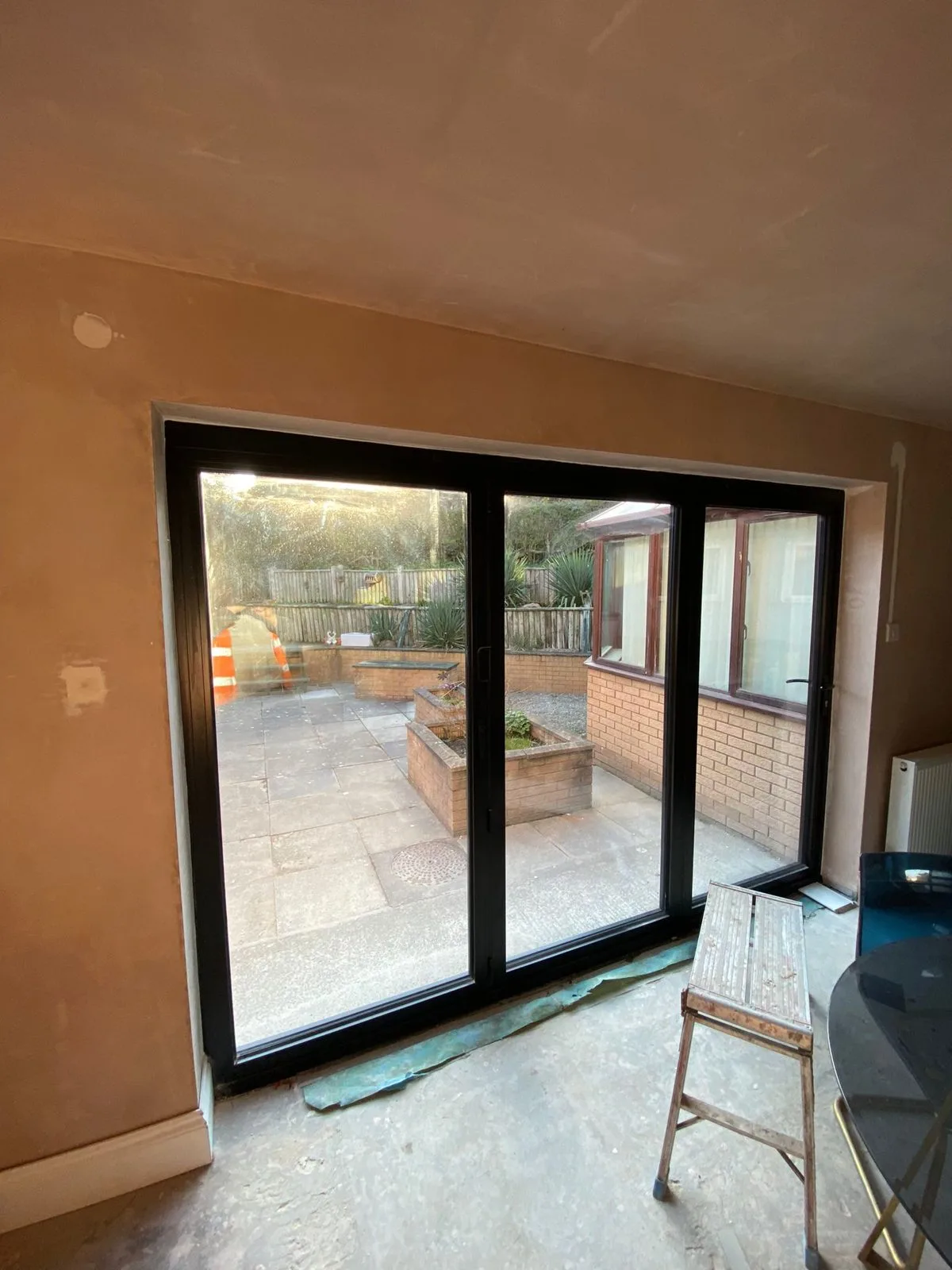
The last photograph is the opening with the bi-fold doors in. The doors themselves were supplied and fitted by another company once Quirks had formed and finished the opening; what Quirks handed over was a structurally complete, plastered room with the opening ready to take them.
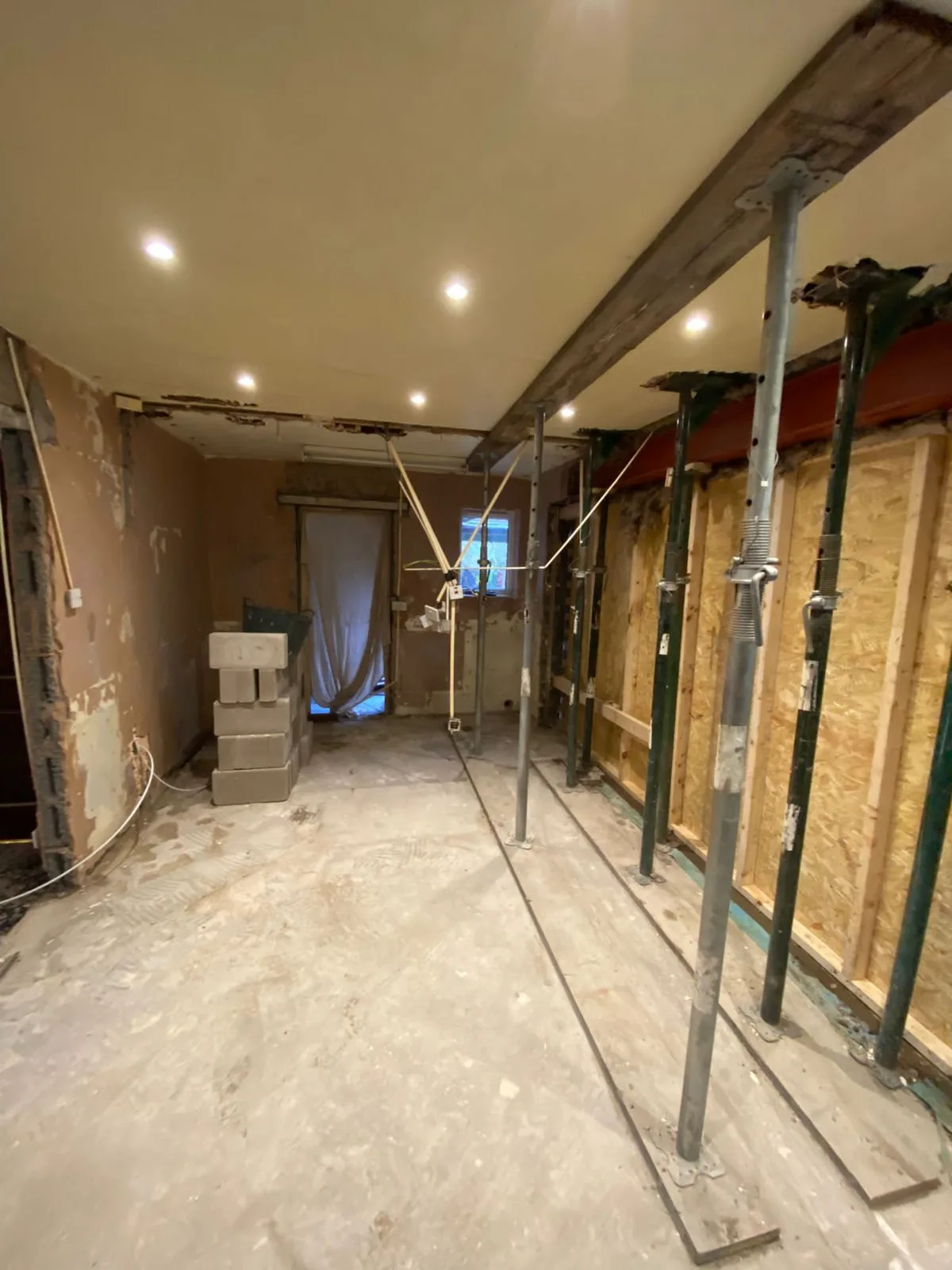
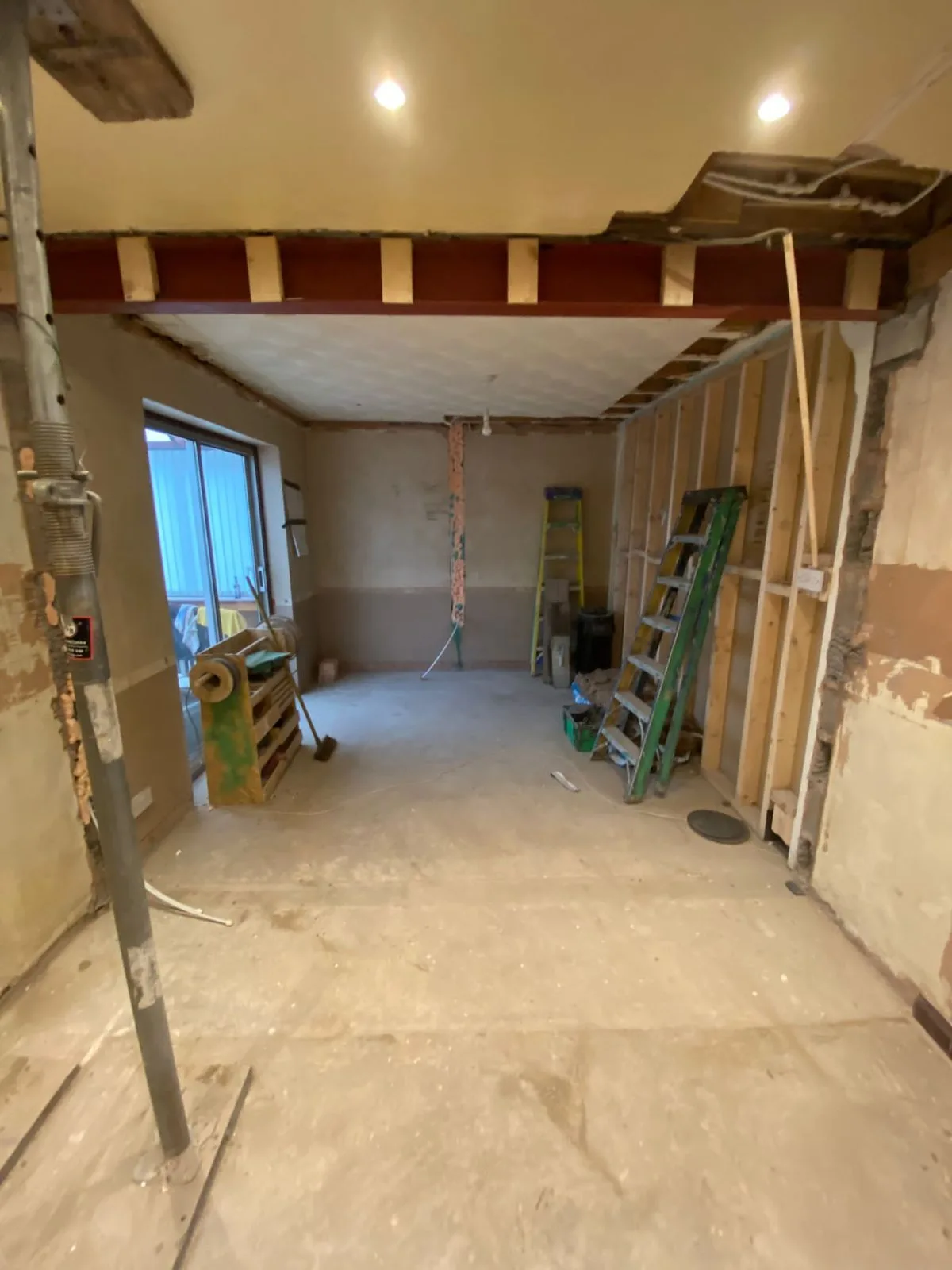
Room with the rear wall removed, a steel beam across the opening and a row of adjustable props supporting the floor above
The rear wall out and the steel in, with the floor above still carried on props while the beam was bedded.
Red-painted steel beam across a wide opening with timber packing above it, props beneath and a new timber stud wall being framed
The beam packed to the masonry above, and the new stud wall going up across the back of the room.
New stud wall boarded in OSB with the door opening formed, and the room walls and ceiling freshly plastered
The new wall boarded and the opening formed, with the room plastered through.
Plastered room with the boxed-in beam running across the ceiling line and patio doors beyond
The beam boxed in and skimmed: a clean downstand, not a steel.
Black-framed bi-fold doors in a plastered opening looking out to a paved garden
The finished opening with the bi-fold doors in — the doors themselves were fitted by others.

This study covers the structural work, the new stud wall and the plastering. The beam was designed by a structural engineer; the bi-fold doors were by others. Decoration was left to the owners.

Scope — what was done

  • Temporary works: the floor and wall above supported on adjustable props and needles before removal
  • Rear wall taken out in sections to the engineer’s line
  • Bearings prepared and padstones set at each end
  • Steel beam, to the engineer’s design, lifted in, bedded and packed
  • New timber stud wall built across the rear and boarded, with the door opening formed
  • Beam boxed in; room replastered throughout
  • Waste removed and the site cleared
LocationFlintshire
PropertyHouse
WorkRear load-bearing wall removed; steel beam installed; new stud wall built and the room replastered
Designed byStructural engineer
Building ControlWork carried out under Building Control (Wales)
Not by QuirksBi-fold doors, supplied and fitted by others
DecorationLeft to the owners
Load-bearing wall removalSteel beamStud wallFlintshire

Where we work

We remove walls and install steels across North Wales, Cheshire and Wirral, and we also cover mid-Cheshire. In the Victorian and Edwardian terraces of Chester, Birkenhead and Wrexham almost every internal wall is solid masonry and load-bearing, so the kitchen-to-dining-room knock-through is the commonest job we do; in the inter-war and post-war semis of Deeside, the Wirral and the Chester estates it is usually a single spine wall, and opening the rear wall for a run of doors has become the standard way to get light into a 1960s kitchen.

Areas we cover

  • Flintshire and Deeside — Connah’s Quay, Shotton, Queensferry, Hawarden, Flint, Mold, BuckleyCH5 to CH8
  • Chester and Ellesmere Port — Hoole, Handbridge, Upton, Blacon, Lache, Ellesmere PortCH1 to CH4, CH65 and CH66
  • Wirral — Birkenhead, Wallasey, Hoylake, West Kirby, Heswall, Bebington, BromboroughCH41 to CH49, CH60 to CH64
  • Wrexham and Denbighshire — Wrexham, Gresford, Llay, Ruabon, Rhyl, PrestatynLL11 to LL18
  • Mid-Cheshire — Northwich, Winsford, Tarporley, KnutsfordCW6 to CW9 and WA16
North WalesNORTH WALESFLINTSHIREWrexhamWREXHAMChesterCHESTERWirralWIRRALEllesmere PortELLESMERE PORTConwyCONWYDenbighshireDENBIGHSHIRECheshireCHESHIREA55M53M56A483A494Boundaries © OpenStreetMap contributors

We cover North Wales, Cheshire and Wirral from the Deeside and Chester districts out to mid-Cheshire.

What customers say

★★★★★ 5.0 · 150+ Google reviews

  • ★★★★★

    “We had two walls removed ( with one needing RSJ) to create a more open kitchen/diner/ living area. Also, new flooring and new kitchen/utility area were fitted. This was a fairly large space. Right from our first meeting with Mike, we were very happy with the high level of professionalism shown by Quirks which gave us confidence to go with them. … The team were always on time, polite and friendly, worked hard and aimed to cause minimal disruption. The site was left tidy at the end of each day which was so helpful. We are so pleased with the work which has been completed to a very high standard- Quirks have some very skilled joiners.Would highly recommend Quirks and would definitely use again in the future.”

    Susan Lloyd-Williams

  • ★★★★★

    “We needed to knock down an interior wall. Quirks was very quick to reply and came out to assess the situation to provide an accurate quote. Very good at communicating timings and all of the workers are friendly and professional. Very happy with the finished product.”

    Nicholas Huxtable

  • ★★★★★

    “Used quirks as they were highly rated and had done work on our house prior to us buying it. They removed two internal walls and did first fix electrical work, installed new heating pipes for a radiator and re-plastered a room and other bits. All done to a good standard and the workers were always polite and cleaned up after every day. Quirks was one of the more expensive quotes I was given but I’d prefer to go with a more trusted local company. Will be using them again should we have any other building work.”

    Ethan Lee Darren

Read all our reviews on Google

More from us

Related services

Your questions

Frequently asked questions

Is my wall load-bearing?

If it runs at right angles to the joists above, sits under a wall on the floor above, or stands in the middle of the house, assume it is until an engineer says otherwise. Stud walls can carry load too. Send us photographs of the wall from both sides and of the rooms above and we will tell you whether an engineer needs to look.

What is the difference between an RSJ and a steel beam?

Nothing you need to worry about. RSJ is the old name for a rolled steel joist; most beams specified today are universal beams or columns, which do the same job. The engineer picks the section; we install whatever the design says.

Do I need Building Control to remove a wall?

Yes. Removing a load-bearing wall is notified to Building Control, who inspect the steel and bearings before they are covered and issue a completion certificate at the end. In Chester, Cheshire and Wirral that is under the Building Regulations in England; in Flintshire, Wrexham and the rest of North Wales, under the Regulations as applied in Wales. The application and fee are yours; we arrange the inspections at each stage either side of the border.

Can I stay in the house while the wall comes out?

Usually, yes. The room being opened up is sheeted off and out of use while the work is on, and the rest of the house carries on. Where the kitchen is the room, you will be without it for the duration; we tell you how long when we quote.

Will there be a step in the ceiling?

If the beam is a downstand, yes — a shallow boxed step, plastered to match. If it is set flush inside the floor, no, but that means opening up the floor above and is a bigger job. Which you get depends on the engineer’s design and the floor construction; we explain both when we quote.

Do you do the plastering and flooring afterwards?

Yes. The beam is boxed and skimmed, the reveals lined and plastered, the floor made good or re-laid through the opening, and doors re-hung where the opening has moved them. You get one quotation for the structural work and the finishing.

How much does it cost to remove a load-bearing wall?

It depends on the length and size of the beam, whether it sits below the ceiling or inside the floor, how much temporary support the opening needs, whether services run through the wall, the engineer’s and Building Control fees, and how much making good follows. Most jobs we can price from photographs — send yours on WhatsApp or by email and we’ll come back with a written quotation.

Written and reviewed by Michael Quirk, Director.

How it works

Send us a photo, we’ll take it from there

You don’t need to describe the problem down the phone. A photo tells us most of what we need.

  1. 1WhatsApp or email us photos. A couple of pictures of the problem and your postcode.
  2. 2We reply with what it looks like and what happens next. Where the photos show enough, that’s a price. If not, we’ll tell you what else we need.
  3. 3You get a written quotation. A clear scope of works, so you know what is included.
  4. 4We do the work and leave it clean.
  5. 5Workmanship guarantee on completed works. In writing on your quote.
Send Photos on WhatsApp
Customer sending Quirks photos of damp, gutters, cracked brickwork and a leaking pipe on WhatsApp

Request a written quotation

Attach photographs of the wall from both sides and of the rooms above it, plus any engineer’s drawings if you have them.

    So we can confirm we cover your area.


    JPG, PNG, HEIC, WEBP or PDF. One photograph per box.

    We use your details and photographs to deal with your enquiry — our privacy policy explains how.

    Prefer to send photos? Message us on WhatsApp

    LOAD-BEARING WALL REMOVAL — SEND US PHOTOGRAPHS

    Thinking of taking a wall out? Send us a photo.

    Scan the code
    Powered by Joinchat