Specialist Building & Property Maintenance Services You Can Depend On.
Storm damage, an active leak, slipped slates or a flat roof that has let go — we make the situation as safe as conditions allow, help keep the weather out and then repair it properly. Emergency call-outs across Cheshire, Flintshire, Wrexham and the Wirral, any day of the week.
If there is an immediate risk to life, a fallen power line, fire, suspected gas escape, major structural collapse or another serious danger, move to a safe place and contact the appropriate emergency service first.
Call 01244 638219 or WhatsApp 07719 535523 now, or send a photo on WhatsApp. For a quote or a non-urgent inspection, use the form further down.
Emergency call-outs are subject to availability, weather, safe access, location and the nature of the damage. We will give you an honest indication of attendance when you call.
Emergency Roofer — Call Any Time, Day or Night
Photographs help us understand the problem before we set off
Photographs help us understand the problem before we set off. They may not show the full extent or cause of the damage, so an inspection may still be needed.
Not every roof fault needs someone out tonight, and we will tell you honestly which yours is. Treat it as an emergency if:
A damp patch that has been there for weeks, a single slipped slate with no water inside, or moss and worn pointing are not emergencies. They still need doing — book them as a normal repair through the form below and we will come and look properly.
Why the first few hours matter
If materials remain wet, plasterboard and insulation can quickly become saturated, timber can take up moisture and the risk of mould and further deterioration increases. Early temporary weatherproofing can significantly reduce the extent of the internal damage.
Do not go up a ladder to look, and do not let anyone else. Wet slates, wind and a damaged structure are how people get badly hurt.
Buckets under the drip, a bin liner over furniture, towels along the base of a wet wall. If a ceiling is bulging, keep everyone out of that room.
If water is near lights, sockets or the consumer unit, switch the electrics off at the consumer unit — but only if you can reach it safely and stay dry doing so.
Away from anything that might still fall — loose slates, a leaning stack, a lifted section of felt.
From the ground or from inside. Send them to us on WhatsApp and tell us your postcode and what kind of building it is.
If you cannot get through first time, send the WhatsApp with your postcode and we will respond as soon as we can.
Do not attempt a repair yourself. A tarpaulin thrown over a roof in wind is a sail, and a roof that has just failed may not take your weight.
AREAS WE COVER
We are based at Ewloe Green in Flintshire and work across Cheshire and North Wales. Each of these pages has the detail for its own area — the housing, the weather, the postcodes and a recent job:
We also come out to Deeside, Ellesmere Port and the rest of west Cheshire, Denbighshire — Ruthin, Denbigh, St Asaph, Rhyl and Prestatyn — and along the North Wales coast to Conwy and Llandudno. If you are not sure whether we cover you, ring and ask.
CHESTER — TILED PITCHED ROOF
A call from Chester with water coming into the property. The tiles were not the whole story — the layer underneath them had perished, which is why a roof that looked serviceable from the ground was letting water into the house.
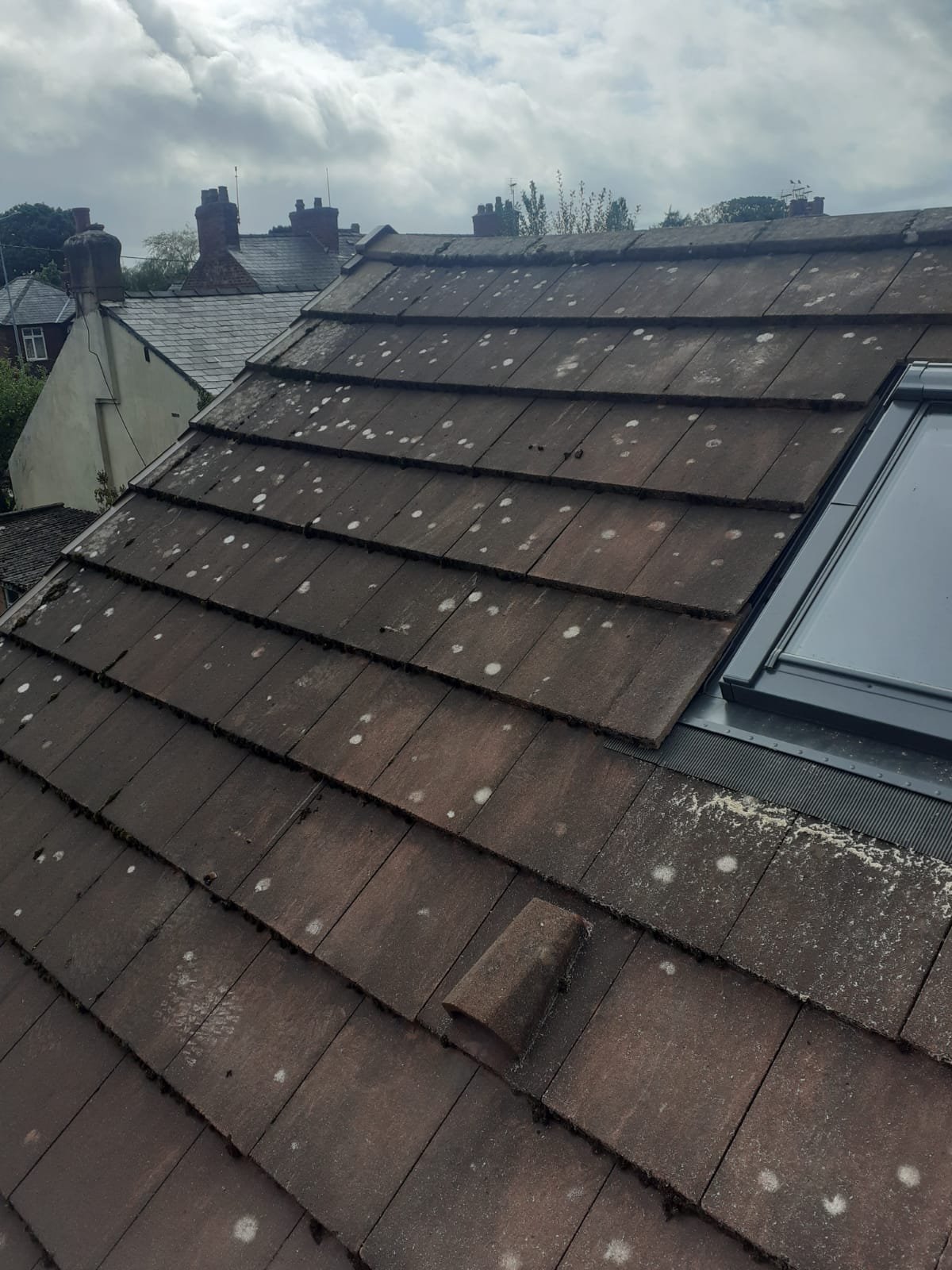
The customer reported water entering the property. From the ground the roof looked much like any other roof of its age: tiles weathered, lichen on the surface, nothing that would make a passer-by stop. That is normal. Almost no roof that leaks looks like a roof that leaks.
Getting onto the slope told a different story. Tiles were sitting proud in places rather than lying down as they should, which is enough on its own to let water past the covering in wind-driven rain. But a roof in good order can take that, because the covering is only the first line — everything that gets past it is supposed to land on the underlay and be shed back out at the eaves.
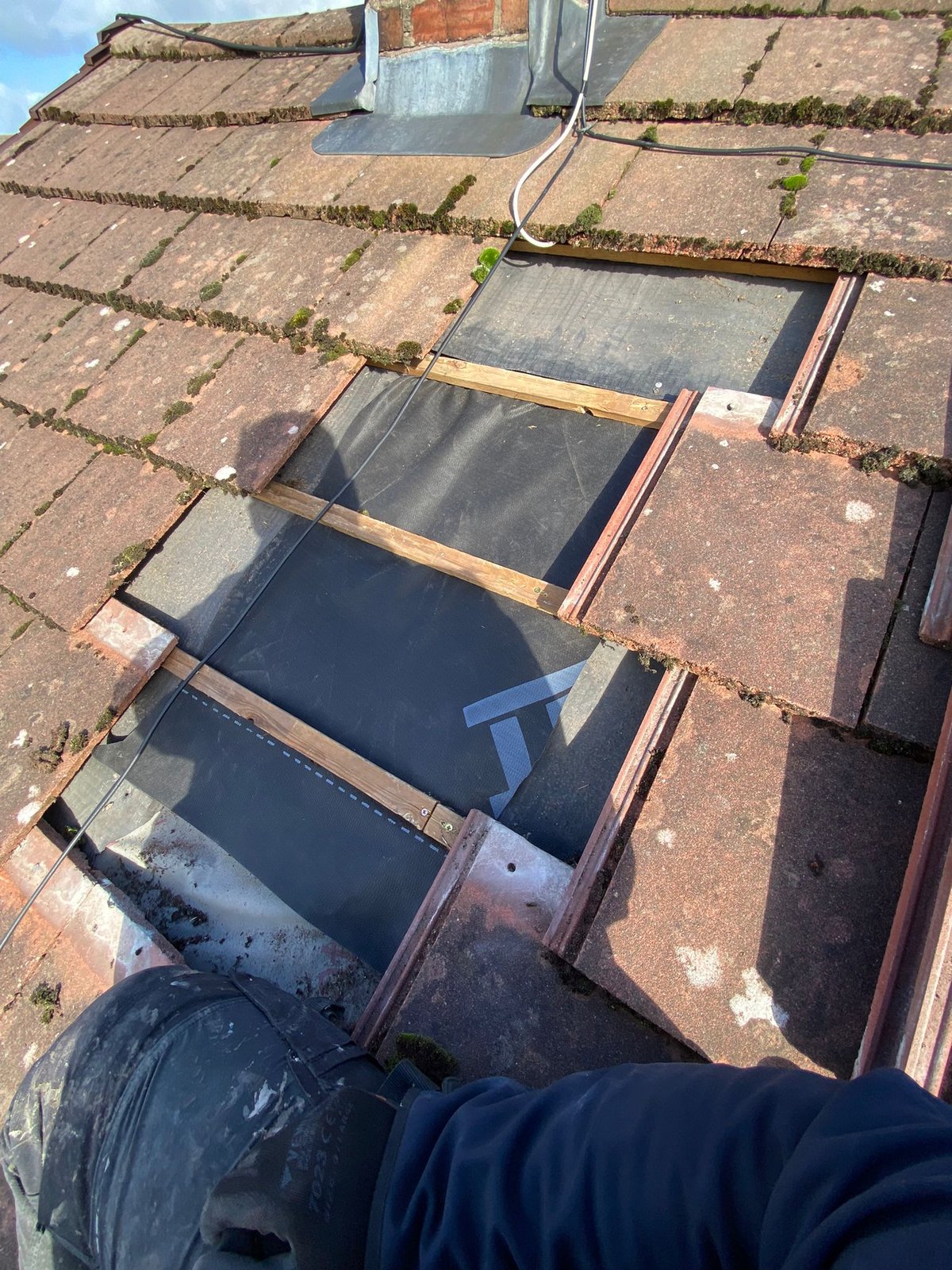
The underlay had perished. On roofs of this age the felt goes brittle, tears along the batten lines and breaks down where it is most exposed, and once that has happened it is no longer doing anything. Water getting past the tiles was landing on nothing and running straight through into the roof space. That is the answer to the question people ask when a roof leaks in one spot after decades of being fine: nothing suddenly broke, the second line had simply worn out.
The affected area was stripped back, the perished underlay removed and replaced with new membrane, and new treated battens fixed over it before the tiles went back down. The work was kept to the area that needed it rather than extended across the whole slope, and the existing tiles were re-laid where they were sound.
With the tiles re-laid, the slope looks as it did before. There is no visible evidence that anything happened, which is the correct outcome for this kind of work — a localised repair on an older roof should disappear rather than announce itself with a patch of new tiles in the middle of weathered ones.
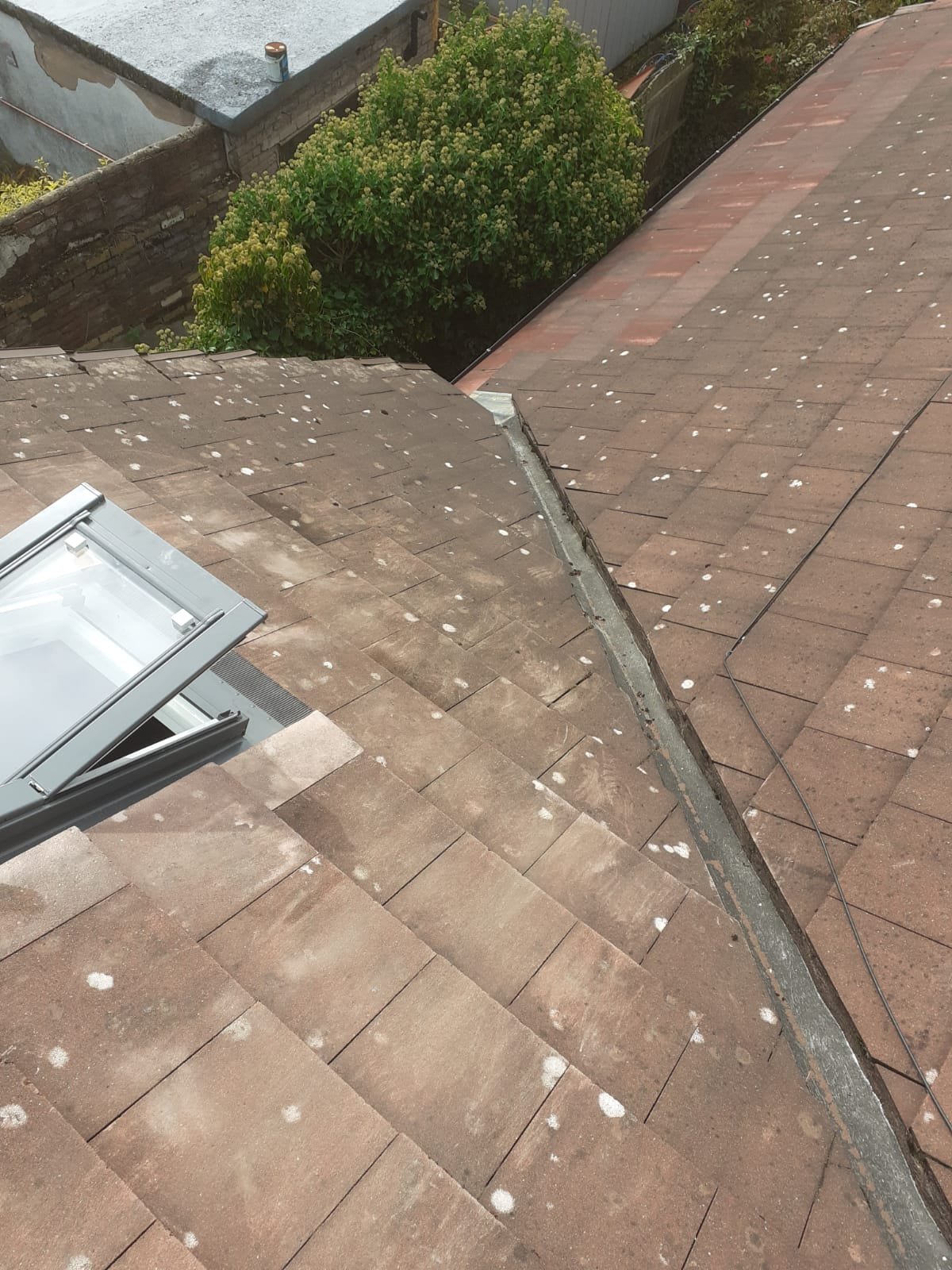
The water ingress was stopped, and the part of the roof that had failed is now doing its job again beneath a covering that matches the rest. The customer was also told plainly that the underlay across the rest of that slope is the same age as the piece that failed and is likely to be in much the same condition — better to know that now than to find out one storm at a time.
The useful thing to take from this one is what a roof actually is. Most people think of it as the tiles, and the tiles are what you can see — but underneath there is a membrane whose entire job is to catch what gets past them. While that layer is intact, a slipped tile is an inconvenience. Once it has perished, the same slipped tile puts water in the house. That is why a roof can be fine for thirty years and then leak in a single storm, and it is why the repair here was to the layer nobody ever looks at rather than to the one everybody does.
| Location | Chester |
|---|---|
| Property | Tiled pitched roof |
| Reported | Water coming into the property |
| Attendance | Attended the same day the water ingress was reported |
| Cause | Perished underlay beneath the tile covering |
| Works | Affected area stripped, new membrane and treated battens installed, sound tiles re-laid |
| Outcome | Permanent repair — water ingress stopped |
WHAT WE ARE CALLED TO
The eleven things we are called out to most often:
Ridge tiles, slates and hip tiles lifted or thrown off; lead flashing peeled back; a whole area of tiles stripped where the wind got under them. Where conditions allow, we make the exposed area safe and apply temporary protection first, then return to repair it properly.
Water through a ceiling or down a chimney breast during rain. Finding the way in is the skill — it is often not directly above the wet patch — and on the first visit we trace it only as far as we can reach safely.
One slipped slate on an older roof can be a sign the nails are failing along the course. We refix or replace what has moved and tell you what the rest of the roof is likely to need, depending on its age, construction and maintenance history.
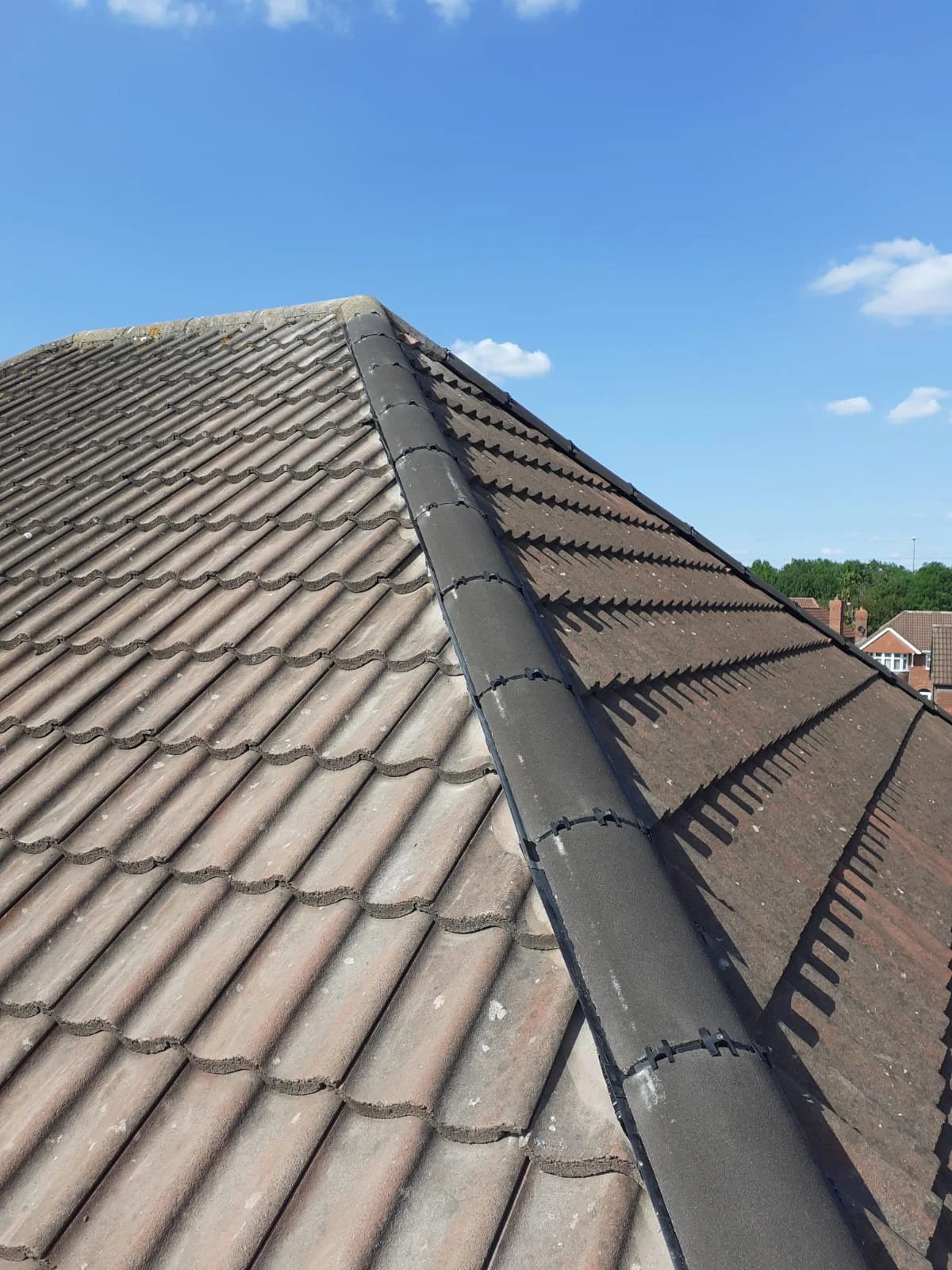
Mortar-bedded ridge and verge tiles are among the commonest storm casualties on bungalows and inter-war semis. Where the mortar has failed along the run, a mechanically fixed dry ridge or dry verge system may be the right permanent repair.
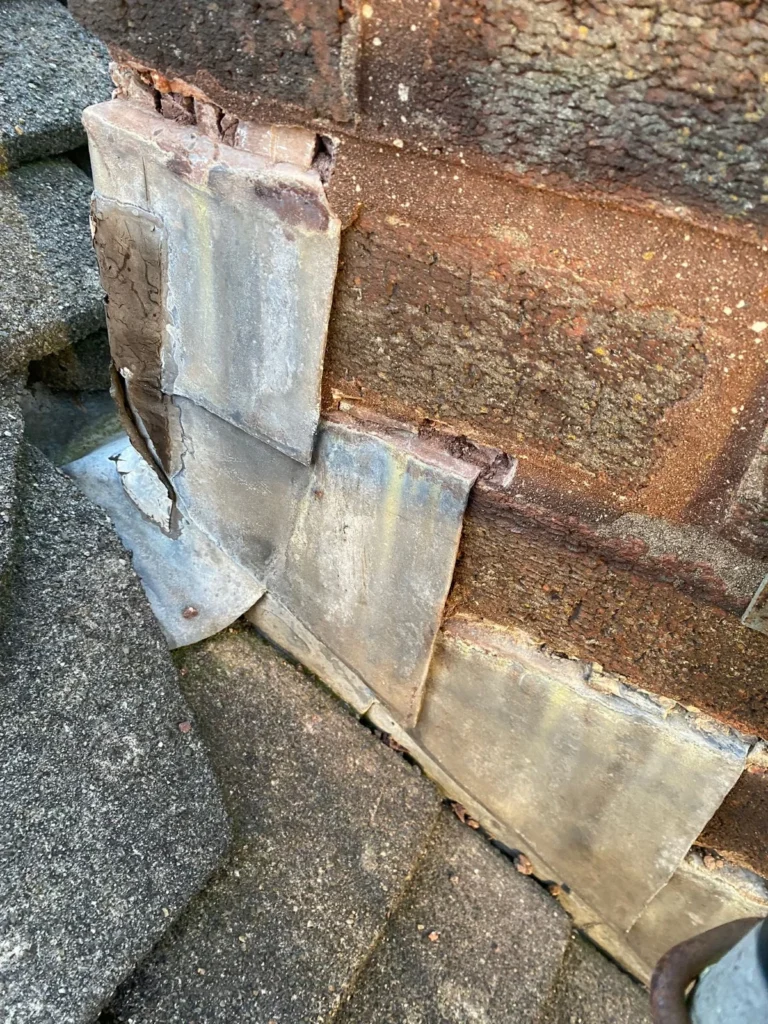
Lead pulled away from a stack or abutment, rotten fascia letting water behind the gutter, a failed valley. Small areas, big leaks.
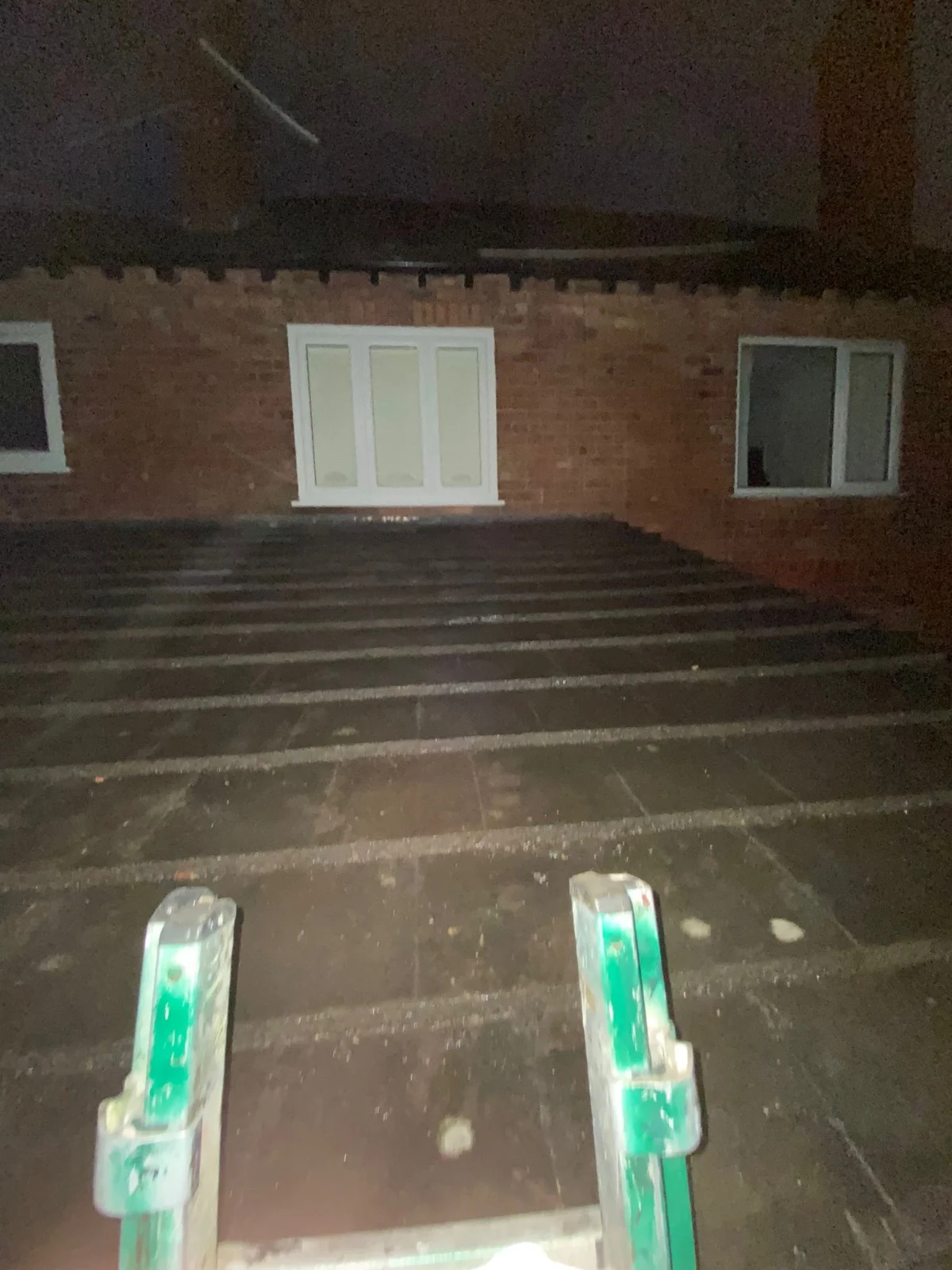
Garages, porches, dormers and extensions with felt, asphalt or EPDM that has split, blistered or lifted. Where it is safe and practicable, we aim to stop or substantially reduce water ingress on the first attendance; a tired flat roof may need a proper recover, which we will quote for separately.
A rooflight or roof window smashed by debris, or one that has started letting water in around the frame during a storm. Where safe access allows, we can cover or seal it on the visit to limit water into the room below, and replace or re-flash it as the permanent repair.
A valley that has split or a gully that has blocked can send a whole roof’s worth of rain down one seam, and it can show up inside fast. Where safe access allows, we clear or temporarily seal it on the visit and quote the proper valley repair.
Storm damage to a stack — loose pots, cracked flaunching, displaced brickwork — often comes with the roof damage around it. Where safe access allows we make the stack safe with the roof, and can carry out chimney repairs as a follow-on where it needs rebuilding or repointing.
A branch, a tree or an aerial through the roof can do more than break tiles — it can crack rafters and push the structure out of line. We clear what is safe to clear, check where we can whether the timbers underneath have been hit, and advise on any shoring or structural make-safe work needed before the roof is covered.
Slates in the garden, a section of guttering down, a stack leaning — anything that could still fall is dealt with before anything else, where safe access allows.
An emergency visit is not the same as a finished repair, and we will not pretend otherwise. This is the order things happen in:
Where safe access and conditions allow, anything that could fall, or that someone could fall through, is dealt with first.
In daylight and dry conditions that usually means getting onto the roof. At night or in a gale it may mean working from a ladder, a platform or inside the loft until conditions allow more.
Where conditions, access and the nature of the damage allow, we can apply temporary weather protection — sheeting, a properly secured tarpaulin, temporary sealing.
Sometimes it can be done there and then. Often it needs materials, scaffolding, daylight or a dry day, and we explain the options, what they involve and what they are likely to cost before we leave.
Temporary weather protection is exactly that: it buys time, it is not the repair. For the permanent work — from refixing a course of slates to a full recover — see planned roof repairs and replacement.
A storm that takes tiles off rarely stops there. If it has brought down masonry, damaged a gable or left a wall or stack that needs making safe, our emergency builder service can be coordinated with the roofing visit where available, and we will advise on the appropriate next repair.
If a rooflight, window or door has gone with it and the building is open, our emergency boarding-up service can secure it — on the same visit where available.
Once the roof is protected, what the water has done inside still needs putting right. Our ceiling, floor and wall water-damage repair service deals with collapsed ceilings, saturated plaster and lifted floors, and can be arranged as the next step.
Where the storm has moved masonry — a cracked gable, a displaced parapet, a stack that has shifted on its base — that is a structural question before it is a roofing one, and our structural crack repair service can assess it and advise on the appropriate next repair.
Where enough water has come in to need the building drying out and stripping back — saturated floors, walls and insulation rather than a wet patch — our flood damage restoration service handles the drying, decontamination and reinstatement, and can be arranged as the next step.
We take emergency roofing calls out of hours, every day of the week.
WHO WE WORK FOR
Most of our emergency roofing calls come from homeowners, and most of what is on this page is written for them. But a roof that lets go at 9pm on a Sunday is the same problem in a rented house or a shop, and we attend those too.
For landlords and letting agents the difference is the paperwork: if requested and agreed, we can report back with photographs and a written description of the visible damage and works carried out, for the tenant and the insurer. For businesses — shops, offices, industrial units, public buildings — the difference is usually scale and access. Our reactive maintenance for landlords and businesses service covers more than roofs.
We're here when you need us most.
What you get when you call us out:
Send photos for fast help
We will explain the likely cost of the emergency attendance and the temporary work before we set off, so you know where you stand before we arrive rather than afterwards. If the job turns out to be more involved than it first appeared, we explain the additional work and what it means before we carry on. Nothing happens without you knowing what it involves.
The permanent repair is quoted separately once we have seen the roof properly. What it costs depends on the size of the damaged area, the roof covering, how high and how accessible it is, whether scaffolding is needed and whether the fault is one storm’s damage or the roof reaching the end of its life.
If requested and agreed, we can provide photographs and a written description of the visible damage and works carried out for you to pass to your insurer. Your insurer decides how a claim is handled.
Six details and we’ll come back to you. For emergencies, call 01244 638219.
We take emergency roofing calls out of hours, every day of the week.
Send photos and details for fast help.
Memberships and certifications
Yes. We take emergency roofing calls out of hours every day of the week. Attendance is subject to availability, weather, safe access and the nature of the damage — in a gale at 2am the safe thing may be to secure what we can from the ground and come back at first light, and we will tell you that on the phone.
We are based at Ewloe Green in Flintshire and cover Flintshire, Chester and the rest of west Cheshire, the Wirral, Wrexham, Deeside, Ellesmere Port, Denbighshire and along the North Wales coast. The pages for Flintshire, Chester, the Wirral and Wrexham above have the detail for each; for anywhere else, ring and ask.
Yes. We work for homeowners, for landlords and letting agents, and for businesses — shops, offices, industrial units and public buildings. For landlords and businesses who want one number for everything that goes wrong, our reactive maintenance service covers more than roofs.
If requested and agreed, we can provide photographs and a written description of the visible damage and works carried out for you to pass to your insurer. Your insurer decides how a claim is handled; the claim itself is yours to make.
Your postcode, what kind of building it is, what you can see from the ground or from inside, whether water is coming in now, and whether anything has fallen or looks like it might. Photographs on WhatsApp help, but ring first if water is coming in.
Where a permanent repair cannot safely be completed on the first visit, temporary weather protection may be appropriate — sheeting or a properly secured tarpaulin, or temporary sealing. We will explain what can safely be done and the recommended next step. It is a stopgap, not the repair.
Sometimes — a few slipped slates or a small flashing repair in daylight can be finished there and then. More often the permanent work needs materials, scaffolding or a dry day, and the first visit is about making it safe and keeping the weather out. We will tell you which yours is before we leave.
We will explain the likely cost of the emergency attendance and the temporary work before we set off, so you know where you stand before we arrive. If more work is needed than first appeared, we explain it before carrying on.
Please do — WhatsApp them to 07719 535523 with your postcode. Photographs from the ground or from inside help us understand what we are coming to and what to bring. They may not show the full extent or cause of the damage, so an inspection may still be needed.
Yes. Split, blistered or lifted felt on garages, porches, dormers and extensions is a large part of what we are called to. Where it is safe and practicable, we aim to stop or substantially reduce water ingress on the first attendance. If a permanent repair cannot be completed safely, we will explain the temporary measures available; if the roof covering has reached the end of its life we quote for a proper recover.
Call 01244 638219 or WhatsApp 07719 535523 any time. Or send photographs of the damage on WhatsApp to WhatsApp 07719 535523 with your postcode and we will respond as soon as we can.
Emergency call-outs are subject to availability, weather, safe access, location and the nature of the damage. We will give you an honest indication of attendance when you call.
Not an emergency? Use the form to book a roof inspection or ask for a quotation and we will come and look properly.
★★★★★
Based on 100+ Google reviews
In building repair and emergency roofing
£5 million public liability insurance
Emergency Roof Repairs — Send Us Photographs
WhatsApp or email is the quickest way to contact us. We’ll respond as soon as we can.