Specialist Building & Property Maintenance Services You Can Depend On.


 5.0★★★★★Based on 150+ Google reviews
 Trading since2008
 £5 millionpublic liability insurance in place
 Workmanship guarantee on completed worksOne contractorAll trades under one roof

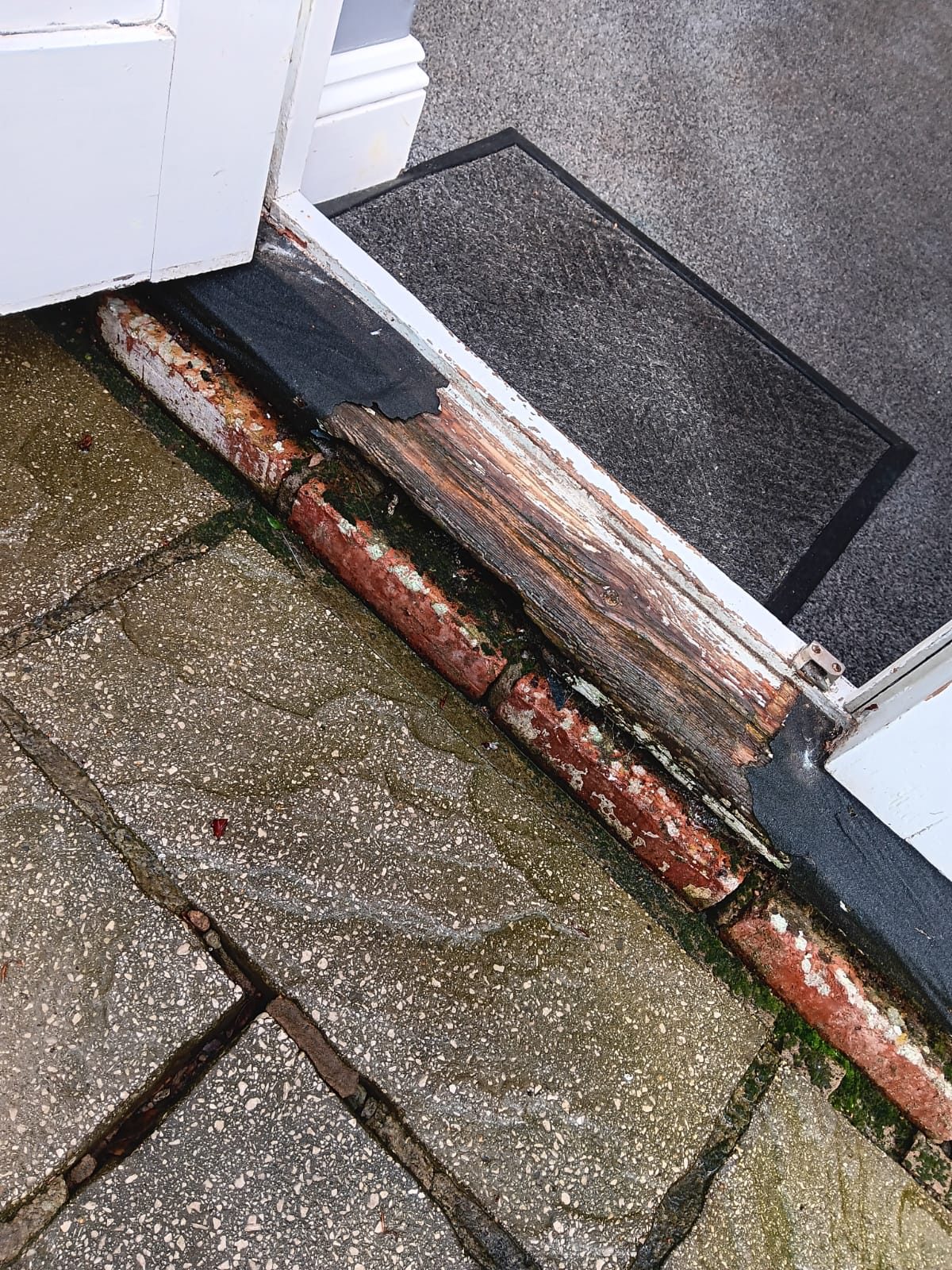
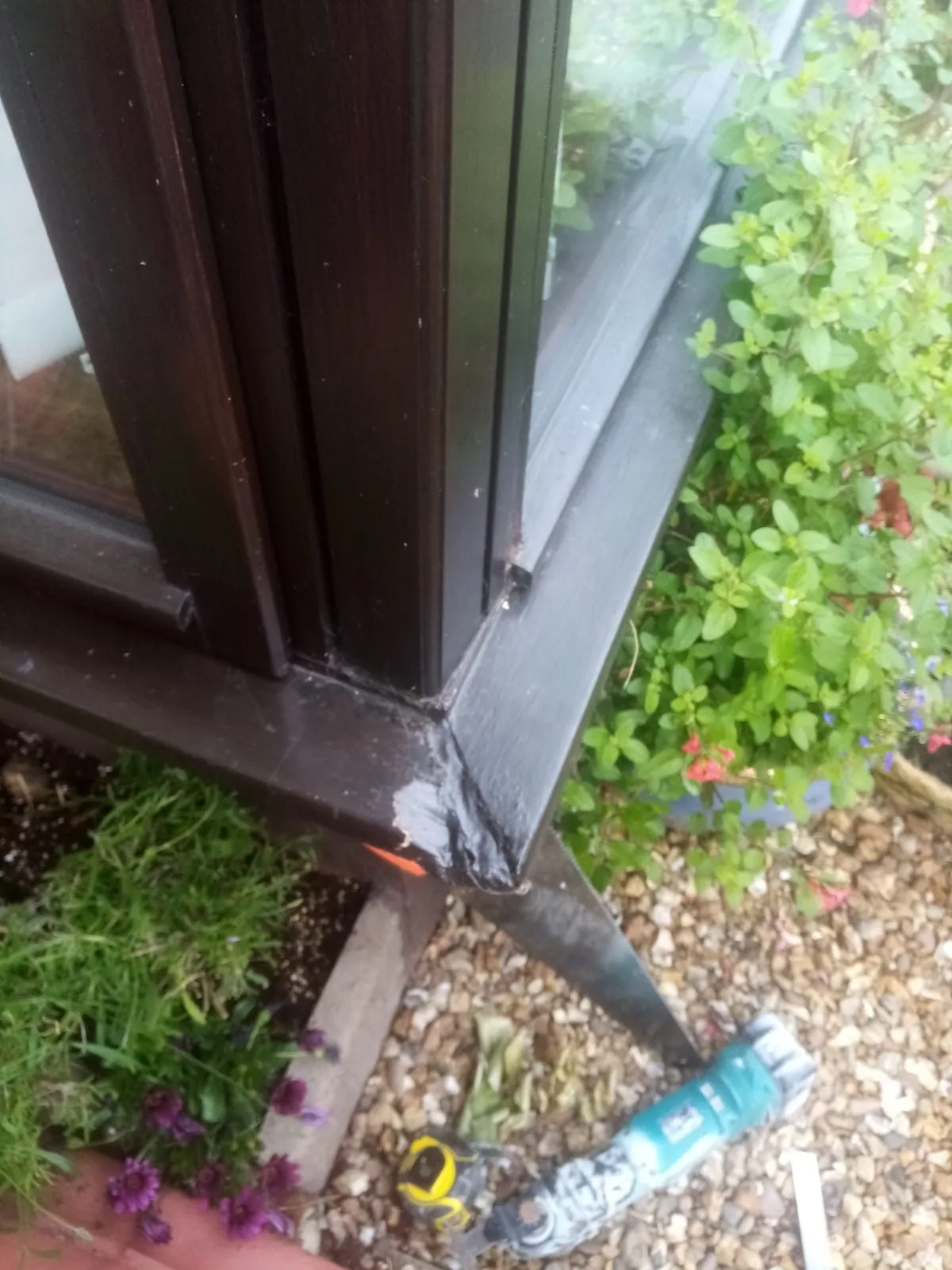
- Wet rot: timber gone dark, soft and spongy, cracking along the grain, paint lifting off it. Sills, frames, bay windows, fascias, bargeboards, rafter feet under a leaking gutter, floors over a wet sub-floor.
- Dry rot: timber dried out, shrunk and split into cube-shaped blocks that crumble; white cotton-wool growth or grey strands on timber or brickwork; a flat mushroom-like growth with a rust-red edge; red-brown dust nearby; a mushroom smell.
- Either: floors that bounce, skirtings pulling away, doors and windows that have dropped.
A photograph usually tells us which it is likely to be. A damp and timber survey — a charged service, with a written report — confirms it. The difference matters: dry rot treatment goes beyond the damage you can see.
Why rot turns up in Wirral homes
The Wirral is a peninsula with the Irish Sea on one side and the Dee estuary on the other, and the housing that faces the water takes the weather. The Victorian terraces and bays of Wallasey, New Brighton and Birkenhead, the large Victorian and Edwardian houses of Oxton and West Kirby, and the seafront rows at Hoylake and Meols all carry timber on their outside — bay windows, sills, frames, fascias, bargeboards — and on an elevation that faces the prevailing wind that timber can stay wet for weeks at a time. Wet rot in external joinery is the commonest rot job on the peninsula, and it is usually worst on the corner posts and lower rails of bays where water collects.
Inside, the same older houses have suspended timber ground floors and timber lintels, and in some streets the ground is heavy boulder clay that holds water around shallow footings and sub-floor voids. The interwar semis of Moreton, Greasby, Bebington and Bromborough have less timber at risk but still have sills, fascias and, in some, suspended floors over a damp void. Neston and the Dee-side villages share the estuary exposure.
None of that is a diagnosis. Age, exposure and a photograph tell us where to look; a survey tells us what is there.
NESTON, WIRRAL — DETACHED HOUSE
Recent wet rot repair project
The customer sent us photographs on WhatsApp of a timber post that had rotted at its foot, and we priced the repair from them. The post stands beside the entrance of this detached house in Neston and carries the corner of the black-painted beam over the window, so it could not simply be pulled out and swapped.
Wet rot at the foot of the post
The decay was at the bottom of the post, where it stood on the sill. The paint had broken away there, and the timber behind it had broken down into brown, stringy fibres that were crumbling out of the post and onto the sill.
Before any timber was cut, an adjustable steel prop with a support bracket went in under the roof edge at the corner to take the weight off the post. It is already in place in the photograph below.
The whole post out, not a splice
The quotation was for a spliced repair: take the rotten bottom off the post and join a new length onto the good timber above. In the event the whole post came out and was replaced, because one new post gives a better finish than an old one with a joint partway up it.
With the old post out, the beam above and the sill below were both sound. The timber left exposed around the opening was sprayed with preservative before the new post went in, and the prop is still holding the roof edge in the photograph below.
The new post in place
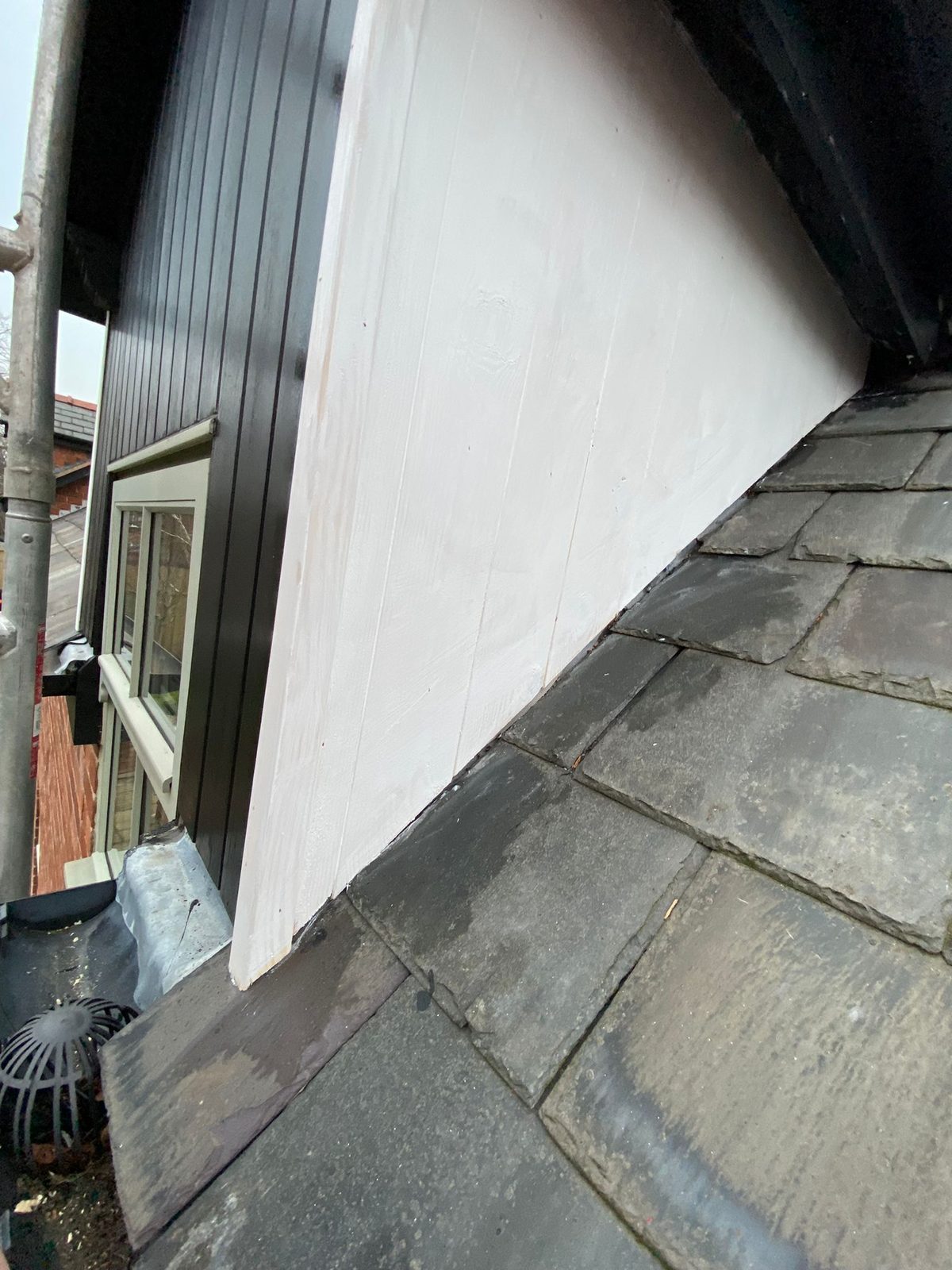
The new post, in pressure-treated softwood, stands where the old one did, under the beam and on the sill. The customer did the painting afterwards, which is why it is white here where the old post was black, and this photograph is theirs.
On any external post, the foot is the part to watch. Rain runs down the post and sits on the sill, and the end grain at the bottom draws it in; once the paint there has cracked, the timber can stay wet long enough to rot. Keeping the paint sound where the post meets the sill is the simplest protection.
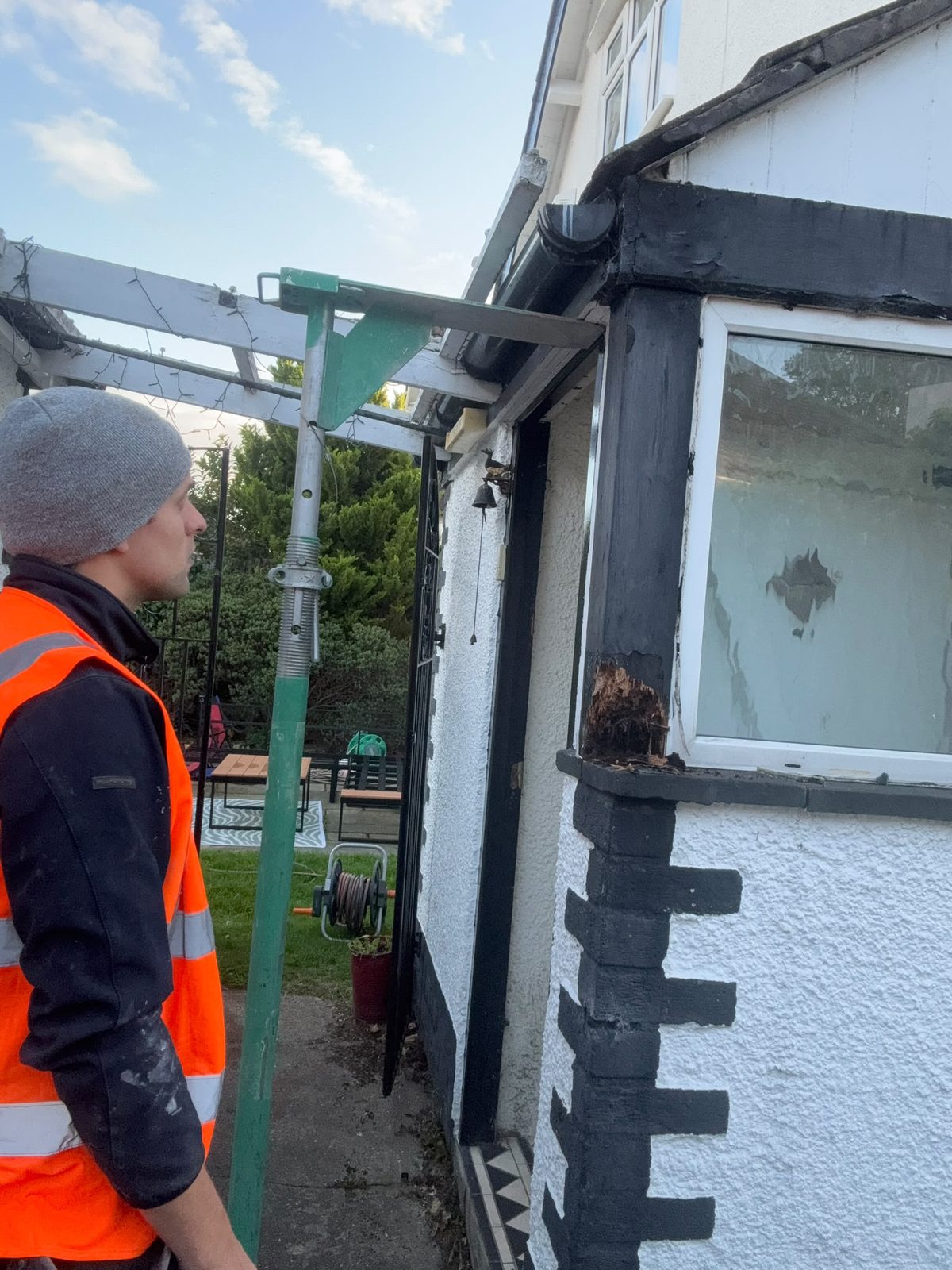
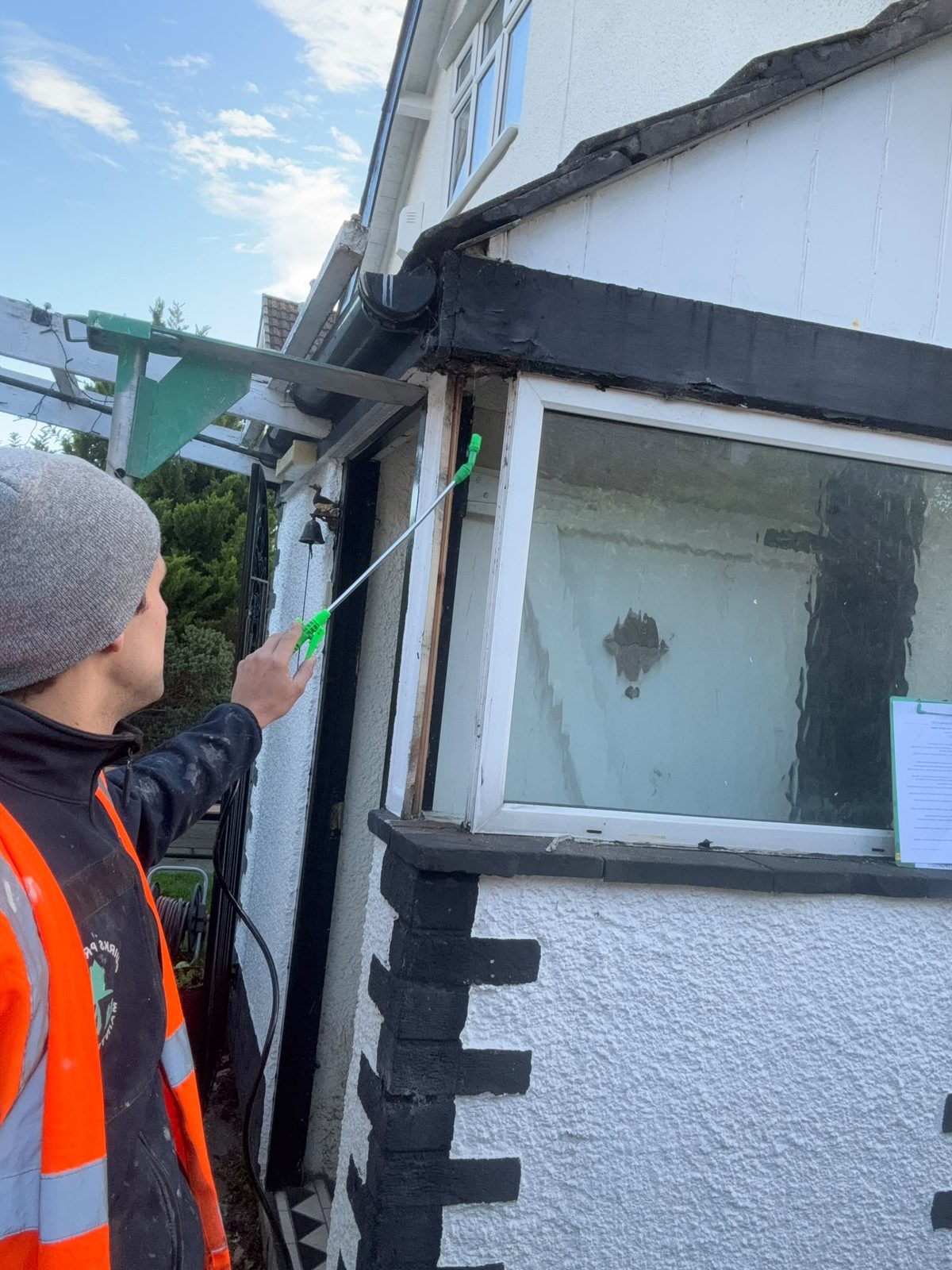
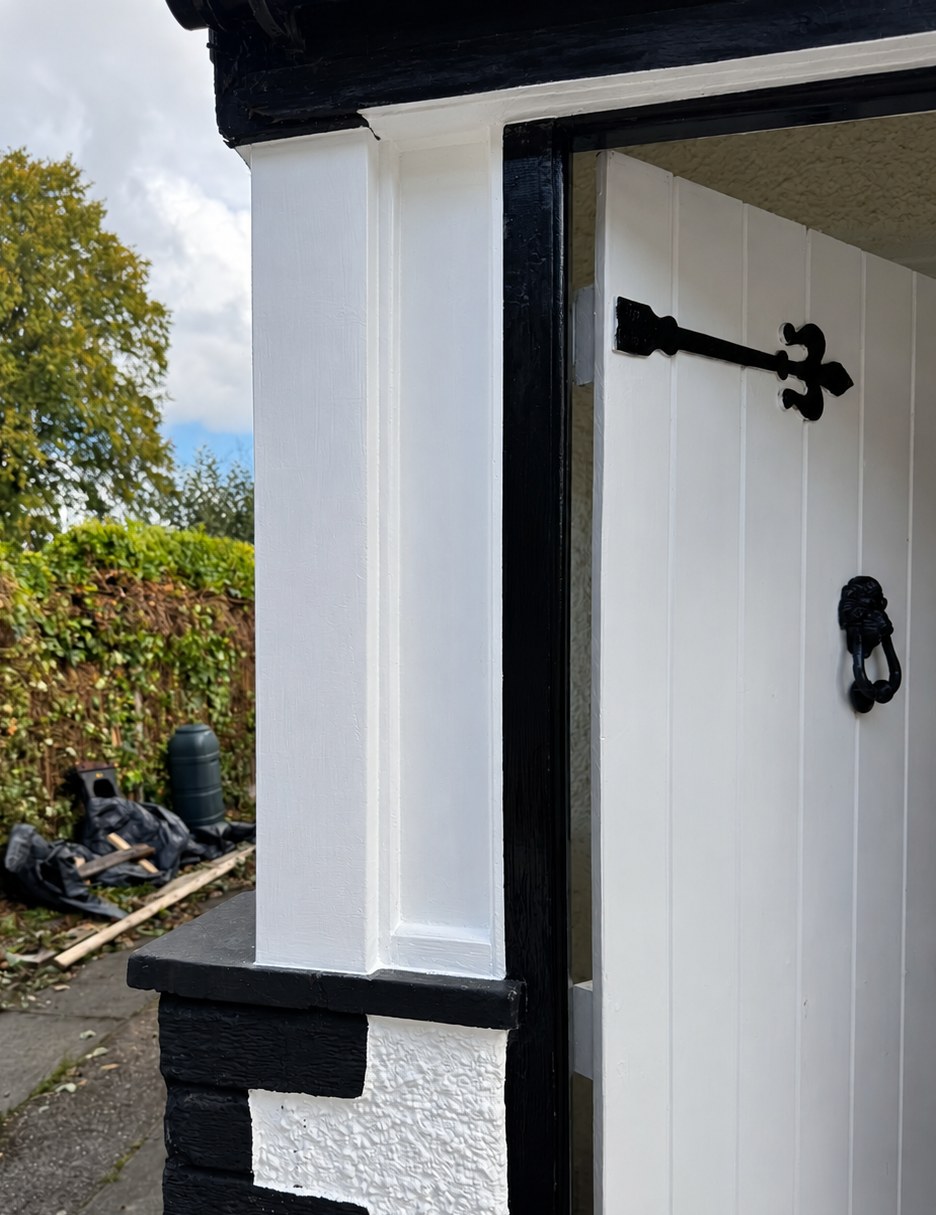
The new post is in, and the job is done. This case study covers the post only: the propping, removing the old post, the preservative around the opening and fitting the new one.
Scope — what was done
- Roof edge propped at the corner before the post was touched
- Old post taken out in full
- Timber preservative sprayed onto the exposed timber around the opening
- New pressure-treated softwood post fitted in the old one’s position
| Issue | External post carrying a beam, decayed at its base |
| Property | Detached house |
| Location | Neston, Wirral |
| How it was priced | From the customer’s photographs, sent on WhatsApp |
| Diagnosis | Wet rot, identified by Quirks; no structural engineer involved |
| Findings | Beam above and sill below sound once the post was out |
| Repair | Whole post replaced, for a better finish |
| Works | Corner propped; old post removed; preservative applied around the opening; replacement post fitted |
| Finish | Painted by the customer after fitting |
WIRRAL — FASCIAS, SOFFITS AND BARGEBOARDS
Recent timber repair project
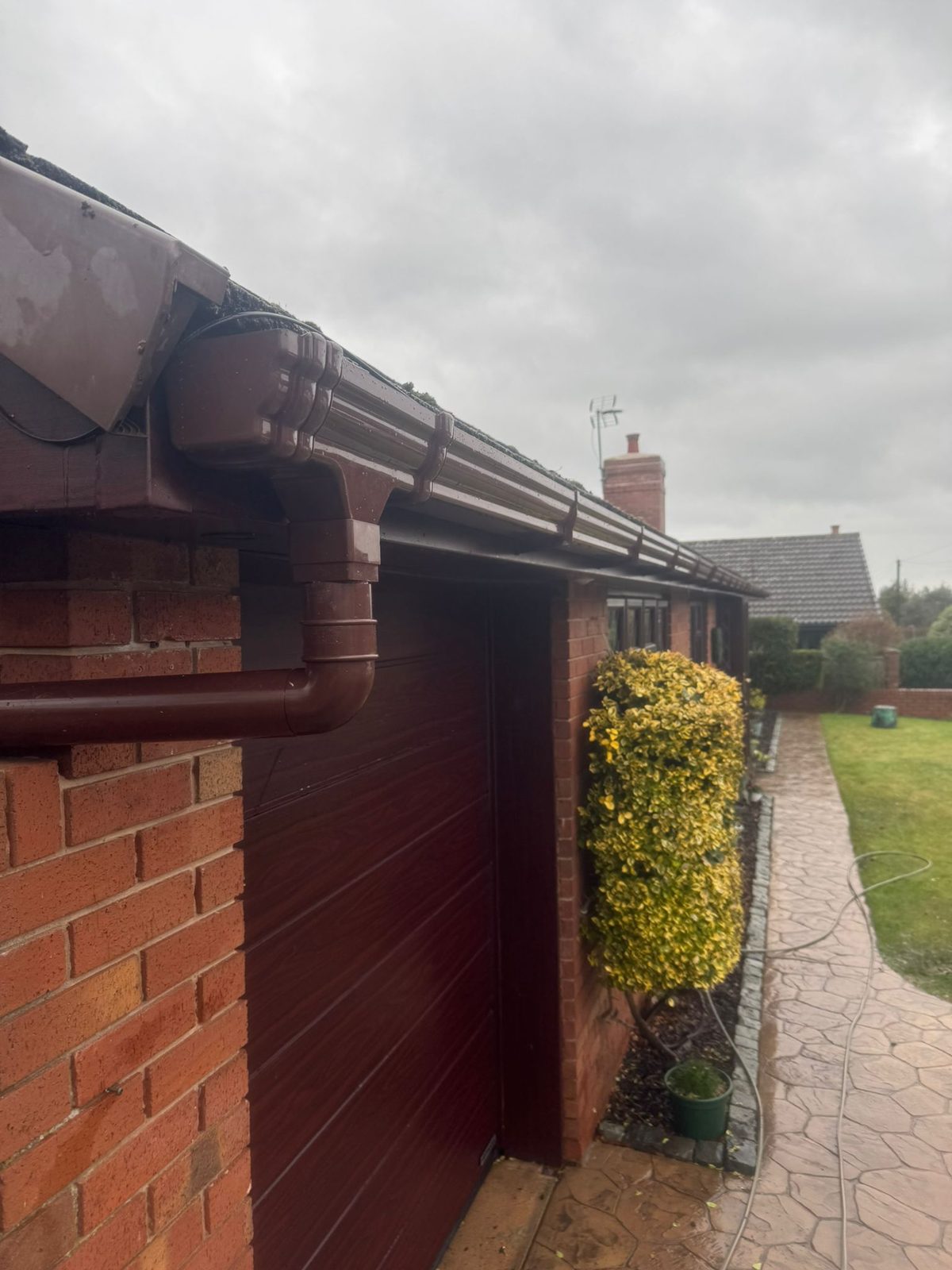
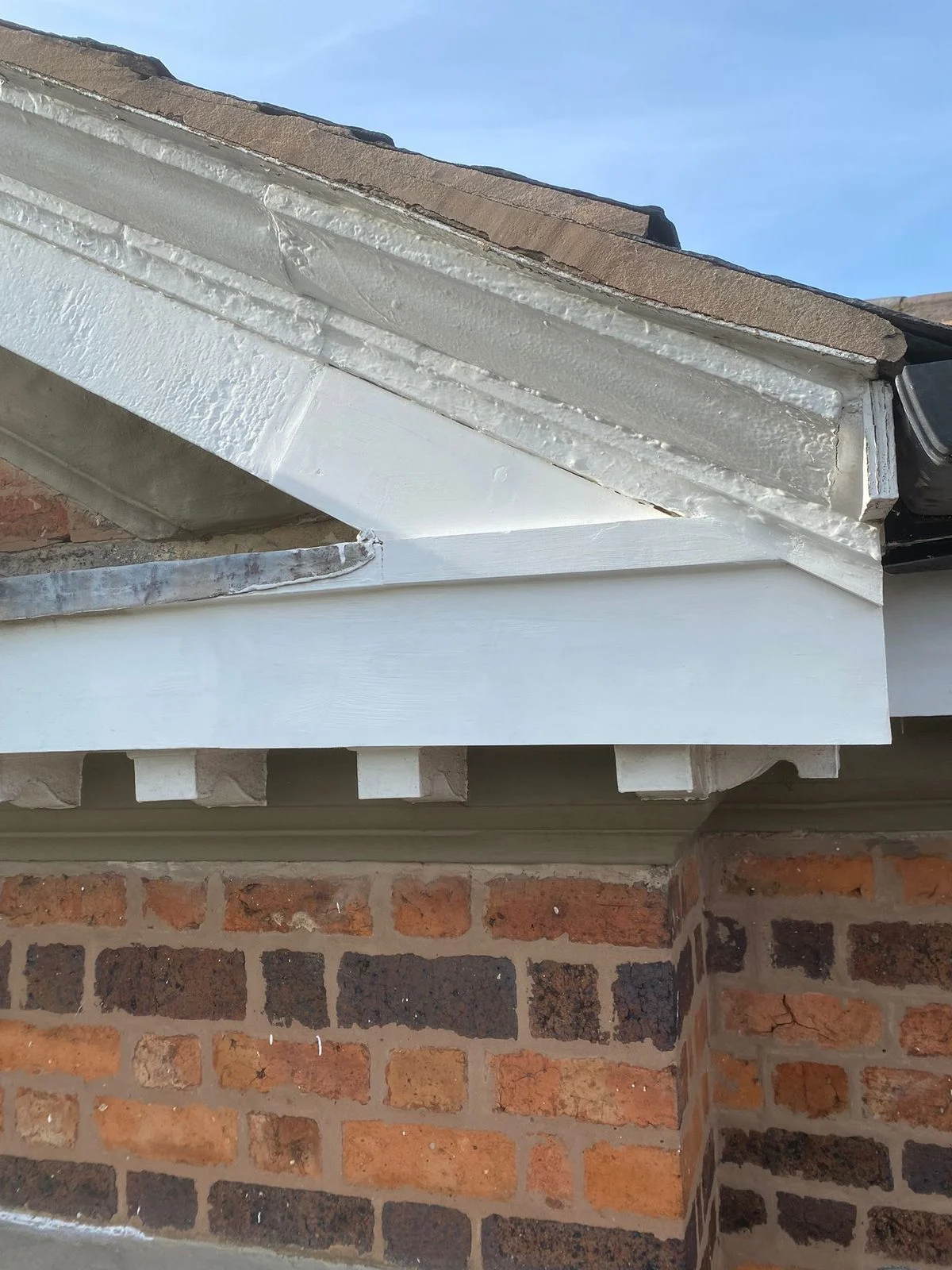
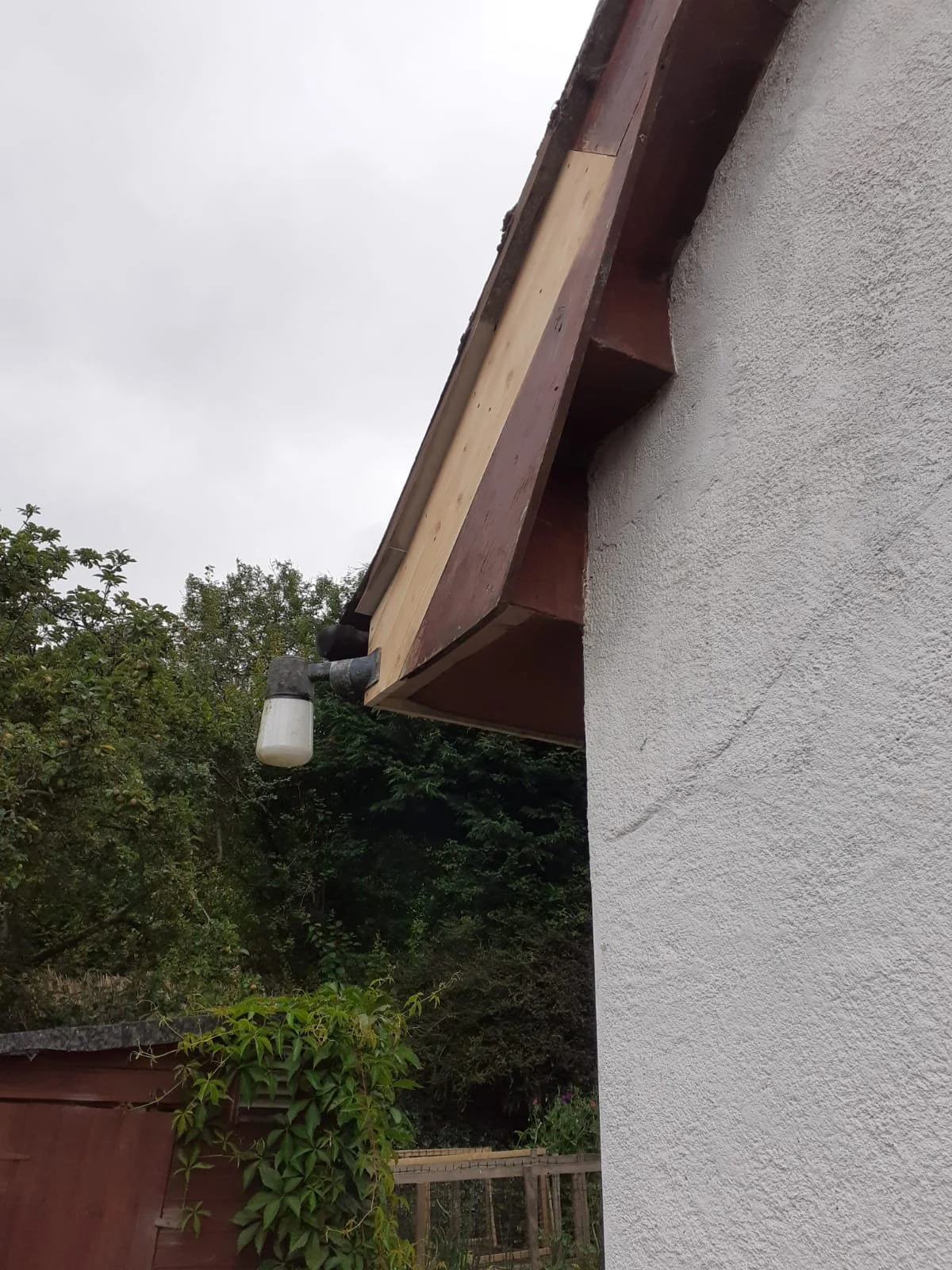
Wet rot to sections of the fascias, soffits and bargeboards of a property in Wirral, caused by a paint finish that had broken down. The decayed lengths were cut out and new timber let in. The rest of the joinery was sound and was left where it was.
Paint is not decoration
The bargeboards along the roof edge had lost their finish. Paint was flaking and lifting, and where it had gone the timber underneath was exposed to everything the weather does. On external joinery the coating is not there to make the house look tidy — it is the only thing standing between the timber and the rain. Once it has broken down, the timber starts taking up water, and wet rot follows in the places that stay wet longest.
That is what had happened here. Wet rot had taken hold in sections of the fascia, the soffit and the bargeboards, but not along the whole run. The timber between the affected areas was still sound, which is the fact that decided how the job was approached.
Cut out what has gone, keep what has not
The straightforward option on a job like this is to strip the lot off and replace the entire run. It is quicker to price, quicker to do, and considerably more expensive for the customer. It is also unnecessary when most of the timber is still in good condition.
Instead the decayed sections were cut back to sound timber and new lengths let in to match the existing profile. That takes longer and needs more care — every joint has to be cut accurately and sit flush, because a splice that stands proud or holds water is a repair that will fail in the same way as the original. The photographs show the new sections in before decoration, which is where the joints are most visible and easiest to judge.
New timber in, and the finish to follow
The new sections are in and the joinery is sound along its full length. The customer is carrying out the decoration themselves, which is why the new timber appears bare in these photographs rather than painted to match.
That last step matters more on this job than on most. The original failure happened because a coating stopped protecting the timber underneath it — so the repair is only as durable as the finish that goes onto it and the maintenance it gets afterwards. New timber left bare will go the same way as the old timber did, just more slowly to begin with.
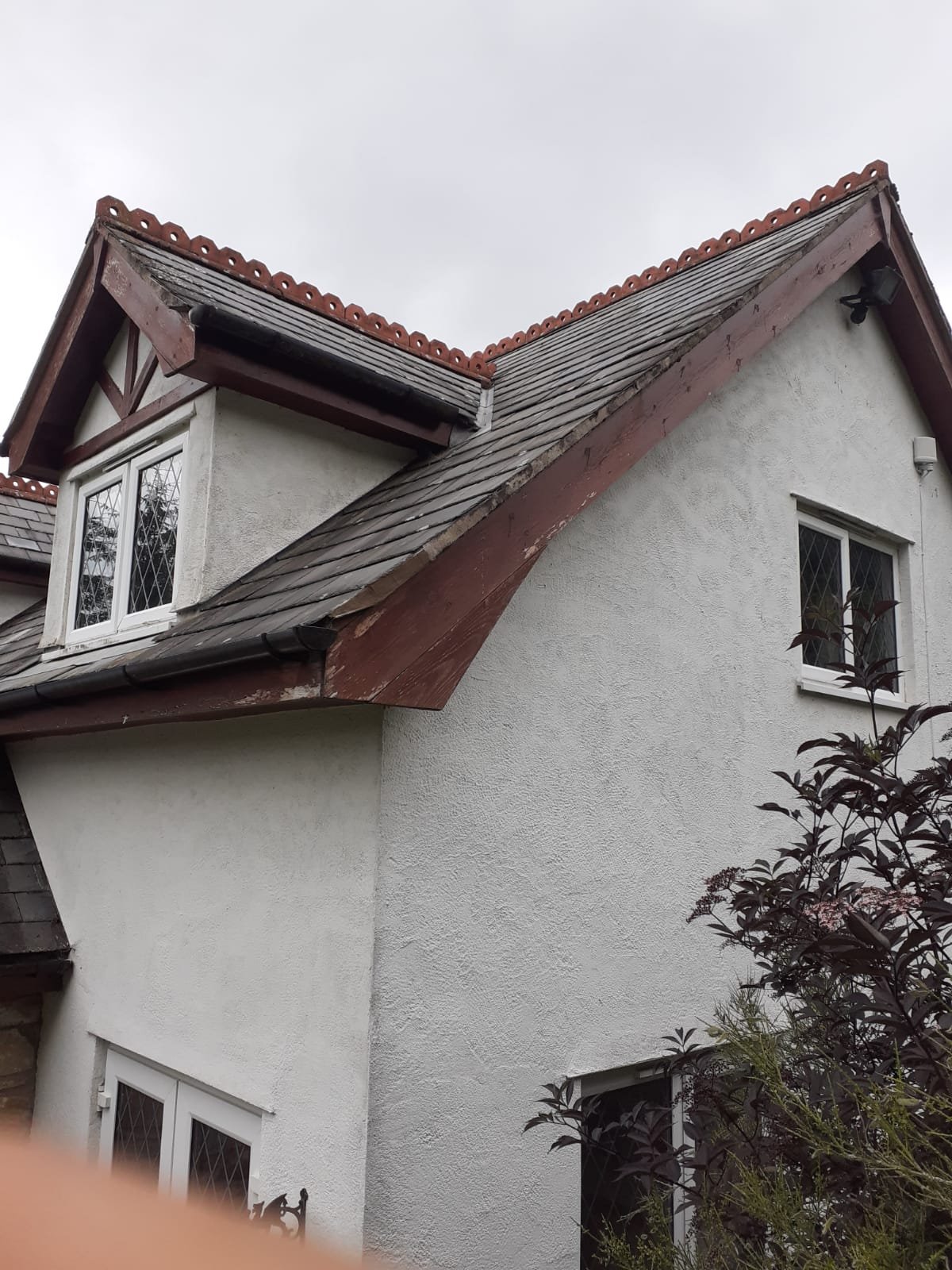
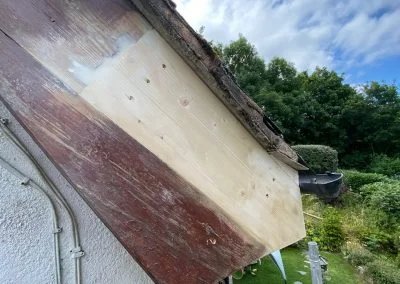
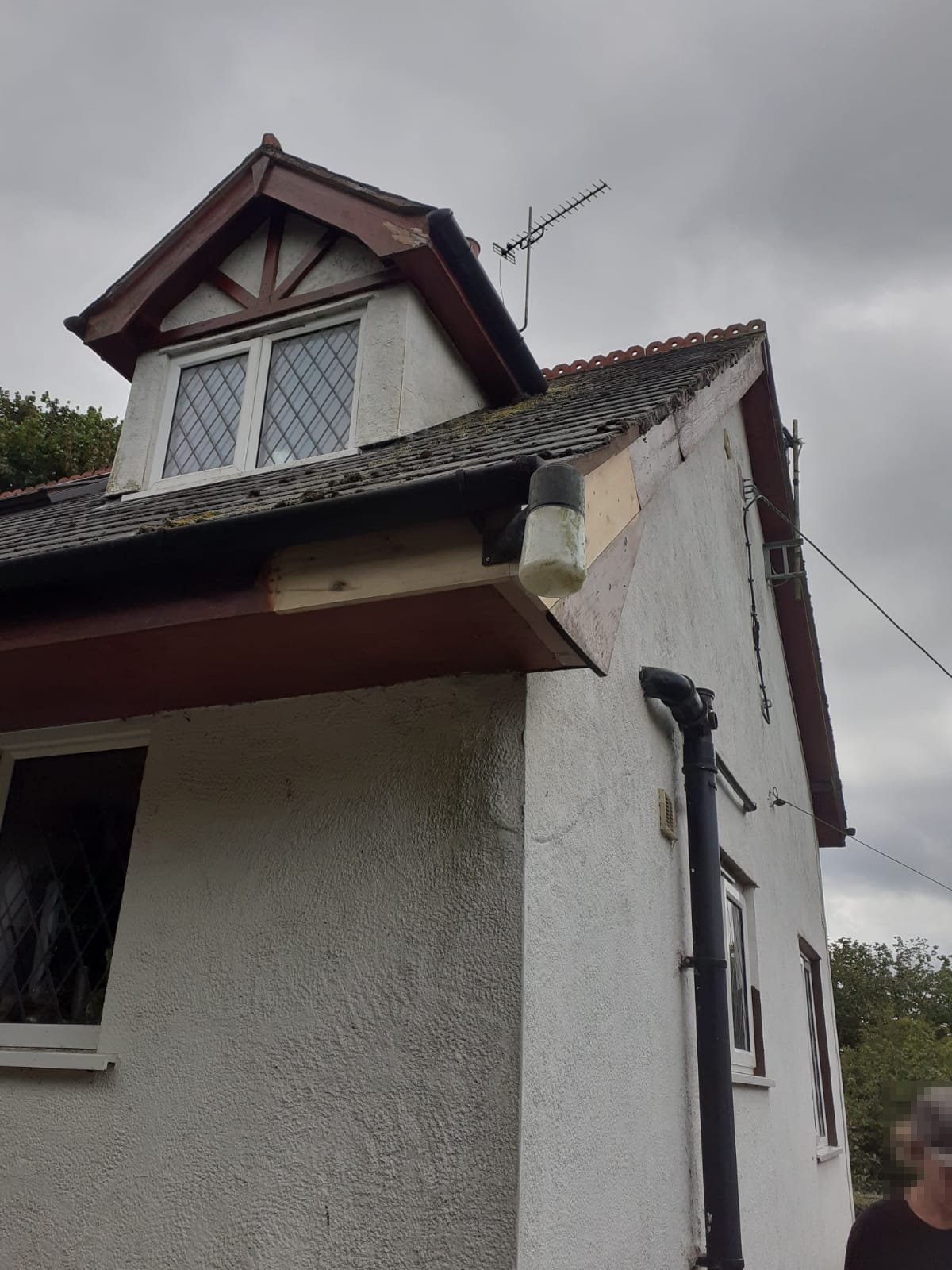
Two things worth taking from this one. The first is that paint on external joinery is weatherproofing rather than decoration, and the point at which it starts flaking is the point to deal with it — not several years later when the timber behind it has gone. The second is that a decayed fascia does not automatically mean a new fascia. Where the surrounding timber is sound, cutting out the failed sections and letting new timber in is a proper repair, not a shortcut, and it costs the customer a good deal less than the alternative.
Scope — what was done
- Fascias, soffits and bargeboards inspected and the extent of the decay established
- Wet rot identified in sections, with the surrounding timber found to be sound
- Decayed sections cut back to sound timber
- New timber let in to match the existing profile at fascia, soffit and bargeboard
- Sound timber retained rather than replaced
- Decoration to be carried out by the customer
| Location | Wirral |
| Issue | Wet rot to sections of the fascias, soffits and bargeboards |
| Cause | Failed paint finish, leaving the timber exposed to the weather |
| Approach | Localised repair rather than full replacement — the sound timber was retained |
| Works | Decayed sections cut back to sound timber and new lengths let in to match the existing profile |
| Decoration | Being carried out by the customer |
One contractor
One contractor for the rot, the water and the timber
Most rot jobs are three trades. We do all three, under one quotation.
Find and stop the water — Leaking gutters, roof leaks, high ground, a failed damp course or a wet sub-floor. The rot does not stop until the water does. Emergency gutter repairs
Treat the rot — Decayed timber cut back to sound wood, the surrounding timber and masonry treated to the specification the survey sets.
Repair or replace the timber — Joists, rafter feet, wall plates, frames and boards spliced or replaced in treated timber, isolated from damp masonry. structural timber repairs
Make good — New timber primed and painted to match, any plaster, flooring or decoration we disturbed put back, and the area left clean.
The bottom of my bay window in Wallasey is soft and the paint keeps flaking. Is that wet rot?
Very likely, if it is on the seaward side. Bay corner posts and lower rails hold water and take the weather, and the paint flaking is usually the first sign the timber beneath has gone. Send us photographs of the corners and the sill from outside, and a wider shot of the bay, and we will tell you whether it looks like a splice or a replacement.
Can you repair a Victorian bay in Oxton rather than replace it?
Where the decay is confined to the lower sections — the sill, the corner post bases, the lower rails — yes: those are cut back to sound timber and new sections are spliced in treated timber, worked to match the existing profile. Where the frame has gone further up, replacement is the honest answer. The photographs usually show which.
Does the sea air make dry rot more likely on the Wirral?
Not dry rot particularly — dry rot needs a damp, still space inside the building, under a floor or behind panelling. What the coast does is keep external timber wet for longer, and that is wet rot. Inside the house the risks are the same as anywhere: blocked air bricks, leaking gutters, a wet sub-floor.
Do you cover Neston and Parkgate?
Yes. Neston, Parkgate and Little Neston are covered from this page.
Do you fix the cause as well as the rot?
Yes, and we would not treat the rot without it. Gutters, roof repairs, plumbing leaks, ground levels, damp proofing and sub-floor ventilation are all our work. One contractor, one quotation.
How much does dry rot or wet rot treatment cost in the Wirral?
It depends on which rot it is, how far it has spread, how much timber has to come out and be replaced, what has to be opened up and made good afterwards, access, and what it takes to stop the water. Dry rot jobs are usually bigger than wet rot jobs for the same visible damage. Most jobs we can price from photographs — send yours on WhatsApp or by email and we’ll come back with a written quotation.
What affects the cost
- Which rot it is — dry rot treatment extends beyond the visible damage.
- How far it has gone, and how much timber has to come out.
- What has to be opened up and put back afterwards.
- What it takes to stop the water.
- Access — ground floor from outside, or scaffold and a roof.
- Whether an engineer’s design is needed for structural timbers.
The figure for your property comes in a written quotation after we have looked.